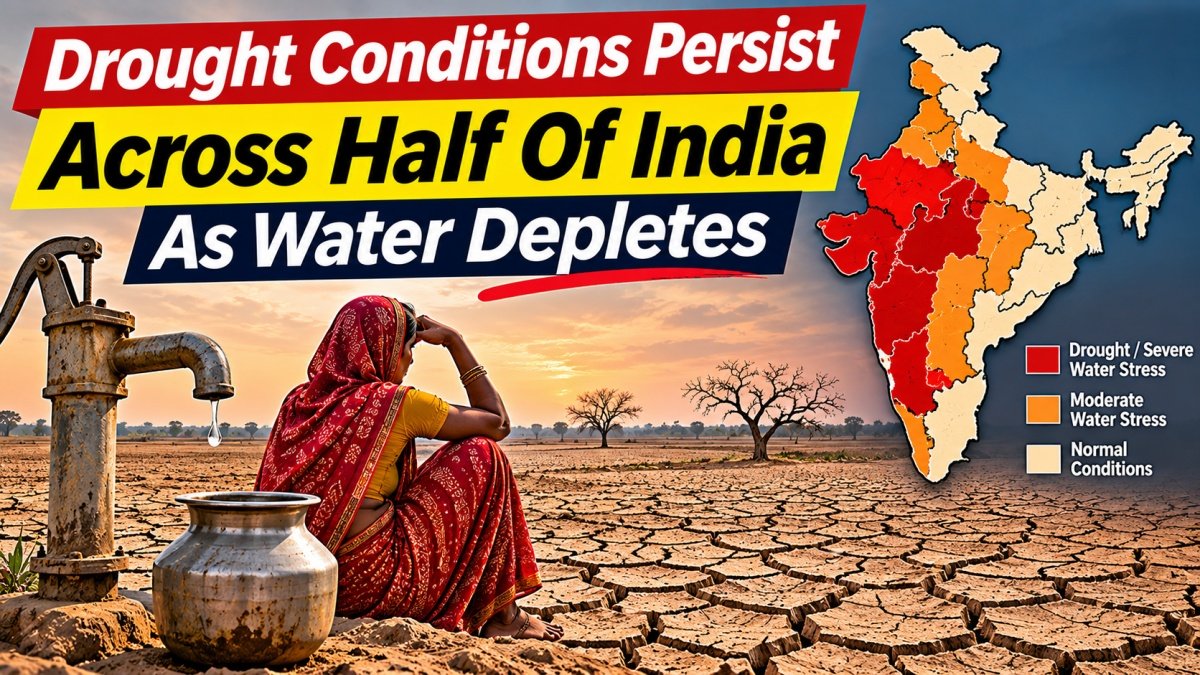
Nearly half of India is currently facing drought-like conditions, with reservoir levels dropping significantly below normal averages across the country.
Key Points
- Drought Coverage: The India Drought Monitor reports that 46.6% of the country is facing drought.
- Reservoir Status: Major reservoirs are at 60.19% capacity, which is 21% lower than the 10-year average.
- Regional Impact: South Indian reservoirs are at only 38% capacity, while North India is 27% below normal.
- State Declarations: Six states have officially declared drought, affecting hundreds of talukas and mandals.
- Rainfall Deficit: Karnataka recorded its lowest monsoon rainfall in 55 years, with a 35% deficit.
Severe Drought Conditions Across India
NEW DELHI: Nearly half of India is currently grappling with drought-like conditions, according to the latest data from the India Drought Monitor by IIT Gandhinagar. As of November 25, 2026, the report indicates that 46.6% of the nation is affected by drought, a slight decrease from the 47.2% recorded on November 18. Experts from IIT Bombay have raised concerns regarding the persistence of these conditions in several regions, including Rajasthan, Maharashtra, Karnataka, Western Madhya Pradesh, Telangana, and South-Western Andhra Pradesh.
The situation is further exacerbated by a rapid depletion in the country's major water reserves. A weekly report released by the Central Water Commission (CWC) on November 26 revealed that 111.209 billion cubic meters (BCM) of water remains in 178 major reservoirs. This figure represents only 60.19% of the total capacity, marking a 21% decline from the 10-year normal average and a sharp 31.64% drop compared to the same period last year.
Regional Water Scarcity and State Declarations
The impact of the water shortage is particularly visible in the southern and northern parts of the country. In South India, reservoirs are holding only 38% of their total capacity, while North India remains 27% below the normal average. These figures highlight a growing disparity in water security across different geographical zones.
In response to the escalating crisis, six states have officially declared drought. In Karnataka, 217 talukas have been affected, while Maharashtra has seen 305 talukas declared drought-hit. Andhra Pradesh reported 412 mandals under drought, Telangana recorded 365 mandals across 31 districts, and Rajasthan has 80 tehsils in 14 districts affected. Additionally, the Gujarat government has declared four districts, including Kutch, Jamnagar, Devbhumi Dwarka, and Porbandar, as drought-affected areas.
Historic Rainfall Deficits and Storage Trends
The current crisis follows a season of historically low rainfall. Karnataka recorded a monsoon deficit of 35%, which is the largest deficit in 55 years. Other states also faced significant shortages, with Maharashtra seeing a 19% deficit and Telangana recording a 17% shortfall. By November 4, post-monsoon rainfall was lower than normal in 59% of the 735 districts across the country.
Data shows that the 2026 monsoon was the 13th driest season in the country's history and the lowest in the last 11 years. While heavy rains before the season's end provided a marginal 2.5% improvement, the overall monsoon ended with a 12.6% deficit. In 43% of the country's districts, rainfall was between 20% and 72% lower than normal, with Punjab experiencing the highest deficit at 41%.
Factors Driving Water Depletion
The continuous decline in water stocks over the last two weeks is attributed to a combination of low rainfall and high demand. While reservoirs typically decrease after rainfall due to withdrawals for irrigation and drinking water, the current deficit is significantly deeper than usual. The lack of sufficient replenishment from the monsoon, coupled with ongoing human and agricultural needs, has intensified the scarcity.
Historical data from September 24 showed that 130 BCM of water was available in 150 major reservoirs, filling them to nearly 71% of their capacity. However, this storage level was notably lower than the previous year, setting the stage for the current critical levels reported in late November.