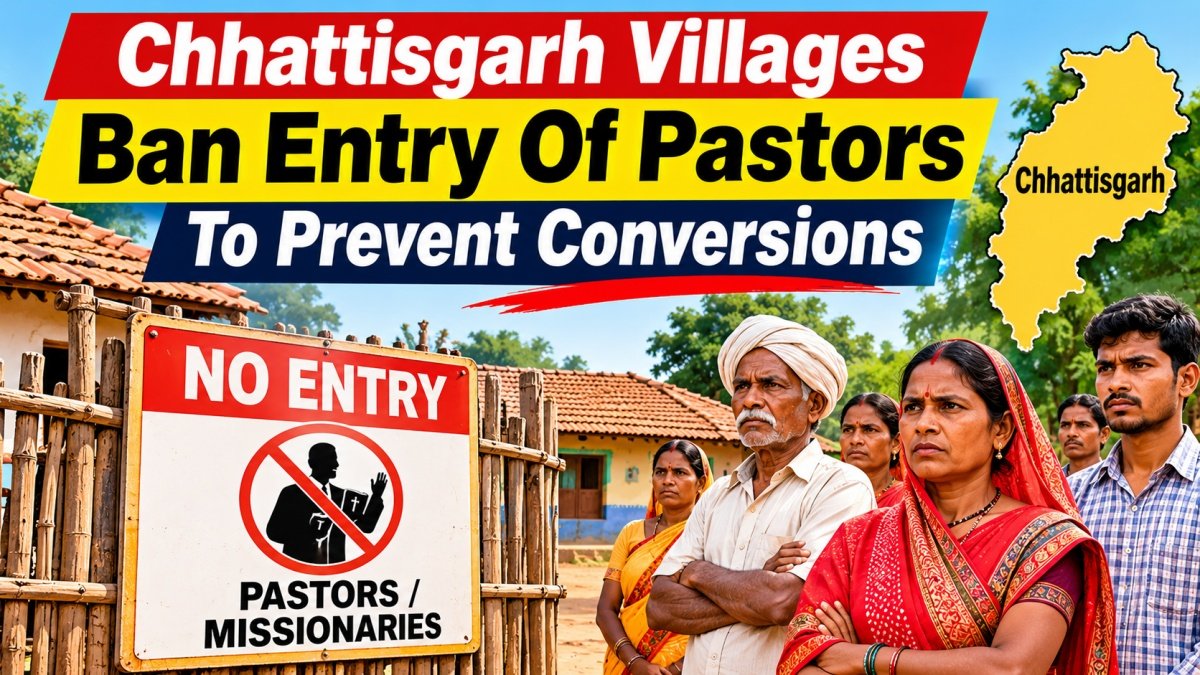
Five villages in Chhattisgarh’s Jashpur district have passed resolutions prohibiting Christian pastors and priests from entering to prevent religious conversions, marking a new trend in northern Chhattisgarh.
Key Points
- New Restrictions: Jabla village became the fifth in Jashpur to ban pastors and priests.
- Tribal Rights: Villages cite the Fifth Schedule and PESA Act to protect local traditions.
- Community Objection: Christian groups allege the move is a politically motivated attempt to divide tribals.
- Legal Context: The Chhattisgarh High Court previously upheld similar boards to prevent forced conversions.
- Past Precedents: Similar bans have been implemented in the Bastar and Sukma districts over recent years.
New Bans in Jashpur District
JASHPUR: The tribal-dominated Jabla village in northern Chhattisgarh’s Jashpur district recently passed a resolution prohibiting the entry of Christian pastors, priests, and nuns. The move, which follows a gram sabha meeting held on Friday, aims to curb activities related to religious conversion. A board has been installed at the village entrance to formally notify visitors of the restriction.
Local authorities and residents stated that the village, which has a majority Urao tribe population, observed a woman laborer from Jharkhand attempting to influence villagers to convert. Ganga Ram, the Janpad Panchayat president of Jashpur, noted that while no conversions had occurred yet, the ban was a proactive measure to protect the community’s cultural integrity.
Jashpur BJP MLA Raymuni Bhagat, who attended the gram sabha, emphasized that the village is protected under Schedule V of the Constitution. She asserted that villagers possess the inherent right to safeguard their traditions and culture from outside influence.
Religious and Political Pushback
The Christian Adivasi Mahasabha has strongly condemned the resolution, labeling it an attempt to create religious divisions among tribal people. Anil Kispotta, the state head of the outfit, pointed out that there are approximately 2 lakh Christian tribals in Jashpur. He accused political parties of using the Fifth Schedule powers to play vote bank politics rather than protecting tribal interests.
Kispotta argued that tribals have the constitutional right to choose their own religion and that the protections intended for ‘Jal, Jungle, and Zamin’ are being misused. The organization has submitted a formal memorandum to both the Jashpur district collector and the Superintendent of Police to address these concerns.
The restrictions in Jashpur follow a similar trend in the Bastar region, where multiple villages have implemented similar bans. Reports indicate that at least four other panchayats in Jashpur have already put up signboards prohibiting preachers and priests from entering.
Historical Context and Legal Rulings
This trend of restricting religious activities is not new in Chhattisgarh. In July 2014, five tribal villages in Bastar passed resolutions barring non-Hindus from holding prayers. More recently, in March 2023, Ransargipal village in Bastar prohibited outside festivals and restricted Christians from burying their dead within the village limits.
In October 2024, Punpalli village in the Sukma district also installed a banner prohibiting pastors from entering for religious activities. Community members reported that at least 10 other villages across Bastar have adopted similar measures this year.
The legal landscape regarding these bans has seen significant activity. In 2025, the Chhattisgarh High Court declined to remove such hoardings, observing that measures taken to prevent forcible conversions through allurement or fraudulent means are not unconstitutional. While some specific burial disputes reached the Supreme Court, the judiciary has generally acknowledged the complexities of these local restrictions.