





























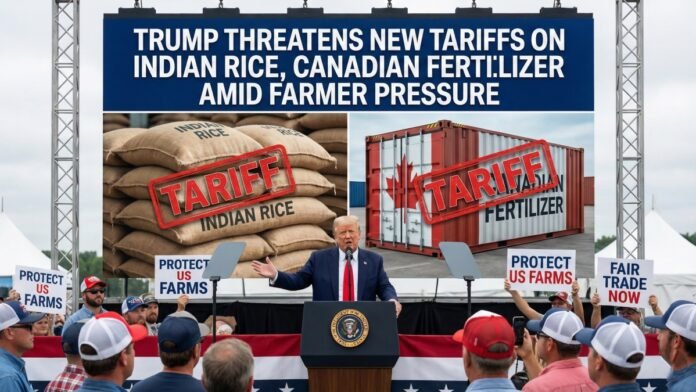
Key Points:
- Trump held a White House roundtable with farmers demanding action on low-priced imports
- Louisiana rice millers specifically named India, Thailand, and China for dumping practices
- Canadian fertilizer imports could face new tariffs as farmers cite unfair competition
- Merrill Kennedy, CEO of Kennedy Rice Mills, presented evidence of illegal Indian subsidies
- A US trade delegation is scheduled to visit India later this month for high-level negotiations
American farmers brought their grievances directly to President Trump during a tense roundtable meeting at the White House, where they detailed how foreign agricultural products are undercutting domestic prices. The gathering, which included representatives from major farming states, turned into a lobbying session for protectionist measures as producers presented data showing sharp declines in their market share.
According to reports from the meeting, farmers didn’t mince words about the challenges they face. They told Trump that imports of rice from Asian countries and fertilizer from Canada are flooding US markets at prices that American producers simply cannot match. The president responded with characteristic bluntness, promising that his administration would investigate these claims thoroughly and take decisive action if evidence of unfair trade practices emerges.
Trump’s direct engagement with agricultural producers signals a shift in trade policy focus. While his administration has previously targeted manufactured goods and technology imports, this new emphasis on agricultural products reflects growing political pressure from rural America, a key constituency that helped deliver his electoral victory.
Rice Dumping Allegations Target India, Thailand, and China
Merrill Kennedy, who heads Louisiana-based Kennedy Rice Mills, emerged as the most vocal advocate for tariffs during the White House session. She presented what she described as clear evidence that India, Thailand, and China are systematically dumping rice into American markets at below-cost prices. Kennedy explained that this practice isn’t just hurting US producers but is also destabilizing rice markets throughout the Western Hemisphere.
The dumping allegations carry significant weight because they invoke specific trade violations. Kennedy told Trump that India is using illegal subsidies to prop up its rice industry, allowing exporters to sell at prices that would be impossible under free market conditions. She claimed these subsidies violate World Trade Organization rules and give Indian rice an unfair advantage in global markets.
Chinese rice presents a more complex challenge, according to Kennedy’s testimony. She revealed that Chinese exporters are circumventing direct US tariffs by shipping rice to Puerto Rico, a US territory with different trade regulations. From there, the rice enters continental US markets through legal loopholes, creating what Kennedy called a “backdoor dumping operation” that harms producers across South America as well as the United States.
Trump’s response was immediate and forceful. He declared that such countries “will not be allowed to cheat” American farmers and directed Treasury Secretary Scott Bessent to launch formal investigations. The president’s sharp rhetoric suggests he’s prepared to use tariffs not just as a negotiating tool but as a punitive measure against trade practices he views as exploitative.
Canadian Fertilizer Next in Trade Crosshairs
The tariff threat extends beyond rice to include Canadian fertilizer, a move that could have far-reaching consequences for American agriculture itself. Farmers at the roundtable argued that cheap Canadian fertilizer is undercutting domestic producers, though many US farmers rely on these imports to maintain their own operations at competitive costs.
Trump’s suggestion to target Canadian fertilizer reflects a broader protectionist impulse that doesn’t always distinguish between products that compete with US manufacturing and those that support American agricultural productivity. The proposal has created uncertainty in farming communities, where operators are calculating next season’s input costs.
Canadian officials have not yet formally responded to Trump’s comments, but trade analysts expect Ottawa to push back vigorously against any fertilizer tariffs. Canada is the largest foreign supplier of potash and nitrogen fertilizers to the United States, and restrictions could trigger retaliatory measures that hurt American agricultural exports to Canada, which totaled billions of dollars last year.
August Tariffs Set Stage for Escalation
Trump’s latest threats build on actions he took in August 2025, when he imposed a sweeping 50% tariff on a broad range of Indian goods. That move came after months of escalating rhetoric about India’s trade policies, particularly regarding pharmaceuticals, textiles, and agricultural products. The August tariffs caught many trade observers by surprise because they preceded formal WTO dispute proceedings, which traditionally serve as the first step in resolving trade disagreements.
The 50% tariff rate is exceptionally high by modern trade standards and signals Trump’s willingness to use extreme measures to force negotiating partners into concessions. For India, which exported over $87 billion in goods to the US in 2024, these tariffs represent a serious threat to its economic relationship with its largest trading partner.
Trade data shows that Indian rice exports to the US, while not the largest category of bilateral trade, have been growing steadily. In 2024, India shipped approximately 250,000 metric tons of rice worth around $200 million to American markets. US rice producers argue this volume, though relatively small, creates a price ceiling that prevents them from covering production costs.
US-India Negotiations Hang in Balance
A high-level US trade delegation is scheduled to travel to India later this month for critical negotiations that could determine the future of bilateral economic relations. The timing of Trump’s tariff threats appears deliberate, designed to give American negotiators maximum leverage as they sit down with their Indian counterparts.
The negotiations will cover multiple contentious issues beyond rice, including India’s data localization requirements, e-commerce regulations, and market access for American dairy products. Indian negotiators have expressed frustration with what they view as America’s shifting demands and unilateral tariff impositions.
Indian commerce ministry officials, speaking on condition of anonymity, indicated that New Delhi is prepared to file WTO complaints if the US proceeds with rice tariffs without following proper anti-dumping procedures. They argue that India’s rice subsidies fall within WTO’s allowable limits for developing countries and that American producers are simply less competitive due to higher labor and land costs.
Global Market Implications
The tariff threats are already rippling through global agricultural commodity markets. Rice futures traded higher in Chicago and Bangkok after news of Trump’s comments spread, with traders pricing in potential supply disruptions. If the US imposes significant tariffs on Indian rice, global prices could rise, particularly affecting food-importing countries in Africa and the Middle East that depend on affordable Asian rice.
The fertilizer tariff threat adds another layer of complexity. Global fertilizer prices remain volatile following supply chain disruptions from the Russia-Ukraine conflict and energy price fluctuations. A trade dispute between the US and Canada, two of the world’s largest fertilizer producers and consumers, could create market chaos just as Northern Hemisphere farmers begin planning for spring planting.
Agricultural economists warn that protectionist measures in one sector often trigger cascading effects. If US rice tariffs prompt India to restrict American agricultural exports like almonds or apples, California farmers could find themselves collateral damage in a trade war they didn’t initiate.
Legal and Procedural Hurdles
Before Trump can impose new tariffs, his administration must navigate complex legal requirements. Anti-dumping investigations typically take 12-18 months and require detailed economic analysis to prove that foreign imports are selling below fair market value and causing material injury to domestic industry.
The US International Trade Commission and Commerce Department would need to launch formal proceedings, collect evidence, and hold public hearings. Farmers would have to provide detailed cost and pricing data, while foreign exporters would have opportunities to defend their practices. Rushing this process could lead to legal challenges that overturn the tariffs.
Treasury Secretary Bessent now faces the task of determining whether the farmers’ allegations warrant formal investigation. His department will coordinate with the US Trade Representative’s office to assess the strength of evidence and potential WTO compliance issues. Any misstep could expose the US to retaliation and damage its credibility in future trade disputes.
What’s Next for American Farmers
For rice producers in Louisiana, Arkansas, and Texas, Trump’s tough talk offers hope that their years of struggling against cheap imports may finally end. They’ve seen their market share erode as Asian producers, particularly India, have expanded production and improved quality. Many family-owned mills have closed, and those remaining operate at reduced capacity.
However, some agricultural economists caution that tariffs alone won’t solve underlying competitiveness issues. American rice production costs are inherently higher due to land prices, environmental regulations, and labor expenses. Without investments in productivity improvements or niche market development, US producers may continue struggling even if tariffs raise import prices.
The fertilizer tariff proposal has divided the farming community. While domestic fertilizer producers support restrictions, most farmers who buy these inputs worry about cost increases. A 25% tariff on Canadian fertilizer could raise production costs for corn, wheat, and soybean growers by hundreds of millions of dollars annually, potentially offsetting any gains rice producers might see.
International Response and Diplomatic Fallout
Beyond Canada and India, other trading partners are watching Trump’s actions closely. Thailand, the world’s second-largest rice exporter, has remained quiet publicly but is reportedly coordinating with India and Vietnam on a joint response strategy. China, already engaged in multiple trade disputes with the US, could use this opportunity to align more closely with Asian partners on trade policy.
The European Union has expressed concern about the precedent these tariffs would set. EU trade officials worry that if the US bypasses WTO procedures, other countries might follow suit, leading to a breakdown in the rules-based international trading system that has governed global commerce for decades.
In New Delhi, Prime Minister Modi’s government faces domestic pressure to stand firm against American bullying while avoiding a full-scale trade war that could harm India’s export-driven economy. Indian officials have hinted at potential compromises, including voluntary export restraints on rice, but only if the US rolls back its August tariffs and approaches negotiations in good faith.