

































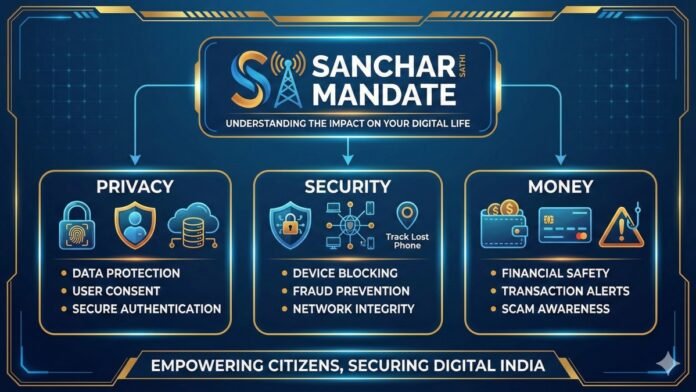
Key Points
- Sanchar Sathi app must be pre-installed and clearly visible on all new smartphones from December 2025 onwards
- Manufacturers have 90 days to implement the mandate and 120 days to submit compliance reports to DoT
- The order covers all major phone makers including Apple, Samsung, Google, Vivo, Oppo, and Xiaomi
- Non-compliance may result in penalties under the Telecommunications Act 2023 and Telecom Cyber Security Rules 2024
- The app has already achieved 1.14 crore registrations with over 1 crore downloads from Google Play Store
The Department of Telecommunications issued a directive on November 28, 2025, requiring all mobile handset manufacturers and importers to pre-install the Sanchar Sathi app on every device sold in India. The app must be prominently displayed and fully functional during device setup, with no option to hide, disable, or restrict its features. For smartphones already manufactured and circulating in distribution channels, companies must roll out software updates to add the app on a best-effort basis.
Why Is the Government Making This Mandatory?
India’s vast second-hand mobile market has become a breeding ground for cybercriminal activity, with numerous cases of stolen and blacklisted phones being resold to unsuspecting buyers. The government warns that duplicate or spoofed International Mobile Equipment Identity (IMEI) numbers pose serious security risks, with the same IMEI sometimes appearing on multiple devices simultaneously. By making Sanchar Sathi mandatory, the DoT aims to strengthen telecom security infrastructure and prevent misuse of telecom services across the country.
What Can Users Do with Sanchar Sathi?
The Sanchar Sathi portal and app provide citizens with comprehensive fraud prevention and device verification tools:
- Verify the authenticity of a mobile handset using its unique 15-digit IMEI number
- Report suspected fraudulent calls and messages directly to authorities
- Block lost or stolen phones to prevent misuse
- View all active mobile connections registered under their name
- Access trusted contact details of banks and financial institutions for verification
- Check if a phone’s IMEI is blacklisted or blocked before purchasing a second-hand device
Users can also verify their IMEI by sending an SMS “KYM [15-digit IMEI number]” to 14422 for quick verification.
What Are the Legal Consequences of Non-Compliance?
The DoT order carries significant legal teeth, backed by the Telecommunications Act 2023 and Telecom Cyber Security (TCS) Rules 2024. Tampering with or falsifying the 15-digit IMEI number is classified as a non-bailable offense, punishable by imprisonment of up to three years, fines of up to ₹50 lakh, or both. Manufacturers and importers failing to comply with the pre-installation mandate face action under these laws, with compliance reports required within 120 days of the directive.
Handset Manufacturers Express Concerns Over Implementation
Despite the government’s cybersecurity objectives, smartphone manufacturers have criticized the mandate as an “avoidable burden”. Companies are concerned about the technical complexity and cost implications of pre-loading the app on all devices across their production chains. However, the DoT has left no room for negotiation, emphasizing that full compliance is mandatory and that the app’s functionality must remain entirely accessible to users without any restrictions or disabling options.
Privacy Concerns Raised by Opposition Parties
The mandatory pre-installation has sparked significant debate among the political opposition and privacy advocates. Congress General Secretary K.C. Venugopal argued that the move violates citizens’ fundamental right to privacy, stating that an uninstallable government app could become a “means of tracking every citizen’s activities”. Congress MP Karti Chidambaram compared the initiative to “Pegasus++,” while Shiv Sena (UBT) leader Aditya Thackeray called it “unannounced dictatorship,” raising concerns about potential government surveillance.
Global Context, India Aligns with International Cybersecurity Trends
India is not alone in mandating government-backed security apps on smartphones, as similar requirements have been implemented globally. In August 2025, Russia introduced a comparable mandate requiring phones to come pre-installed with its state-backed messenger app, MAX. However, the scale of India’s smartphone market and the universal application of this directive make it one of the largest and most comprehensive cybersecurity initiatives of its kind.
Timeline for Implementation and Compliance
| Milestone | Deadline | Details |
|---|---|---|
| Implementation deadline | 90 days from Nov 28, 2025 (ends Feb 26, 2026) | All new phones must have Sanchar Sathi pre-installed |
| Compliance report submission | 120 days from Nov 28, 2025 (ends Mar 28, 2026) | Manufacturers must file reports confirming adherence |
| Software updates for existing devices | Best-effort basis by Mar 28, 2026 | Already manufactured phones must receive app via update |
| App accessibility during setup | Immediate with pre-installation | App must be visible, functional, and unrestricted |
The Sanchar Sathi mandate represents India’s aggressive stance on cybersecurity and fraud prevention in the telecom sector. While the government emphasizes the app’s protective benefits against device fraud and identity theft, privacy concerns raised by opposition parties highlight the need for robust safeguards and transparency about data collection practices. With over 1.14 crore registrations already achieved, the app’s mandatory status is expected to exponentially increase its user base and strengthen India’s cyber defense infrastructure.