


























Key Points:
- PESA and criminal defamation laws are being weaponized to intimidate journalists, with security agencies increasing pressure
- Physical violence and detentions occur during security operations, particularly in Balochistan and Khyber Pakhtunkhwa, with no transparent investigations
- Women journalists face coordinated online harassment, trolling, and reputation attacks, especially those covering human rights and politics
- Self-censorship has become standard practice in newsrooms, with editors softening language and omitting names to minimize risk
- Constitutional free speech guarantees contrast sharply with undeclared restrictions on reporting about powerful institutions and religious matters
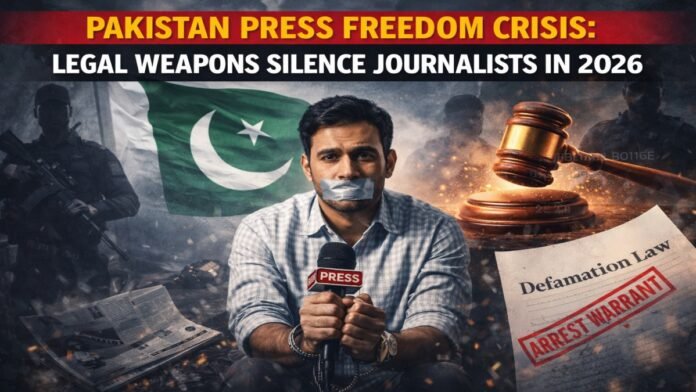
Pakistan’s media industry is confronting an unprecedented crisis in 2026, with journalists paying an increasingly heavy price for raising their voices amid a rapidly deteriorating environment for press freedom. According to the latest report by Journalism Pakistan, freedom of expression exists largely on paper. At the same time, journalists on the ground face severe legal restrictions, physical threats, and systematic harassment that are fundamentally undermining the country’s democratic structure and public discourse.
Legal Weapons Turned Against Journalists
The Pakistani government is employing a sophisticated legal arsenal to suppress journalistic work, with the Prevention of Electronic Crimes Act (PESA) and criminal defamation laws serving as primary tools of intimidation. These statutes are being widely misused to target reporters who cover sensitive topics, creating a chilling effect that extends far beyond individual cases. Increasing pressure from security agencies, combined with strict legal controls, is systematically preventing journalists from practicing their profession freely.
Furthermore, authorities are wielding blasphemy and anti-terrorism provisions as effective weapons to restrict reporting on critical issues. This legal onslaught has created an environment where journalists must constantly weigh the risk of prosecution against their duty to inform the public, fundamentally compromising their ability to hold power to account.
Physical Violence and Security Operations
Journalists covering sensitive regional issues and political movements face direct physical violence and severe harassment. Many reporters have been detained during security operations, with authorities actively obstructing their professional work. The situation is particularly acute in provinces like Balochistan and Khyber Pakhtunkhwa, where local journalists face greater risks than their counterparts in urban centers.
In these remote areas, lack of legal aid and stringent security operations exacerbate the difficulties faced by media workers. Even in distant regions of Sindh, reporting has become life-threatening due to limited resources and the absence of security guarantees. Disturbingly, reports indicate that transparent investigations rarely follow incidents of violence against journalists, strengthening a pervasive sense of impunity within the system.
Women Journalists Bear Brunt of Coordinated Attacks
Women journalists in Pakistan face a uniquely hostile environment, with coordinated trolling, threats, and derogatory comments targeting them online. Perpetrators deliberately attempt to damage the professional reputation of women reporters, particularly those who cover human rights and political issues. The polarized political environment has transformed digital harassment into both a global problem and an internal crisis, forcing many women journalists to either abandon sensitive beats or withdraw from public-facing roles entirely.
Self-Censorship Becomes Newsroom Norm
Due to the combined weight of legal, security, and economic pressures, self-censorship has evolved from an exception to a common and compelling practice in Pakistani newsrooms. Editors routinely soften the language of news stories or omit important names to minimize risk, creating a sanitized version of reality that fails to serve the public interest. This gradual erosion of editorial independence is systematically undermining public trust in professional media, while the space for unbiased journalism is disappearing.
Public Discourse Suffers as Unverified Sources Fill the Vacuum
When mainstream media provides limited coverage of sensitive issues, audiences naturally turn to unverified sources and rumors on social media. Speculation circulating on digital platforms is steadily reducing the scope for fact-based debate in society. This dynamic, in the long run, degrades the quality of public discourse and severely damages the credibility of professional journalism, creating a vicious cycle where media outlets become even more cautious.
Constitutional Promise Versus Ground Reality
While Pakistan’s Constitution guarantees freedom of expression, the practical situation appears to be the opposite. Numerous undeclared and draconian restrictions limit reporting on powerful institutions and religious matters. Security pressure and digital restrictions have created a stifling environment that has effectively surrounded press freedom, leaving journalists to navigate a minefield of visible and invisible barriers in their pursuit of truth.