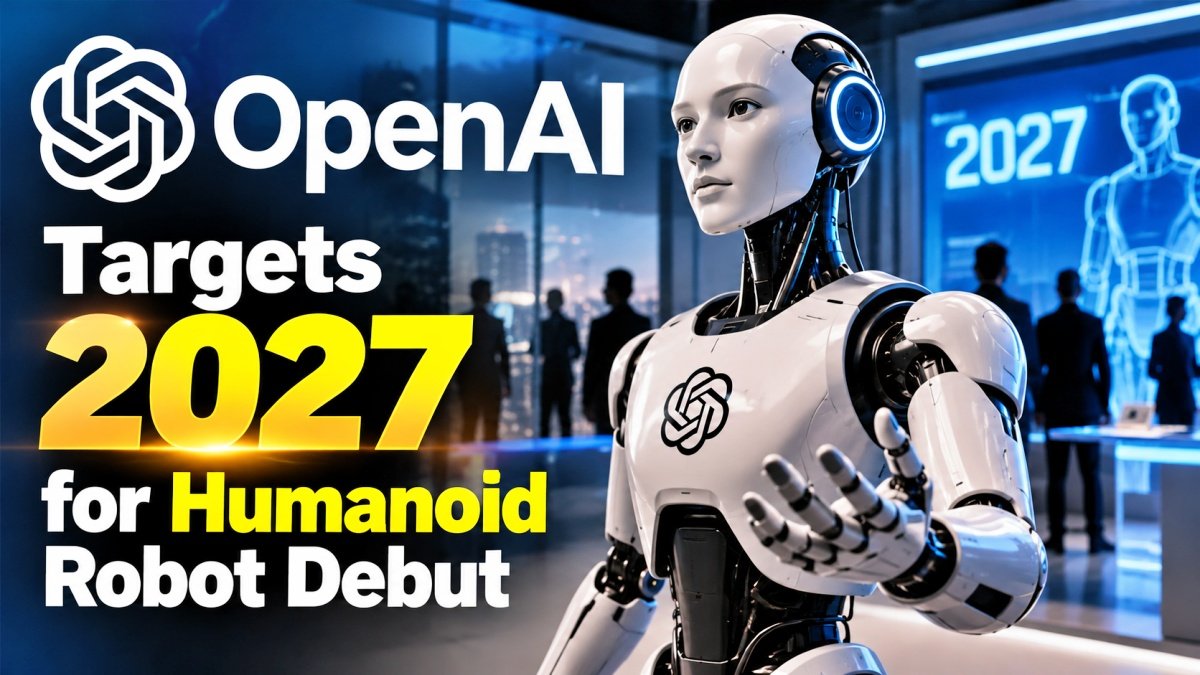
OpenAI is officially developing its own humanoid robot, with CEO Sam Altman confirming a public demonstration by 2027 to showcase an advanced, AI-powered machine designed primarily for industrial applications.
Key Points
- OpenAI plans to debut a proprietary humanoid robot demo in 2027.
- Initial production will focus heavily on industrial tasks in factories and data centers.
- The primary engineering challenge is developing a highly capable AI brain to process complex real-world data.
- Consumer versions for domestic households remain several years away.
OpenAI, the renowned creator of ChatGPT, is officially expanding its technological footprint into physical hardware. During a recent appearance on the Sources podcast, CEO Sam Altman confirmed that the company is actively developing its own humanoid robot. While an exact commercial launch date remains undisclosed, Altman teased a highly anticipated public demonstration slated for 2027.
This transition marks a significant strategic pivot. OpenAI previously partnered with robotics firms like Figure AI and 1X, providing the underlying artificial intelligence models for their machines. By choosing to build its own physical hardware, the company is positioning itself to compete directly in a rapidly growing market alongside established players such as Tesla, Boston Dynamics, and Agility Robotics. The company has been aggressively hiring hardware specialists to build out this division, though early robotics leader Caitlin Kalinowski reportedly resigned in early 2026.
The Importance of a Humanoid Form
Altman has emphasized that the physical world is inherently designed for humans, from the height of staircases and doorways to the layout of modern kitchens. Consequently, engineering a robot to work effectively alongside humans requires a humanoid structure equipped with agile limbs and grasping capabilities. By mimicking the human body, these robots can seamlessly navigate existing infrastructure without requiring costly environmental modifications.
Developing the AI Brain
While mechanical engineering is crucial, Altman noted that the primary hurdle lies in creating an advanced artificial brain. A robot must do more than simply walk, it needs to interpret complex environments in real time and respond safely to human commands. For example, fetching a glass of water requires the machine to process continuous sensor data, calculate precise grip strength, and adjust its trajectory to prevent dropping a fragile object.
To achieve this, OpenAI is heavily investing in state estimation and sensor fusion technologies, ensuring the robot relies on high-quality spatial information to connect its AI models with physical reality.
Industrial Applications First
For the near future, OpenAI’s robotics initiative will focus exclusively on assisting skilled workers. Initial production units are expected to target industrial workloads, manufacturing, and data center operations. While the long-term vision includes personal robots designed to assist with household chores, consumer availability for domestic environments remains years away. The upcoming 2027 demonstration will provide the first real glimpse into how OpenAI plans to shape the future of automated physical labor.