





























Key Points:
- Kashmir receives first snowfall as 40-day Chilla-i-Kalan period begins today
- Delhi records coldest day of season, cold wave declared with temperatures dropping to 4°C
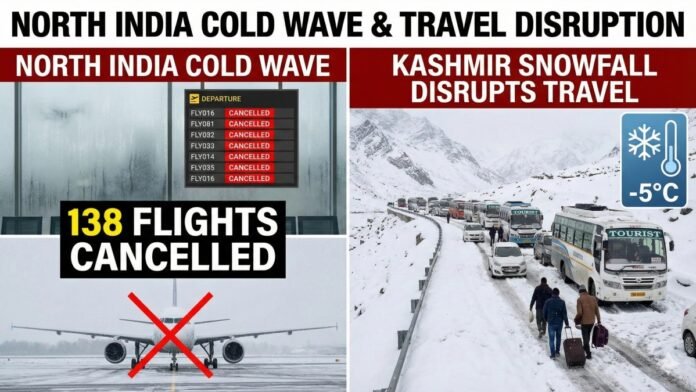
- 138 flights cancelled at Delhi’s IGI Airport, 700 departures delayed due to dense fog
- Over 70 trains delayed by more than two hours, including Rajdhani and Shatabdi
- Bulandshahr coldest in Uttar Pradesh at 7°C, red alert issued for severe cold
- Home Minister Amit Shah’s Himachal Pradesh visit cancelled due to inclement weather
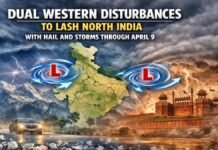
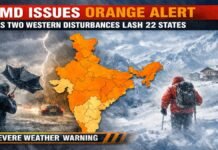
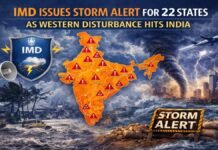
A potent Western Disturbance that activated over the weekend has triggered a dramatic weather transformation across North India, unleashing the season’s first substantial snowfall in Kashmir, dense fog in the plains, and a severe cold wave that has paralysed transportation networks and disrupted daily life for millions.
Kashmir and Himachal Pradesh: Snowfall Begins
Kashmir Valley witnessed its first significant snowfall of the season on Saturday, marking the onset of Chilla-i-Kalan, the 40-day period of the harshest winter, which will continue until January 30, 2026. The upper reaches of Himachal Pradesh, including Shimla, Kufri, and Manali, continue to receive fresh snowfall, with the weather office predicting more precipitation over the next three days. Uttarakhand is also expected to experience snowfall in higher altitudes, with Dehradun receiving heavy rainfall.
The snowfall, while welcome for tourism and water reserves, has triggered immediate challenges. Snow clearance machines have been deployed across snow-prone areas, but many roads remain blocked. The Jammu-Srinagar National Highway, a vital lifeline for the region, experienced intermittent closures due to landslides and snow accumulation.
Delhi-NCR: Coldest Day of Season
Saturday emerged as the coldest day of the season in Delhi, with the minimum temperature plunging to 4 degrees Celsius at Safdarjung Observatory, the city’s primary weather station. The India Meteorological Department (IMD) officially declared a cold wave across the national capital, prompting the Delhi government to activate its winter action plan.
A cold wave is declared when the minimum temperature in the plains falls to 4 degrees Celsius or below, or deviates 4.5 to 6.4 degrees Celsius below normal. A severe cold wave occurs when the temperature drops to 2 degrees Celsius or below, or falls 6.5 degrees Celsius below normal. Sunday morning brought no relief, with mercury dipping further to 3.8 degrees Celsius in parts of Delhi.
Uttar Pradesh: Red Alert and Dense Fog
Uttar Pradesh bore the brunt of the weather fury, with the Meteorological Department issuing a red alert for severe cold across the state. Dense fog enveloped the region from Friday night through Saturday morning, reducing visibility to less than 50 meters in several districts from Western UP to Purvanchal.
Bulandshahr recorded the state’s lowest temperature at 7 degrees Celsius, followed by Lakhimpur Kheri at 8 degrees Celsius and Barabanki at 8.5 degrees Celsius. Varanasi experienced the smallest diurnal temperature variation at just 3.3 degrees Celsius, indicating persistent cold throughout the day.
The fog forced authorities to take emergency measures. Schools remained closed in Kanpur, Bareilly, and several other districts, while school timings were revised in the Bundelkhand region. Vehicles crawled on highways and expressways, with the Yamuna Expressway reporting multiple minor accidents due to poor visibility.
Transportation Chaos: Flights and Trains Disrupted
The inclement weather wreaked havoc on transportation systems across the region. Delhi’s Indira Gandhi International Airport witnessed unprecedented disruption, with 138 flights cancelled, including 69 arrivals and 69 departures. Five international flights were among those cancelled, affecting passengers travelling to Dubai, Singapore, and Europe.
Delhi International Airport Limited (DIAL) implemented CAT-3B instrument landing procedures from 4:00 AM to 12:00 PM on Sunday to ensure safe operations. Despite these measures, 700 flights departed later than scheduled, creating a cascading effect throughout the day. Seven flights were diverted to alternative airports in Jaipur, Lucknow, and Ahmedabad.
The Delhi-Dehradun flight was cancelled, while the Bhubaneswar-Dehradun service was diverted to Jaipur. At Patna Airport, nine arriving and 15 departing flights faced delays ranging from 30 minutes to three hours. Birsa Munda Airport in Ranchi, Jharkhand, suspended operations until noon, resulting in three cancellations and significant delays for incoming flights.
The railway network suffered equally. More than 70 trains arriving in Delhi were delayed by over two hours, including premium services like Rajdhani, Shatabdi, Vande Bharat, Duronto, and Humsafar. The New Delhi-Lucknow Tejas Express ran behind schedule by two and a half hours, the New Delhi-Kalka Shatabdi by two hours, and the New Delhi-Rajendra Nagar Rajdhani Express by two hours.
Political and Administrative Impact
The severe weather forced the cancellation of Union Home Minister Amit Shah’s scheduled visit to Kangra, Himachal Pradesh, where he was to attend the Sashastra Seema Bal (SSB) foundation day ceremony. The event has been postponed indefinitely.
The Jammu and Kashmir administration has activated its winter disaster management plan, with emergency services on high alert. The Himachal Pradesh government has advised tourists to avoid travelling to high-altitude areas until weather conditions improve.
Forecast and Warnings
The Meteorological Department has warned that the cold wave and dense fog conditions will persist for the next week. A fresh Western Disturbance is expected to affect the region from December 24, potentially bringing more precipitation and exacerbating the cold conditions.
Residents have been advised to avoid unnecessary travel, especially during early morning and late evening hours when fog density peaks. The IMD has also issued a health advisory, warning vulnerable populations about the risk of hypothermia and respiratory ailments.