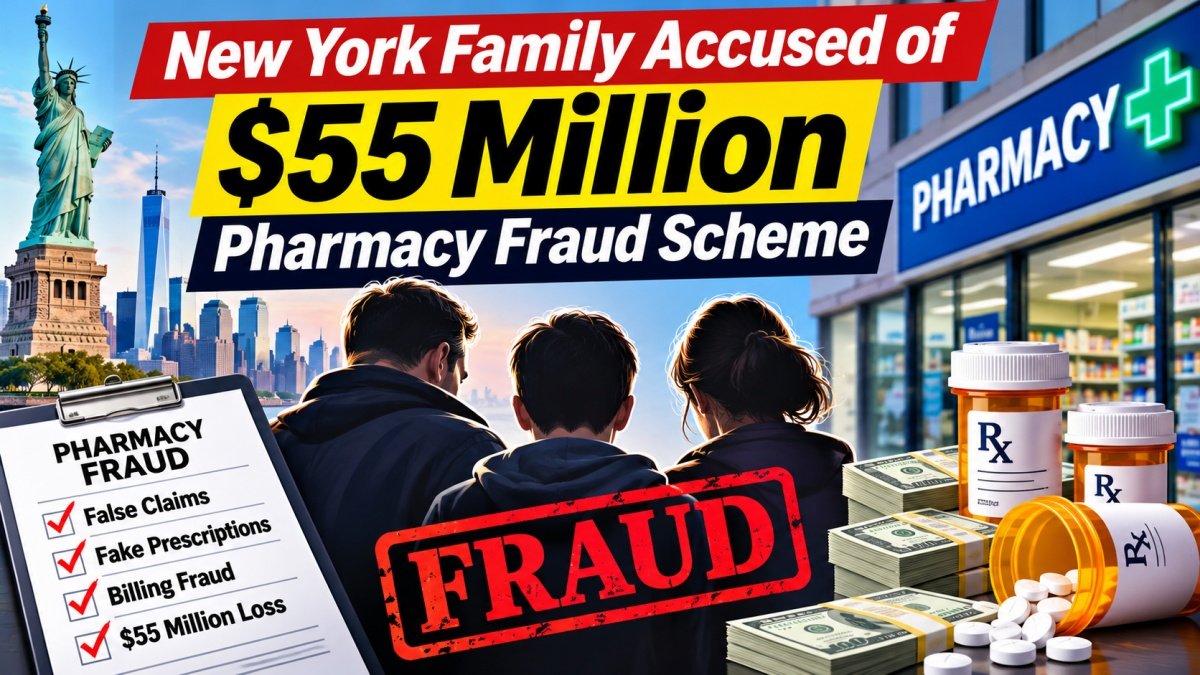
Four members of a Queens family have been charged with defrauding public health plans of over $55 million by billing for medically unnecessary prescription drugs through a network of pharmacies.
Key Points
- Fraud Amount: The family allegedly obtained more than $55 million from Medicare and Medicaid.
- Assets Seized: Authorities have seized approximately $12.4 million in assets linked to the scheme.
- Kickback Scheme: Employees allegedly paid patients in cash and gift certificates to fill unneeded prescriptions.
- Money Laundering: One family member used his financial expertise to launder proceeds and evade taxes.
- Potential Penalties: The primary defendant faces a maximum prison sentence of 107 years if convicted.
Federal Charges Against Queens Family
NEW YORK: Federal prosecutors have indicted four members of a family in Queens, New York, for orchestrating a massive healthcare fraud scheme. The Justice Department alleges that Zhang Huang, Yanle Huang, Jian Xin Huang, and Xiuqin Huang used a network of pharmacies to bill Medicare, Medicaid, and related health plans for more than $55 million in medically unnecessary prescription drugs between September 2020 and March 2026.
The indictment, returned by a federal grand jury on November 20, 2026, includes charges of healthcare fraud, illegal kickbacks, money laundering, and tax offenses. According to the government, the family operated several businesses, including 168 DME Inc., 169 DME Inc., QS Pharmacy Inc., ROK Pharmacy Inc., and 19 Pharmacy Corp. Yanle Huang, a licensed pharmacist, reportedly worked at multiple locations within this network.
Alleged Kickbacks and Money Laundering
The prosecution alleges that the pharmacies billed public health programs for medications that were not medically required, such as pain patches and topical drugs. To ensure patients filled these prescriptions, pharmacy employees reportedly paid kickbacks and bribes to Medicare and Medicaid recipients. These incentives were allegedly provided in the form of cash and supermarket gift certificates.
Zhang Huang, who is also an IRS-enrolled agent and owner of two accounting firms, is accused of using his professional expertise to conceal the fraud. Prosecutors claim he used a client’s personal information without consent to open company and bank accounts. He allegedly used shell companies to filter millions of dollars, which were then used to purchase luxury vehicles, real estate, financial investments, and cryptocurrency.
Asset Seizures and Legal Consequences
The government has already seized roughly $12.4 million in assets traceable to the alleged scheme and has identified an additional $6.7 million in real property for potential forfeiture. Assistant Attorney General Colin M. McDonald stated that the scheme exploited vulnerable patients and diverted resources intended for essential medical care.
The legal consequences for the defendants are significant. Zhang Huang faces a maximum penalty of 107 years in prison for charges including conspiracy to defraud the United States and aggravated identity theft. Yanle Huang faces a maximum of 55 years, while Jian Xin Huang and Xiuqin Huang face potential sentences of 35 years and five years, respectively. The investigation was conducted by the Department of Health and Human Services Office of Inspector General and the IRS Criminal Investigation.
Context of Healthcare Fraud
This case highlights a broader issue where prescription drug billing becomes a target for fraud through financial incentives between pharmacies and patients. Medications like topical treatments can be billed repeatedly, making them attractive targets for illicit schemes. The Justice Department’s Health Care Fraud Strike Force Program has charged over 6,200 defendants who collectively billed federal and private insurers more than $45 billion since 2007.
The defendants, including Jian Xin and Xiuqin Huang, are described as Chinese nationals with lawful permanent residency in the United States. While the indictment outlines a sophisticated operation, all four individuals remain presumed innocent until proven guilty in a court of law.