

































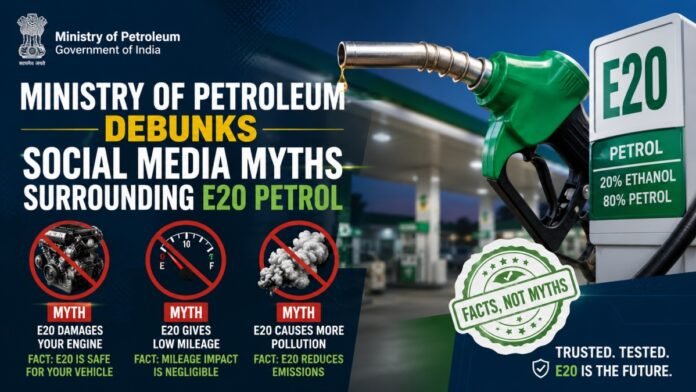
Quick Reference: E20 Petrol Myths vs. Facts
| Aspect | Viral Social Media Claim | Certified Scientific Fact |
|---|---|---|
| Engine Health | Causes structural rust, component corrosion, and sudden engine failure. | Enhances anti-knocking properties and improves overall driving quality. |
| Warranties | Invalidates vehicle warranties and standard insurance policies. | SIAM confirmed all vehicle manufacturers fully honor warranty and insurance terms. |
| Insect Attraction | The sweet smell of ethanol attracts ants and bees into the fuel tank. | Fuel-grade ethanol is completely sugar-free and contains insect-repellent additives. |
| Water Scarcity | Producing 1 liter of ethanol drains up to 10,000 liters of fresh water. | Relies on industrial surplus/damaged grain and sugarcane; expanding to low-water maize. |
Detailed Breakdown of the Government Clarifications
1. Engine Safety and Insurance Security
A primary source of concern online has been the allegation that ethanol-blended fuel causes premature engine degradation or severe drops in fuel efficiency.
Technical studies conducted by the Automotive Research Association of India (ARAI), Indian Oil, and the Indian Institute of Petroleum (IIP) Dehradun have thoroughly refuted this. The research highlights that E20 fuel actually boosts the engine’s anti-knocking capability, optimizing thermal efficiency and giving drivers smoother acceleration. Furthermore, the Society of Indian Automobile Manufacturers (SIAM) has officially guaranteed that all valid vehicle warranties and insurance protections remain fully intact for E20-compliant automobiles.
2. Environmental Advantages & Lower Emissions
Far from causing pollution, data verified by joint research bodies proves that E20 is a substantial milestone for urban air quality. Real-world testing has demonstrated notable drops in harmful exhaust outputs:
- Carbon Monoxide (CO): Reduced by 50% in two-wheelers and up to 30% in four-wheelers.
- Unburnt Hydrocarbons: Dropped by approximately 20% across tested platforms.
3. The “Sweet Fuel” Insect Rumor
A bizarre internet rumor alleged that ants and bees were swarming vehicle fuel tanks due to the organic nature of ethanol. An official investigation by Bharat Petroleum Corporation Limited (BPCL) clarified the science behind the production process: fuel-grade ethanol undergoes strict industrial distillation that completely removes residual sugars. Additionally, standardized chemical denaturants and additives are blended into the fuel specifically to act as an insect repellent.
4. Sustainable Resource Allocation
The ministry has forcefully denied claims that the ethanol program causes an extreme ecological footprint through a 10,000-to-1 water consumption ratio. The national strategy leverages pre-existing agricultural surpluses, utilizing damaged food grains and excess sugarcane yields that would otherwise go to waste. To safeguard water tables moving forward, the government is incentivizing a transition toward less water-intensive crops, such as maize, ensuring timely financial returns to the rural sector without straining freshwater ecosystems.