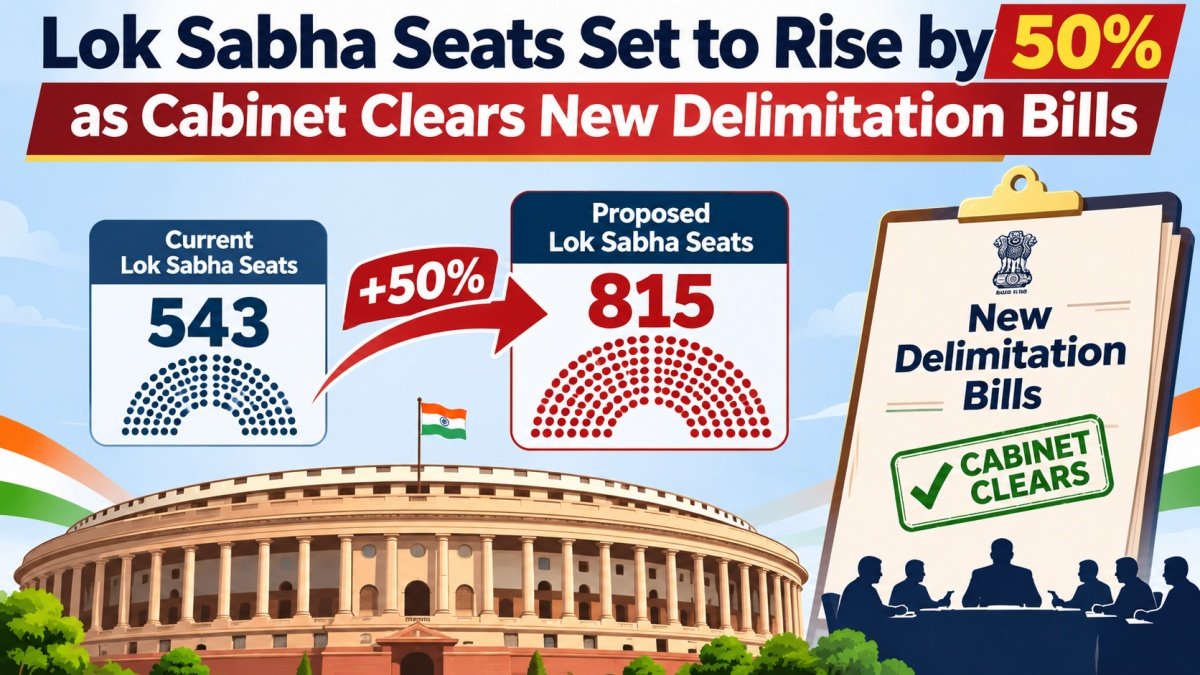
Key Points
- 50% Seat Expansion: The proposed legislation increases the existing seat allocation for each State and Union Territory by 50 per cent, raising the Lok Sabha’s maximum constitutional strength from 550 to 850.
- Preserving Inter-State Balance: By applying a uniform percentage hike rather than recalculating shares solely by population, the Centre addresses southern states’ concerns over losing political representation.
- Women’s Reservation Rollout: The revised bills are designed to give immediate effect to the 33 per cent reservation for women in Parliament and State Legislative Assemblies, with reserved seats allotted by rotation.
- Historical Context: India has increased Lok Sabha seats only three times since independence (1952, 1963, and 1973), with seat numbers frozen since the 1976 and 2001 constitutional amendments.
Following a meeting chaired by Prime Minister Narendra Modi, the Union Cabinet cleared the Constitution (One Hundred and Thirty-Second Amendment) Bill, 2026, alongside the Delimitation (Second) Bill, 2026. The fresh legislative package replaces the earlier Constitution (131st Amendment) Bill, which failed to secure the required two-thirds special majority in the Lok Sabha on April 17, 2026.
Under the new framework, the maximum strength of the Lok Sabha will rise from 550 to 850, while the upper limit for State Legislative Assemblies will be raised to 650. By amending Article 334A, the government aims to operationalise the 33 per cent women’s reservation law ahead of the upcoming electoral cycles. Once enacted, a newly constituted Delimitation Commission will redraw internal territorial boundaries using the latest published census figures, while ensuring that every State and Union Territory retains its current proportional share of national seats.
A 70-Year History of Delimitation in India
Delimitation, the process of fixing limits or boundaries of territorial constituencies to represent changes in population, spans more than seven decades in independent India. Since 1947, the number of Lok Sabha seats has been expanded on only three occasions:
- First Delimitation (1951–1952): Carried out under the Delimitation Commission Act, 1952, and based on the 1951 Census, the first exercise raised the number of Lok Sabha seats from 489 to 494.
- Second Delimitation (1963): Following the 1961 Census and the linguistic reorganisation of states, the second commission increased the Lok Sabha’s strength from 494 to 522, which took effect during the 1967 general elections.
- Third Delimitation (1973): Based on the 1971 Census, the third exercise expanded the House from 522 to 542 seats. The subsequent merger of Sikkim with India added one more seat, bringing the effective strength to its current total of 543.
- Fourth Delimitation (2002): Unlike earlier exercises, the 2002 delimitation did not alter the total number of Lok Sabha seats. Because the 42nd Constitutional Amendment (1976) and the 84th Constitutional Amendment (2001) froze state-wise seat allocations to encourage family planning initiatives, the fourth commission only redrew internal constituency boundaries based on the 2001 Census.
Periodic Shifts in the Lok Sabha’s Maximum Strength
Alongside actual seat allocations, the Constitution of India has periodically revised the maximum permissible strength of the Lower House to accommodate new territories and changing demographics:
| Year / Legislation | Maximum Strength | Key Constitutional Change |
|---|---|---|
| 1950 (Original Constitution) | 500 | Initial cap established upon the adoption of the Constitution. |
| 1956 (7th Amendment) | 525 | Adjusted to accommodate the States Reorganisation Act. |
| 1973 (31st Amendment) | 545 | Raised following the 1971 Census and creation of new states. |
| 1987 (Goa, Daman and Diu Reorganisation Act) | 552 | Fixed at 530 from states, 20 from Union Territories, and 2 nominated Anglo-Indian members. |
| 2019 (104th Amendment) | 550 | Abolished the provision for 2 nominated Anglo-Indian seats, effective January 2020. |
| 2026 (132nd Amendment Bill) | 850 | Proposed ceiling to allow a uniform 50% seat expansion across all States and UTs. |
With the Cabinet’s approval secured, the focus now shifts to Parliament, where the passage of the constitutional amendment will require a two-thirds majority of members present and voting, alongside ratification by at least half of the State Legislatures.