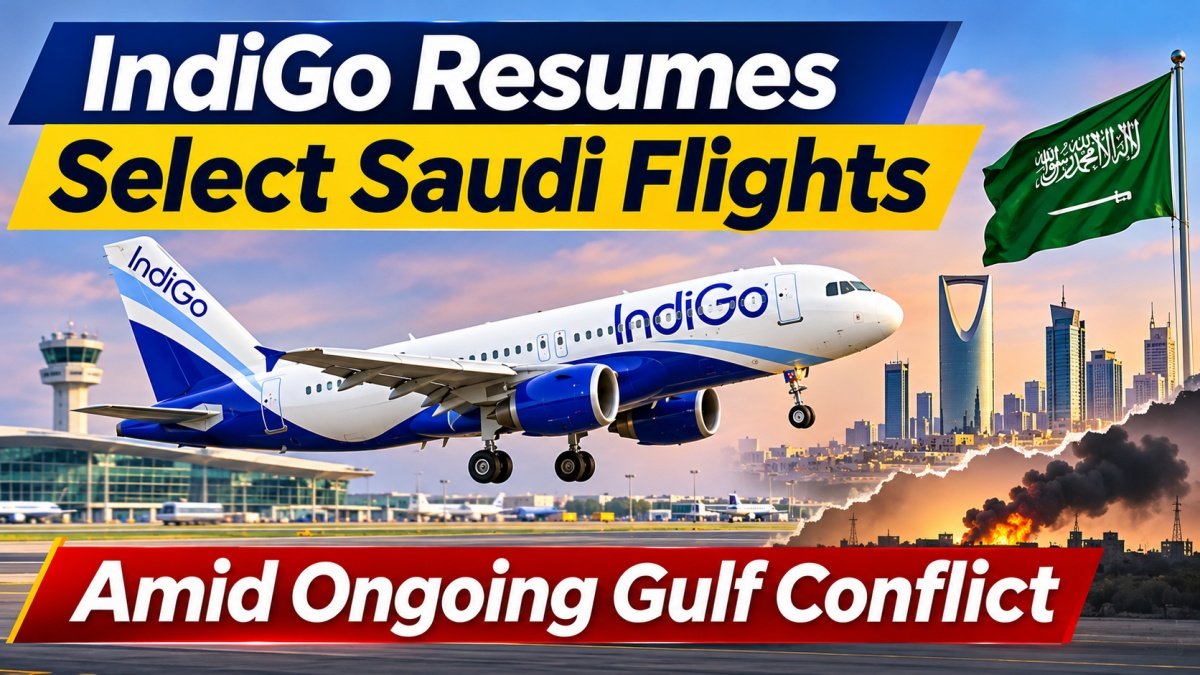
IndiGo has announced the resumption of select flights to Jeddah and Madinah in Saudi Arabia, while maintaining cancellations for Riyadh and Dammam until December 7 due to regional security issues.
Key Points
- Partial Resumption: IndiGo is restarting services to Jeddah and Madinah following a security assessment.
- Continued Suspensions: Flights to Riyadh and Dammam remain grounded until December 7, inclusive.
- Security Context: The decision follows intensified fighting between Saudi-led forces and Yemen’s Houthi rebels.
- Maritime Standoff: The US and Iran remain in a naval standoff over the Strait of Hormuz, impacting global oil trade.
Partial Restoration of Saudi Services
NEW DELHI: IndiGo has announced that it will resume select flights to and from the Saudi Arabian cities of Jeddah and Madinah. The airline stated that this decision was reached after a thorough assessment of the current security situation and various operational considerations. Affected passengers are being notified via the contact information provided during their initial booking.
However, the airline will continue to suspend all services to Riyadh and Dammam until December 7, inclusive. This update follows a previous advisory issued on November 18, which had cancelled all flights to four major Saudi routes until November 30 due to prevailing security concerns. The Indian embassy in Riyadh has also shared this advisory with travelers, emphasizing the continued suspension of services to the capital and Dammam.
Escalating Security Situation in the Gulf
The travel restrictions come as fighting between Saudi-led forces and Yemen’s Houthi rebels has intensified since July. Recent incidents include a Houthi attack on an Aramco oil refinery in Jazan, which resulted in the death of a Nepali worker and caused a temporary halt in operations. Additionally, the Houthis claimed a strike on the Ras Tanura refinery, the kingdom’s largest, and a drone strike on a Riyadh tower housing the Public Investment Fund, which wounded 11 people.
On Friday, the Saudi-led coalition reported intercepting a Houthi drone heading toward Riyadh, while Saudi Civil Defence issued and quickly retracted danger alerts in Al-Kharj and the Eastern Province. Meanwhile, Pakistan, Turkiye, and Saudi Arabia recently reviewed the Mecca defence pact to focus on collective defence commitments in the region.
The ongoing conflict has significant implications for regional infrastructure. The Public Investment Fund is a major sovereign wealth fund, and its facilities are key to the kingdom’s economic diversification goals. The repeated strikes on oil refineries, such as those in Jazan and Ras Tanura, highlight the vulnerability of energy infrastructure in the Gulf.
International Tensions and Maritime Blockades
The regional instability is further complicated by a naval standoff between the US and Iran over the Strait of Hormuz, a critical waterway for global oil transport. US Central Command reported disabling the cargo ship M/V Pacific Archer in the Gulf of Oman on Thursday after the crew allegedly attempted to evade a naval blockade. The US stated it has redirected 158 ships and disabled six others since the blockade began in April.
In a related incident, Italian Foreign Minister Antonio Tajani confirmed that Kuwaiti investigations identified a drone used in a recent attack, which killed two Italian technicians, as being manufactured in Iran. While Iran denies launching the drone from its territory and calls the incident a false flag, Kuwait has summoned Iran’s ambassador. These tensions are contributing to market volatility, with Brent crude trading near $96 per barrel.
The Strait of Hormuz is one of the world’s most important oil transit chokepoints. Any disruption in this area can lead to immediate spikes in global energy prices. Iran’s claims of sea mines and the US naval blockade have created a high-risk environment for commercial shipping, leading to the redirection of hundreds of vessels to safer routes.
Domestic Impact and Economic Outlook
The conflict is also creating internal pressures within Iran. Reports indicate that gas supply to petrochemical plants has fallen sharply, with some units expected to shut within 72 hours as fuel is prioritized for winter heating. This suggests that the maritime blockade and regional tensions are beginning to affect Iran’s industrial output and domestic energy security.
For the aviation industry, the situation necessitates a dynamic approach to safety. Airlines like IndiGo are forced to balance passenger demand with real-time security intelligence. As the situation in Saudi Arabia evolves, travelers are advised to monitor official advisories from the Indian embassy and airline updates regularly.