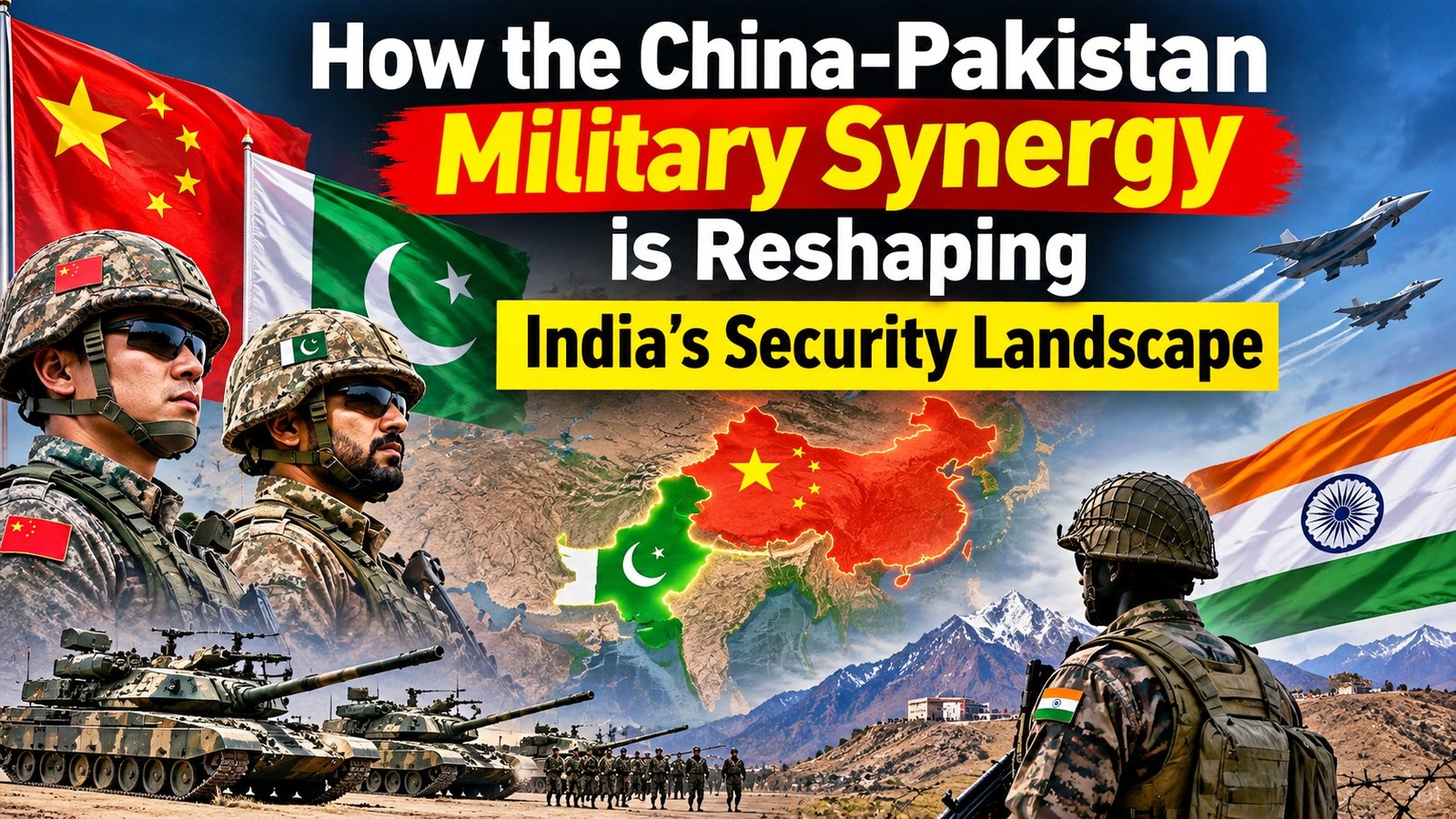
The deepening military and strategic ties between China and Pakistan are emerging as a significant national security concern for India. A recent report by the US-China Economic and Security Review Commission (USCC) warns that this partnership could potentially create a “two-front war” scenario for New Delhi. In response, the commission has advised the United States to intensify defense cooperation with India and fortify military coordination in the Indian Ocean to maintain regional power balance.
The Challenge of Two-Front Warfare
The USCC report highlights that China’s military synergy with Pakistan allows Beijing to provide strategic support without direct kinetic involvement. By bolstering Pakistan’s capabilities, China significantly increases the complexity of any potential conflict. The report notes that if tensions escalate between India and Pakistan, Chinese assistance could amplify Pakistan’s military reach, making it increasingly difficult for India to manage security threats on two fronts simultaneously.
Recent Conflict Context: Operation Sindoor
The commission references the military friction between India and Pakistan in May 2025. Following a terrorist attack in Pahalgam, India launched “Operation Sindoor,” targeting terror launch pads and bases across the Pakistan-Gulmarg border. This conflict underscored how Chinese strategic backing serves as a decisive multiplier for regional instability.
China’s Perception of India’s Rising Influence
According to the report, China views India’s rapid economic and military growth as a direct challenge to its regional hegemony. The commission identifies several factors contributing to this concern:
- India’s large population and robust economy.
- Its established nuclear capabilities.
- Its strategic geographical position in Asia.
Consequently, the report suggests that China may seek to exert increasing pressure on India across military, economic, and maritime dimensions to offset India’s growing influence.
Strategic Competition in the Indian Ocean
Beyond the 2,100-mile land border, the Indian Ocean has become a primary theater of strategic competition. As a vital corridor for China’s trade and energy supplies, the region is a focal point for Chinese maritime ambitions.
The USCC expressed concern over China’s increasing presence in the Indian Ocean, specifically noting the deployment of surveillance and research vessels. The report warns that China may employ “South China Sea” tactics in the Indian Ocean, including making territorial claims, renaming maritime zones, and establishing long-term naval outposts, to gradually solidify its influence.
Strategic Recommendations for US-India Cooperation
To counter these developments, the USCC proposed a series of strategic recommendations:
- Enhanced Military Coordination: Moving beyond routine joint exercises toward substantive, real-time military coordination.
- Maritime Surveillance: Sharing real-time intelligence on Chinese submarine and warship movements in the Indian Ocean.
- Strategic Leadership Exchange: Establishing an “Indo-American Strategic Leadership Exchange Program” to facilitate cooperation between defense, trade, and government officials.
- Respecting Strategic Autonomy: The commission emphasized that the U.S. must respect India’s strategic autonomy while deepening the bilateral partnership.
BACKGROUND
This report arrives amidst a period of complex diplomacy. In September, Prime Minister Narendra Modi and Chinese President Xi Jinping met during the 18th BRICS Summit in New Delhi, signaling a period of high-level engagement as both nations navigate their evolving bilateral relationship.
IMPORTANT FACTS OR DATA
- Border Length: India and China share a 2,100-mile land border.
- Key Operation: Operation Sindoor (May 2025) in response to the Pahalgam attack.
- Primary Concern: The “two-front war” risk posed by the China-Pakistan military axis.
- Maritime Strategy: Comparison of Chinese tactics in the Indian Ocean to its “South China Sea” strategy.
ANALYSIS
The USCC’s findings suggest that India’s rise as a global power has triggered a proactive defensive-offensive posture from China. By utilizing Pakistan as a proxy for military synergy, China attempts to create a buffer and a deterrent against Indian influence. The report underscores that the Indian Ocean is no longer just a trade route but a critical maritime frontier where the “Salami Slicing” strategy, gradual encroachment on territory, poses a long-term threat to India’s maritime security.
CONCLUSION
The USCC report serves as both a security alert and a diplomatic roadmap. It highlights that for India to safeguard its interests against a two-front threat, it must prioritize deep, technologically integrated cooperation with the United States. Strengthening maritime surveillance and establishing institutional leadership exchanges are essential steps to balancing China’s expanding influence in the region.