





























Key Points
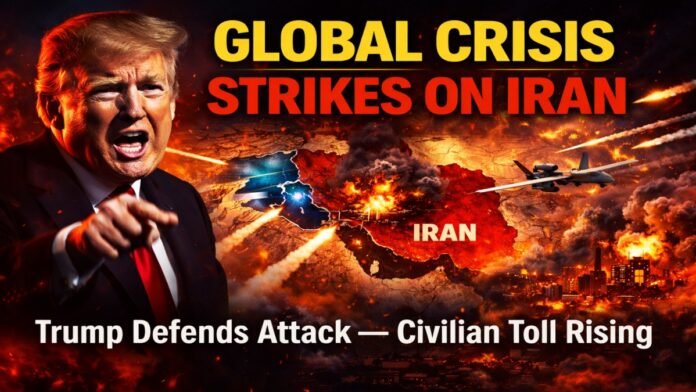
- Military Escalation: President Trump ordered strikes on February 28, 2026, citing an imminent Iranian nuclear threat.
- IAEA Refutation: Agency chief Rafael Grossi reports no evidence of an organized Iranian nuclear weapons program.
- Humanitarian Crisis: Over 780 Iranian civilians have died, including 165 victims in a Minab school bombing.
- Legal Controversy: Experts question the “self-defense” justification under Article 2(4) of the UN Charter.
- Regional Spillover: Iran has retaliated against Gulf bases and civilian targets, while Lebanon faces rising casualties.
The ongoing war between Iran and Israel has pushed the international community to a perilous crossroads, as the cycle of violence threatens to ignite a broader regional conflagration. UN Secretary-General Antonio Guterres has issued an urgent plea for restraint, condemning the loss of life and calling on all combatants to adhere strictly to international law. While the United States and Israel frame their recent military operations as essential self-defense, a growing chorus of legal experts and international observers is demanding concrete evidence to support these claims.
Trump’s Nuclear Claims vs. IAEA Findings
Following the commencement of heavy bombing on February 28, President Donald Trump defended the intervention by accusing Tehran of covertly developing nuclear weapons. The administration asserts that Iranian missiles now pose a direct threat to U.S. allies and the American mainland.
However, this narrative has been challenged by Rafael Grossi, the head of the International Atomic Energy Agency (IAEA). Grossi stated that despite rigorous monitoring, his agency has found no verifiable evidence of an organized plan to weaponize nuclear material. This discrepancy has fueled a global debate regarding the legitimacy of the intelligence used to justify the latest round of airstrikes.
The Legality of Self-Defense
The conflict has raised fundamental questions regarding the UN Charter, specifically Article 2(4), which prohibits the use of force against the territorial integrity of any state. Under international law, the right to self-defense is only triggered by an “imminent” threat that is both concrete and indisputable.
Legal scholars, including Sir Geoffrey Nice, have noted that the coalition has yet to present a transparent evidentiary basis for the strikes. Without such proof, critics argue the military actions could be classified as unlawful aggression, setting a dangerous precedent for future global conflicts.
The Staggering Human Cost
The humanitarian impact of the war is increasingly devastating. In southern Iran, a strike on a school in Minab resulted in the deaths of 165 individuals, primarily young girls and faculty members, an event that has sparked international outrage. To date, the civilian death toll in Iran has climbed past 780. Simultaneously, Israeli operations in Lebanon have claimed over 50 lives, as the fighting expands beyond the immediate borders of the primary belligerents.
Iran’s Retaliatory Strikes
Citing its own national security interests, Iran has launched retaliatory strikes against Gulf nations that house U.S. military installations. These counterattacks have been criticized for their lack of precision. Experts point to the bombing of a prominent luxury hotel in Dubai as a clear violation of the rules of proportionality, as the attack targeted a civilian landmark rather than a strictly military objective.
A Threat to the Global Order
The long-term implications of this conflict extend far beyond the Middle East. There is a growing fear among diplomats that if world powers continue to bypass international legal frameworks without consequence, the post-World War II system of rules-based order will collapse. This shift could lead to a volatile era where “the law of the mighty” replaces diplomacy, encouraging expansionist regimes to use force with impunity.