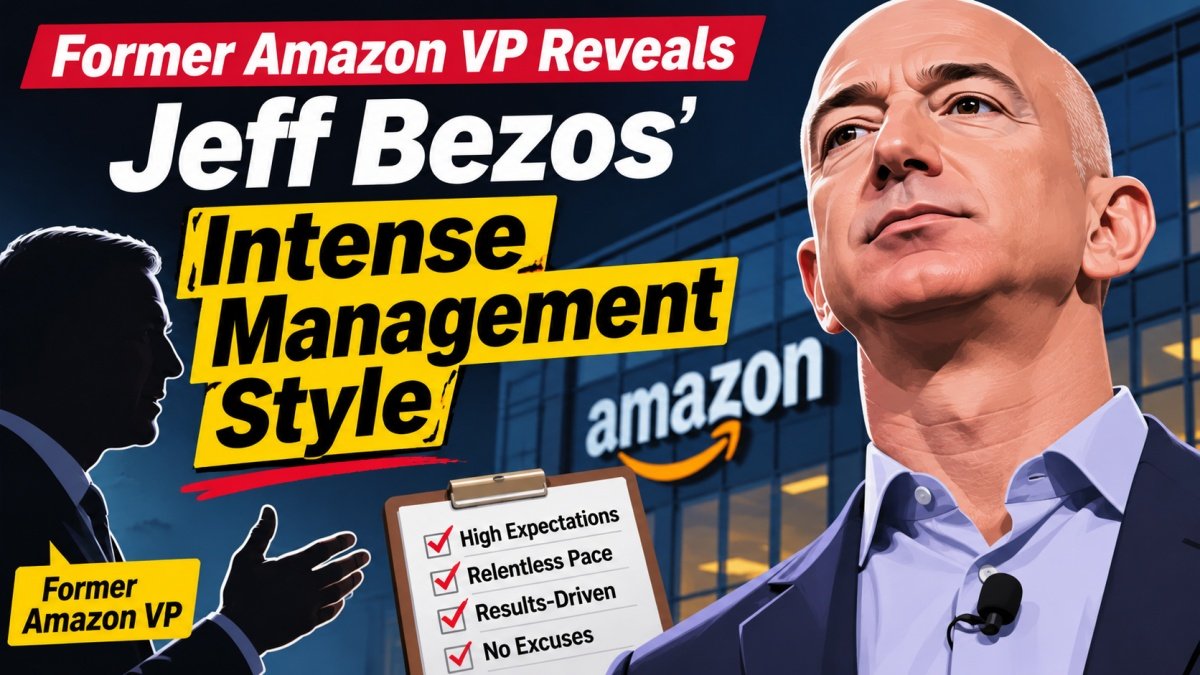
A former Amazon executive has shared rare insights into Jeff Bezos' demanding leadership style, describing a high-pressure environment focused on identifying flaws rather than celebrating successes.
Key Points
- Demanding Leadership: Ethan Evans described Bezos as a leader who rarely offered praise and focused intensely on improvements.
- Attack Mode: Bezos was known to switch into a harsh mode during meetings when presentations were deemed unsatisfactory.
- Executive Pressure: The founder reportedly confronted senior executives, including the former CFO, during disagreements over spending.
- Product Legacy: Despite the tough culture, Evans credited Bezos for backing major successes like Kindle and Prime.
High Pressure Corporate Culture
NEW DELHI: Ethan Evans, a former vice president at Amazon, has provided a candid account of the internal dynamics of the tech giant under its founder, Jeff Bezos. Speaking on the 'My First Million' podcast, Evans characterized Bezos as an exceptionally demanding leader who prioritized identifying problems over celebrating corporate wins. According to Evans, the environment was one where employees often spent weeks preparing presentations, only to face immediate scrutiny regarding flaws.
Evans noted that while Bezos was not considered mean, his management style was defined by a lack of positive reinforcement. Even when teams achieved significant results, they were typically met with brief acknowledgments followed by a new list of required improvements. Evans suggested that this constant focus on criticism could be particularly difficult for employees who were not accustomed to such a rigorous feedback loop. He recalled a specific meeting where Bezos spent nearly an hour highlighting shortcomings before offering a quick compliment as he exited the room, suggesting a conscious effort to be more encouraging.
Bezos' 'Attack Mode' in Meetings
The former executive recalled specific instances where the atmosphere in closed-door meetings became intense. Evans described a phenomenon he called 'attack mode,' where Bezos would become visibly frustrated with a presentation. In one instance, Bezos reportedly questioned if the 'A team' was available for a project, implying the current team was insufficient. Evans also observed a vice president being harshly critiqued during a session, leading the executive to call his superior immediately afterward.
The intensity of Bezos' leadership extended to the highest levels of the company. Evans recalled a disagreement over spending where the then-CFO, Tom Szkutak, reminded Bezos of the company's limited cash reserves. Bezos reportedly responded by asking for the specific amount, indicating his intent to spend it regardless. Evans remarked that the founder had a distinct ability to put even senior leaders in their place during these high-stakes discussions.
Legacy of Innovation and Failure
Despite the demanding nature of the workplace, Evans expressed continued respect for Bezos' decision-making and vision. He attributed Amazon's massive growth to Bezos' willingness to back transformative products and services, specifically highlighting the success of Amazon Prime and the Kindle. However, Evans also acknowledged that the founder's leadership involved accepting costly missteps, citing the Fire phone as a notable example of a failed venture.
Evans, who has since transitioned into executive coaching, noted that while he appreciates the lessons learned under Bezos, he now enjoys a more balanced work schedule and greater personal satisfaction. His reflections provide a rare look into the leadership style that propelled Amazon into one of the world's largest companies. This narrative highlights the duality of Bezos' tenure, where a relentless drive for perfection fueled global expansion while creating a high-stress environment for those within the inner circle.
Context of Amazon's Leadership Evolution
Jeff Bezos founded Amazon in 1994, initially as an online bookstore, before expanding into a global e-commerce and cloud computing powerhouse. His leadership style has long been associated with 'Day 1' thinking, a philosophy that emphasizes maintaining the urgency and curiosity of a startup despite the company's massive scale. This philosophy often manifests as a high bar for excellence and a willingness to take significant risks on new technologies.
The transition of leadership at Amazon has seen a shift toward more diversified management, yet the cultural hallmarks established during the Bezos era remain influential. The 'attack mode' described by Evans reflects a common trait in high-growth tech environments where the speed of innovation requires constant iteration. As Amazon continues to dominate the retail and technology sectors, these historical accounts serve as a blueprint for understanding the internal pressures required to sustain such a dominant market position.