

































Key Points
- Action: Lucknow University officials sealed the 200 year old Lal Baradari building and its internal mosque, citing structural instability.
- Protest: Students uprooted barricades and offered Namaz in the open, alleging the site was closed without prior notice or consultation.
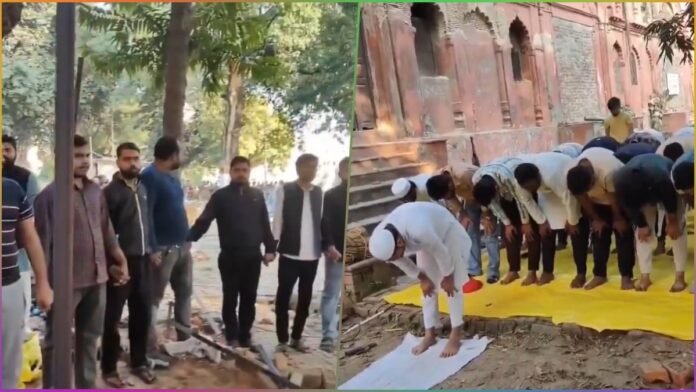
- Solidarity: In a viral moment of communal harmony, Hindu students formed a “human shield” to protect Muslim peers during their prayers.
- Heritage: Built in 1800 AD by Nawab Nasiruddin Haider, the Lal Baradari is an ASI-protected monument that predates the university itself.
- Political Fallout: The incident has drawn national attention, with Rajya Sabha MP Imran Pratapgarhi pledging to raise the issue in formal forums.
A wave of student activism and communal solidarity swept through the historic campus of Lucknow University on Monday, transforming an administrative dispute into a powerful statement of interfaith brotherhood. The unrest began when the university administration, citing severe safety concerns, moved to seal the main entrance of the Lal Baradari building, effectively barring access to the mosque housed within its ancient walls.
The sudden move, which included the installation of heavy barricades, was met with immediate resistance. Hundreds of students gathered at the site, claiming the administration had bypassed all protocols of transparency and consultation. In an act of defiance, protesters dismantled the university’s barricades and organized an open-air prayer session directly in front of the sealed gates.
A Human Shield for Harmony
The highlight of the protest occurred when Muslim students knelt to offer Namaz on the university grounds. In a spontaneous display of unity, their Hindu classmates stood behind them, locking hands to form a protective cordon. This “human chain” served as a shield against potential administrative interference or security threats, creating a striking visual that has since gone viral across social media platforms.
“We are students first, and our identity is defined by our unity,” remarked one of the protesting students. The gesture has been hailed as a significant rebuff to communal polarization, illustrating a deep-seated culture of mutual respect on the 100 year old campus.
हमारा लखनऊ हमारी गंगा जमुना तहजीब,l
— S. U. Khan 🇮🇳 INDIA (@sayeed_uddin) February 22, 2026
मेरा मुकद्दर मेरा नसीब…
यह हमारा असली हिंदुस्तान है ,
लखनऊ यूनिवर्सिटी में मुसलमान छात्र नमाज पढ़ रहे हैं और हिंदू छात्र सुरक्षा में खड़े हैं pic.twitter.com/s4pnAdekNj
The Battle Over Lal Baradari
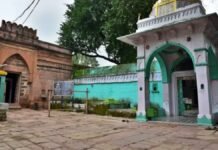
At the heart of the conflict is the Lal Baradari, a red sandstone masterpiece commissioned in 1800 AD by Nawab Nasiruddin Haider. A centerpiece of Oudh architecture, the structure was originally the throne room for the Nawabs and has served as a protected monument under the Archaeological Survey of India (ASI) for decades.
The university administration defends its decision as a necessary safety precaution. The Registrar stated that the building is in a state of extreme dilapidation, making it a “ticking time bomb” for structural collapse. Officials clarified that the closure is not limited to the mosque, but extends to all facilities within the building’s perimeter, including a bank, a club, and a canteen. The administration claims it reached out to the ASI multiple times regarding urgent repairs but received no response, forcing them to take independent action to protect student lives.
Growing Political Pressure
The controversy has quickly transitioned from a campus grievance to a political flashpoint. Protesting students reportedly held a telephonic discussion with Congress leader and Rajya Sabha MP Imran Pratapgarhi, who expressed solidarity with their cause. Pratapgarhi has assured the students that the matter of “heritage versus safety” and the perceived lack of notice will be addressed with higher authorities.
As of Monday evening, the campus remains under heavy police surveillance. While the administration maintains that the closure is temporary and based strictly on engineering reports, the students remain adamant. They have vowed to continue their demonstrations until a compromise is reached that respects both the safety of the students and the religious sanctity of the historic mosque.