
































Key Demands
- Full ownership rights to lands allotted during 1947, 1965, and 1971 conflicts
- Fair compensation for agricultural lands beyond border fencing
- Free electricity for irrigation and domestic use in border areas
- Immediate government action on long-pending grievances
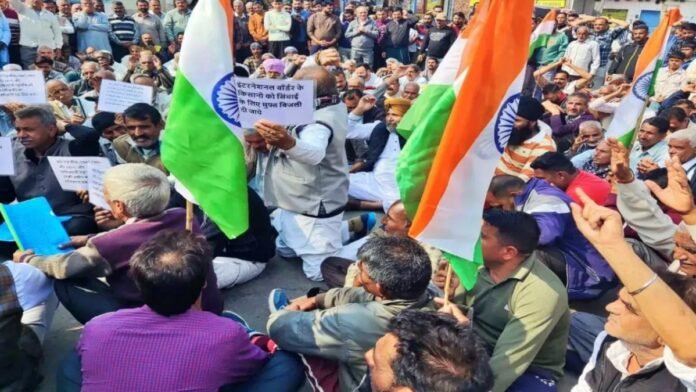
Hundreds of villagers from the Arnia sector of the India-Pakistan international border assembled under the banner of the Border Kisan Sangharsh Samiti (BKSAS) to voice their long-standing demands. The protesters raised slogans and displayed banners emphasizing three critical issues: ownership rights to lands allotted during the wars of 1947, 1965, and 1971, adequate compensation for agricultural lands situated beyond the border fencing, and provision of free electricity in border areas.
The Arnia sector, located just 1.5 kilometers from the international border in Jammu and Kashmir’s RS Pura district, has historically been a sensitive zone affected by cross-border tensions, ceasefire violations, and security challenges. Farmers in this region face unique hardships, including disruptions to farming activities due to security fencing, frequent firing incidents, and threats of infiltration.
Historical Context of Land Allotment
The protesters’ primary demand centers on securing full ownership rights to lands that were allotted to their families during three pivotal periods in the region’s history. Following the 1947 Partition of India, thousands of families were displaced from what is now Pakistan-occupied Kashmir (PoJK) and resettled in border areas of Jammu. Similarly, during the Indo-Pak wars of 1965 and 1971, additional families were displaced and given land allotments by the government.
According to recent government records, displaced persons from 1947, 1965, and 1971 have received ownership rights under various government orders and acts, including Cabinet Order No. 578-C of 1954, the Agrarian Reforms Act of 1976, and orders issued in 1966 and 2024. However, farmers argue that many cases remain pending, and full proprietary rights have not been transferred despite continuous possession of these lands for decades.
Former sarpanch and committee representatives stated that ownership rights to these lands are their constitutional rights. They emphasized that this issue has been pending for far too long, and the government has not taken adequate concrete steps to resolve it. The protesters also noted that recent government orders issued in 2024 provide for the transfer of evacuee land and full proprietary rights to displaced persons who have maintained continuous recorded possession, but implementation has been slow and incomplete.
Impact of Border Fencing on Livelihoods
A significant portion of agricultural land in the Arnia belt has been affected by border fencing installed for security purposes. Thousands of acres of farmland lie beyond the fencing, severely restricting farmers’ access to their own fields and drastically reducing their income. The fencing, while necessary for national security, has created substantial economic hardship for farming families who depend on these lands for their livelihoods.
In March 2025, Jammu and Kashmir Chief Minister Omar Abdullah informed the legislative assembly that over Rs 144 crore had been disbursed to farmers whose lands were affected by fencing along the International Border. He acknowledged the humanitarian nature of the issue and promised to convene a meeting with all MLAs representing border areas, along with officials, to address the concerns comprehensively.
Despite this compensation, protesters argue that the amounts provided are inadequate and do not fully account for the loss of agricultural productivity, reduced land access, and ongoing economic hardship. They demand immediate and fair compensation that reflects the true value of their losses and enables them to maintain sustainable livelihoods.
Security Challenges and Daily Hardships
Living in the Arnia sector means facing constant security threats that significantly impact daily life and farming activities. The protesting farmers described their existence as continuously stressful due to regular firing incidents, threats of infiltration, and military activities along the border. These security challenges force farmers to abandon their fields during periods of heightened tension, further reducing agricultural productivity.
Recent reports from May 2025 indicate that farmers in border villages like Treva and Suchetgarh have been racing against time to complete harvesting amid security alerts following the April 2025 Pahalgam terror attack. Local authorities arranged 20 harvesters to speed up the harvesting process, with farmers reporting that 95 percent of harvesting was completed in affected areas.
One farmer from Treva village stated that they live in a danger zone where every instance of shelling brings the threat of death and destruction. Another farmer noted that their families packed hundreds of bags of wheat in just a few days to complete harvesting before potential security escalations.
Demand for Free Electricity
The protesters have also demanded free electricity for border areas, citing that power supply is erratic and essential for both irrigation and domestic needs. Farmers argue that their financial situation has worsened due to the burden of electricity bills, especially when combined with reduced agricultural income from lands affected by fencing.
They contend that providing free electricity would be a reasonable form of compensation from the state government, given the unique hardships and sacrifices made by border residents in the interest of national security.
Government Response and Previous Initiatives
In September 2025, Union Agriculture Minister Shivraj Singh Chouhan announced that farmers without land ownership rights in India’s border villages would start receiving PM-KISAN benefits once certified by the state government, fulfilling a long-pending demand of border areas. He promised that one installment of the scheme would be released immediately.
This announcement came during a tour of flood-affected areas in Jammu and Kashmir, where the minister also promised increased MGNREGA workdays from 100 to 150 and housing assistance under the Pradhan Mantri Awas Yojana.
However, protesters note that while these initiatives are welcomed, they do not address the core issues of land ownership rights and adequate compensation for lands beyond the fencing. The Border Kisan Sangharsh Samiti maintains that comprehensive solutions are needed to resolve all pending demands.
Warning of Escalated Agitation
Leaders of the Border Kisan Sangharsh Samiti have issued a clear warning to the government that if positive decisions are not taken on their demands in the coming days, they will be forced to launch a more aggressive agitation. While the current protest remained peaceful, the slogans and banners displayed indicate a determined effort to pressure the government into action.
Local residents emphasized that the problems faced by citizens living in sensitive border areas like the Arnia sector cannot be ignored or postponed indefinitely. They argue that these are not merely economic demands but matters of justice, dignity, and constitutional rights for families who have lived on the frontlines for decades.
Broader Context of Farmer Protests
This protest is part of a broader pattern of farmer agitations in India and around the world. In 2024-2025, large-scale farmer protests occurred in Punjab and Haryana, with thousands of farmers marching toward Delhi demanding minimum support prices and other agricultural reforms. Internationally, farmers in Greece, the United Kingdom, and other countries have also organized major protests over subsidy issues, inheritance taxes, and agricultural policies.
The Arnia sector protests, however, are distinct in their focus on border-specific issues, including security-related land access restrictions, compensation for fencing, and the unique challenges faced by farming communities living in conflict-prone areas.
The protest by border farmers in the Arnia sector re-emphasizes long-standing demands that have remained unresolved for decades. The three core demands, ownership rights to lands allotted during 1947, 1965, and 1971, adequate compensation for lands beyond border fencing, and free electricity, represent fundamental issues of economic justice and constitutional rights for families who have sacrificed much while living on the nation’s frontlines.
The Border Kisan Sangharsh Samiti has made it clear that they will pursue their demands peacefully but will intensify their agitation if the government fails to take concrete action. With thousands of acres of land and hundreds of farming families affected, the resolution of these demands remains crucial for the economic stability and social well-being of the border region.