
































Key Points
- Rajya Sabha passed the Developed India Guarantee Employment and Livelihood Bill by voice vote, hours after Lok Sabha approval
- The legislation replaces MGNREGA, increasing guaranteed work days from 100 to 125 annually
- Opposition strongly protested removal of Mahatma Gandhi’s name, staging walkout and Constitution Hall demonstration
- Mallikarjun Kharge threatened street protests, warning the government may be forced to withdraw the law
- Shivraj Singh Chouhan defended the bill, accusing Congress of betraying Gandhi’s ideals and glorifying the Nehru-Gandhi family
- AIADMK supported the bill but objected to the 60-40 financial burden sharing provision
- BJD and YSRCP demanded the bill be sent to a select committee, citing implementation flaws
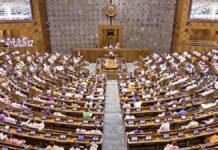
The Rajya Sabha passed the Developed India Guarantee Employment and Livelihood (Rural) Bill by voice vote on December 19, just hours after the Lok Sabha approved the controversial legislation. The bill, which replaces the Mahatma Gandhi National Rural Employment Guarantee Act (MGNREGA), will guarantee 125 days of wage employment annually, up from the current 100 days. Union Agriculture and Rural Development Minister Shivraj Singh Chouhan insisted the reform was necessary to address systemic shortcomings in the two-decade-old scheme.
The opposition’s protests reached a fever pitch during the debate. Several MPs walked out of the Upper House, shouting slogans against the government and demanding the bill’s withdrawal. The walkout followed heated exchanges over the removal of Mahatma Gandhi’s name from the flagship scheme. Opposition members argued that stripping the Mahatma’s name was not just a symbolic insult but a deliberate attempt to erase his legacy from India’s social welfare framework.
Opposition’s Fury, Gandhi’s Name and Political Symbolism
Congress MP and Leader of Opposition in the Rajya Sabha, Mallikarjun Kharge, launched a blistering attack on the government during the debate. He warned that the legislation would trigger nationwide protests similar to the farm laws agitation. Kharge’s speech carried ominous undertones: “A time will come when you will withdraw this law just like the three farm laws. Do you want a movement where people take to the streets, get injured and die from bullets? Only then will you withdraw the law? People will take to the streets, face bullets, but will never support this law.”
Aam Aadmi Party MP Sanjay Singh employed religious symbolism to criticise the name change. He pointed out that Gandhi’s statues stand in 80 countries and that the Mahatma was a devotee of Rama. Singh warned the government against playing politics with religious figures, stating, “It was because of this kind of exploitation in the name of Rama that they lost in Ayodhya. Lord Rama himself will not be happy with the removal of his devotee’s name. He will curse you. Is this ‘Jai Shri Ram’ scheme honouring or insulting Rama?”
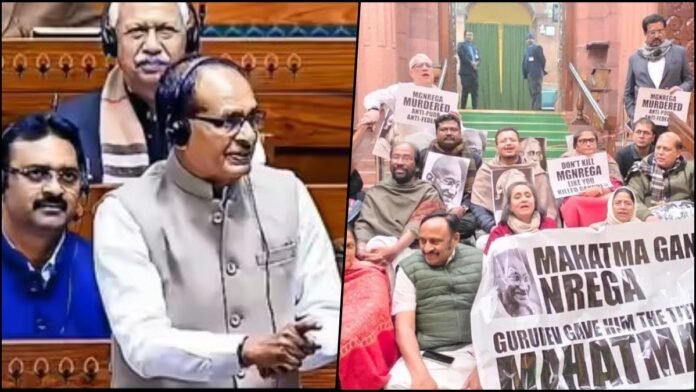
The opposition staged a dramatic protest outside the Constitution Hall in the Parliament complex immediately after the bill’s passage. Leaders from Congress, AAP, DMK, and other parties gathered with placards demanding the government respect Gandhi’s legacy. They also insisted the bill should have been referred to a parliamentary committee for detailed scrutiny.
Government’s Counterattack, Congress Accused of Betraying Gandhi
Shivraj Singh Chouhan mounted an aggressive defence in the Lok Sabha, turning the tables on the opposition. He accused Congress of systematically betraying Mahatma Gandhi’s ideals since independence. Chouhan referenced Gandhi’s 1948 statement that Congress should dissolve itself and transform into a Lok Sevak Sangh after achieving independence. He alleged that Jawaharlal Nehru’s lust for power prevented this transformation, marking the first betrayal of Gandhi’s vision.
The minister listed subsequent alleged betrayals: “Accepting the partition of the country, granting special status to Kashmir, imposing the Emergency and trampling on the Constitution, and firing on saints in Delhi, all these incidents were against Gandhiji’s principles.” Chouhan claimed Congress plunged India into corruption and scams, repeatedly crushing Gandhi’s ideals while hypocritically using his name for political gain.
Chouhan presented statistics to support his naming politics accusation. He stated that 25 state government schemes bear Rajiv Gandhi’s name, 27 carry Indira Gandhi’s name, and over 86 universities and educational institutions plus dozens of roads are named after the Nehru-Gandhi family. He argued that a true tribute to Gandhi lies in implementing his vision, not merely naming schemes after him.
Bill’s Core Provisions: What Changes for Rural Workers
The Developed India Guarantee Employment and Livelihood Bill introduces several significant changes beyond the name alteration. The guaranteed employment period increases from 100 to 125 days per rural household annually. The legislation aims to streamline implementation, reduce corruption, and incorporate technological solutions for worker registration and payment disbursement.
The government claims the new framework will address MGNREGA’s implementation gaps, including delayed wage payments, ghost workers, and material cost inflation. However, opposition members argue that the changes are cosmetic and politically motivated. They contend that the real intent is to dismantle a scheme associated with the Congress party’s pro-poor credentials.
Federalism Concerns, States Cry Foul Over Financial Burden
AIADMK MP M. Thambidurai expressed conditional support but raised serious objections about the 60-40 funding provision. Under the new bill, states must bear 40 per cent of the scheme’s cost, compared to the previous 90-10 central-state split in MGNREGA. Thambidurai argued this shift would strain state finances, particularly for non-BJP-governed states.
BJD MP Subhashish Khuntia demanded the bill be referred to a select committee, warning that changing the name would not benefit labourers. He pointed out implementation flaws that needed thorough examination. YSRCP’s Niranjan Reddy echoed this demand, emphasising that rushed legislation would create more problems than solutions.
The financial burden issue has become a major flashpoint. Several chief ministers have privately expressed concerns that the new cost-sharing formula punishes states with larger rural populations and weaker tax bases. They argue this violates the cooperative federalism principle and could lead to uneven implementation across states.
Regional Voices, Mixed Signals from Non-BJP Parties
The debate revealed cracks in opposition unity. While Congress and Left parties vehemently opposed the bill, regional parties showed nuanced positions. AIADMK’s qualified support demonstrated that not all non-BJP parties view the legislation as entirely negative. However, their concern about the financial formula indicates potential future friction.
The DMK’s stance remained ambiguous during the Rajya Sabha debate. Party sources suggest they are internally divided, with some leaders viewing the increased work days as beneficial for Tamil Nadu’s rural workers, while others oppose any dilution of Gandhi’s legacy. This ambivalence reflects the complex political calculations regional parties must make.
What Happens Next: Implementation Challenges Loom
With presidential assent expected within days, the government faces the daunting task of rolling out the new scheme before the next financial year. Officials indicate that existing MGNREGA workers will be automatically migrated to the new system, but technical integration remains a challenge.
Opposition parties have announced plans to challenge the bill legally and politically. Congress leaders are consulting constitutional experts to explore whether the name change and funding formula violate any legal provisions. More importantly, they are mobilising grassroots organisations to protest the “insult to Gandhi.”
The political fallout could extend beyond employment policy. Analysts suggest the controversy might become a rallying point for opposition unity ahead of state elections. The government’s aggressive push, despite walkouts, signals its confidence in parliamentary numbers but risks alienating moderate voters who view Gandhi as a sacrosanct national figure.