






























Key points
- India is YouTube’s largest market, with about 490 million users, turning the platform into a mainstream utility rather than just an entertainment app.
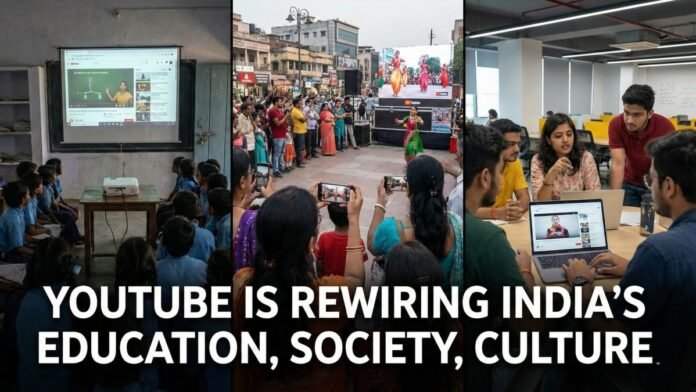
- For many students and parents, YouTube now works as a free parallel classroom that fills gaps left by formal schooling.
- Teachers, professionals, and creators use YouTube to teach everything from school subjects to high‑end skills like VFX, coding, and content production.
- Health, wellness, legal rights, and financial literacy channels are reshaping everyday decision-making and civic awareness.
- Creators in regional languages are using YouTube to preserve local traditions while taking Indian music, art, and stories to a global audience.
India has emerged as YouTube’s biggest audience, with roughly 490 million users in 2025, which makes the platform a de facto public learning infrastructure. Beyond economic impact, it now functions like a second school system where students, parents, and working professionals all turn for explanations, tutorials, and doubt clearing.
For learners, YouTube lowers cost and access barriers, since anyone with a smartphone and data can watch competitive exam prep, school lessons, language courses, and how‑to guides in their own language. Creators who once had no access to formal film or media schools now learn end‑to‑end skills, such as editing, shooting, and visual effects, purely from platform content, then feed that knowledge back into the ecosystem through their own channels.
Wellness, Rights, And Social Belonging
YouTube is also reshaping how Indians think about health, self‑improvement, and everyday problem-solving, with wellness creators popularising evidence‑based routines, traditional remedies, and mental health practices in simple, relatable language. Viewers frequently report lifestyle changes such as improved diets, better fitness habits, and even participation in local environmental or community initiatives inspired by these videos.
Civic‑focused channels that explain labour laws, social schemes, and basic financial rights help viewers avoid scams, recover dues, and understand complex policies in plain language, which effectively turns them into informal public service outlets. For teenagers and young adults, the platform doubles up as a social space where they find niche communities around careers, fandoms, technology, or identity, especially when they struggle to find such support offline.
Preserving Roots, Projecting Global Influence
With most Indian users consuming content in regional languages, YouTube has become a digital archive of local dialects, folk arts, rituals, and traditional professions that might otherwise fade from mainstream media. Small creators document village life, crafts, regional cuisines, and oral histories, allowing younger audiences from other states or countries to reconnect with cultures they rarely see on television.
At the same time, music labels, indie musicians, comedians, and storytellers use the platform as a global stage where an upload from India can reach audiences in the US, Europe, and the wider diaspora within hours. This combination of hyper‑local preservation and borderless distribution is why many policy experts now describe YouTube as India’s digital town square, where the classroom, clinic, community hall, and cultural stage increasingly exist on a single screen.