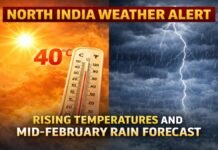
































Key Points
- Heatwave Alert: Severe heatwave conditions are prevailing in Saurashtra, Kutch, and Southwest Madhya Pradesh, with temperatures hitting 40,42°C.
- Monsoon-like Rain: Arunachal Pradesh, Assam, and Meghalaya are under a heavy rainfall alert, with significant downpours already recorded in Tuting and Shillong.
- Delhi’s Rising Heat: The national capital recorded temperatures 5,7°C above normal, though a fresh Western Disturbance promises relief by March 15.
- South India Humidity: A cyclonic circulation over the Bay of Bengal is bringing sultry weather and light showers to coastal Tamil Nadu.
- Upcoming Relief: A new Western Disturbance arriving March 14 is expected to trigger rain across North India, potentially breaking the early summer spell.
On Friday, March 13, 2026, India’s weather landscape presents a stark contrast that highlights the increasing volatility of the pre-monsoon season. While residents in the western corridors are battling a premature and intense summer, the eastern and northeastern regions are dealing with atmospheric conditions more reminiscent of the peak monsoon months. According to the India Meteorological Department (IMD), this regional disparity is driven by a combination of dry, hot winds from the northwest affecting Central India and a surge of moisture from the Bay of Bengal feeding into the Northeast.
Heatwave Intensifies in Gujarat and Madhya Pradesh
The western states are currently the epicenter of a severe heatwave. In Gujarat’s Saurashtra and Kutch regions, the mercury has consistently crossed the 40°C mark, with Rajkot reporting highs of 42°C. Similarly, in Southwest Madhya Pradesh, districts like Ratlam, Dhar, and Narmadapuram are under an orange alert.
Health officials have issued urgent advisories, warning that the sudden spike in temperature, which is nearly 6,7°C above the seasonal average, poses significant risks of heat exhaustion. The transition from winter to summer has been exceptionally rapid this year, leaving little room for the traditional spring season.
Delhi’s Heat and Poor Air Quality
In the national capital, the weather remains uncomfortably warm and hazy. Delhi recorded a maximum temperature hovering around 35°C on Friday, which is markedly above normal. Alongside the heat, the city continues to grapple with “Poor” to “Severe” air quality, with an AQI reaching 286 in several localities. The lack of strong surface winds has allowed pollutants to accumulate, making the afternoon sun feel even more oppressive for commuters.
Torrential Rain and Landslide Risks in the Northeast
In a complete reversal of the western heat, the northeastern frontier is witnessing a deluge. Heavy to very heavy rainfall has been forecast for Arunachal Pradesh, Assam, and Meghalaya through March 15. Tuting in Arunachal Pradesh has already recorded a staggering 9 cm of rain in 24 hours.
In Shillong, unexpected hailstorms have caused temperatures to plummet, though the IMD has warned that the intense precipitation could trigger landslides in hilly terrains and waterlogging in the low-lying plains of Sub-Himalayan West Bengal.
Cooling Trend: Rain Forecast for North India
There is, however, a glimmer of relief on the horizon for the heat-stricken plains of the north. A fresh Western Disturbance is scheduled to affect the Himalayan region starting Saturday, March 14. This system is expected to bring scattered rainfall and thunderstorms to Jammu and Kashmir, Himachal Pradesh, and Uttarakhand.
By March 15 and 16, the influence of this disturbance will likely extend to Punjab, Haryana, Rajasthan, and Uttar Pradesh. Delhi-NCR is also expected to see cloudy skies and light drizzle during this period, which should finally bring the maximum temperatures down toward more seasonal norms.