



























Key Points
- Covert Activity: The U.S. claims China conducted nuclear explosive tests with yields in the “hundreds of tons,” including a specific event on June 22, 2020.
- Treaty Vacuum: The New START treaty formally expired on February 5, 2026, leaving the world’s largest nuclear arsenals without legal limits for the first time in over 50 years.
- Arsenal Expansion: U.S. intelligence reports indicate China’s nuclear stockpile has reached 600 warheads, with projections exceeding 1,000 by 2030.
- Diplomatic Deadlock: While the U.S. and Russia agreed in Abu Dhabi to restart dialogue, Beijing continues to reject a trilateral arms control framework.
The Trump administration has intensified its pressure on Beijing, alleging that China has conducted clandestine nuclear tests in violation of the global moratorium. Speaking at the UN-backed Conference on Disarmament in Geneva on February 6, 2026, Under Secretary of State Thomas DiNanno revealed that the U.S. government possesses evidence of tests with designated yields in the hundreds of tons.
U.S. officials claim that the People’s Liberation Army (PLA) utilized “decoupling,” a technique involving large underground chambers to muffle seismic signals, to hide these activities from international monitoring systems. One such test is alleged to have occurred in mid-2020 at the Lop Nur testing site, a claim that China has categorically dismissed as a “bundle of false statements” designed to justify American nuclear dominance.
The Expiration of New START
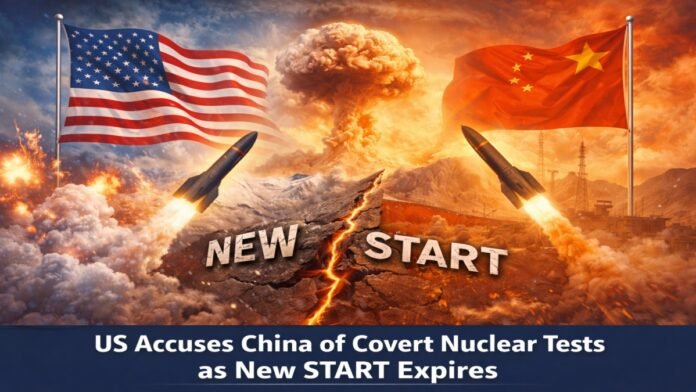
This escalating friction comes at a precarious moment for global security. On Thursday, February 5, 2026, the New Strategic Arms Reduction Treaty (New START) between the United States and Russia officially sunset. For the first time since the SALT I agreement of 1972, there are no binding constraints on the deployment of strategic missiles or warheads between the two primary nuclear superpowers.
Although Russian President Vladimir Putin had offered a one-year extension of existing limits, President Donald Trump declined the proposal. The White House maintains that any future agreement must be modernized to include China, arguing that the 2010 bilateral framework is “simply inappropriate” for the multi-polar threats of 2026.
A Strategic Pivot in Abu Dhabi
Despite the lapse of the treaty, there is a flicker of diplomatic movement. In a recent high-level meeting in Abu Dhabi, U.S. and Russian negotiators agreed on the urgent need to launch fresh arms control talks. While the two nations have agreed to re-establish high-level military-to-military dialogue, which had been suspended for years, the inclusion of China remains the primary sticking point.
U.S. Secretary of State Marco Rubio emphasized that a framework excluding China would leave the U.S. and its allies “less safe.” China, however, continues to rebuff these calls. Ambassador Shen Jian argued that Beijing’s arsenal remains a fraction of the U.S. and Russian stockpiles, which together account for over 80 percent of the world’s nuclear weapons.
China’s Nuclear Trajectory
The urgency behind Washington’s demands is fueled by the rapid expansion of China’s nuclear capabilities. Current estimates suggest Beijing has tripled its arsenal from 200 warheads in 2020 to over 600 today. With the construction of hundreds of new intercontinental ballistic missile (ICBM) silos in its northwestern deserts, U.S. intelligence warns that China is on track to field 1,000 operational warheads by 2030, potentially achieving “qualitative parity” with the U.S. and Russia.
Without a new treaty in place, security analysts fear a return to a Cold War-style arms race, where secrecy and a lack of transparency increase the risk of global miscalculation.