Key Points
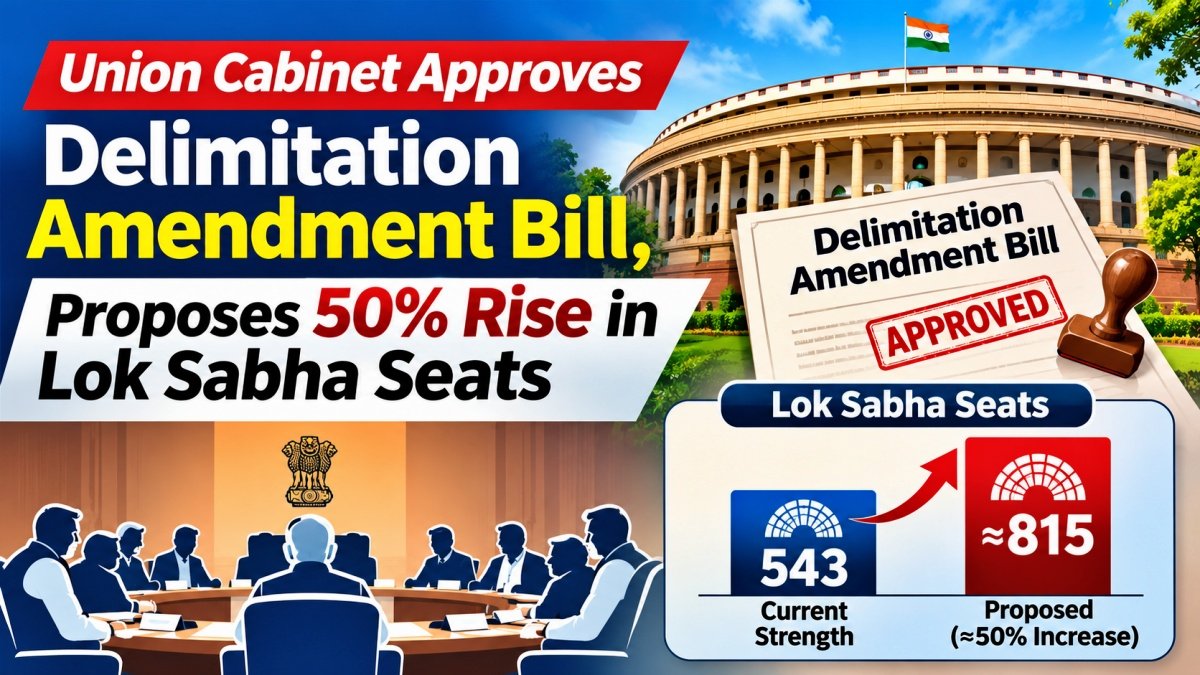
- Cabinet Nod: The Union Cabinet met on Friday afternoon in New Delhi and cleared the amended Constitution Amendment Bill ahead of a special Parliament sitting.
- 50% Seat Expansion: The bill proposes a uniform 50 per cent increase in Lok Sabha seats across every state, paired with the implementation of the 33 per cent quota for women.
- Ratio Frozen Till 2051: To address concerns from southern states over losing political representation, the government has proposed extending the freeze on current state-wise seat proportions for another 25 years, until 2051.
- Special Session Ahead: The legislation will be taken up during a brief, reconvened sitting of Parliament starting with the Lok Sabha on November 30 and the Rajya Sabha on December 2.
The Union Cabinet, chaired by Prime Minister Narendra Modi, on Friday approved major amendments to the Constitution Amendment Bill governing delimitation and women’s reservation. Following intense political speculation throughout the morning, the high-level meeting concluded in New Delhi with the government clearing a revised legislative framework designed to break the deadlock over parliamentary seat redistribution.
Key Provisions of the Approved Bill
According to official sources, the cleared draft directly links the rollout of the 33 per cent reservation for women in the Lok Sabha and state assemblies with the delimitation exercise. To resolve deadlocks that stalled the previous version of the bill, the Cabinet introduced two major structural changes:
- Uniform 50% Seat Increase: The total strength of the Lok Sabha is proposed to rise by an equal 50 per cent across all states, expanding the lower house from its current effective strength of 543 seats.
- Extension of the Representation Freeze: The existing proportion of seats allocated to each state, originally anchored to the 1971 Census, will remain unchanged until 2051.
By scaling up seat counts proportionately rather than redistributing them solely on recent population growth, the Centre aims to neutralize opposition from southern states such as Tamil Nadu, Kerala, and Telangana, which had warned that a population-based redrawing would shrink their political clout in Parliament.
Legislative Background and Special Sitting
The Cabinet’s decision comes months after the government failed to muster the required two-thirds majority to pass its earlier delimitation-linked legislation in April 2026. Rather than waiting for the regular Winter Session, the Centre has opted to reconvene the Monsoon Session, which was adjourned sine die on August 13 without being formally prorogued.
Under the schedule announced by Parliamentary Affairs Minister Kiren Rijiju, the Lok Sabha will reconvene on Monday, November 30, followed by the Rajya Sabha on December 2, with proceedings expected to conclude by December 3. Both the Bharatiya Janata Party (BJP) and its allies have begun issuing three-line whips to ensure full attendance of their MPs.
Political Reactions and Numbers Game
Passing a Constitution Amendment Bill requires a special majority in both Houses, a threshold the ruling National Democratic Alliance (NDA) cannot cross without support from outside parties.
While parties such as the Congress, Samajwadi Party, and Shiv Sena (UBT) have strongly criticized the Centre’s push as politically motivated, the revised formula protecting existing state ratios has opened the door for regional outreach. Ahead of the Cabinet decision, parties including the YSR Congress Party (YSRCP) and NCP (Sharadchandra Pawar) signaled conditional openness to backing the legislation, provided fair regional balance and women’s reservation are guaranteed. Meanwhile, Tamil Nadu Chief Minister and DMK president M.K. Stalin reiterated on Friday that his party would accept no compromise that reduces Tamil Nadu’s current 7.18 per cent share in the Lok Sabha.