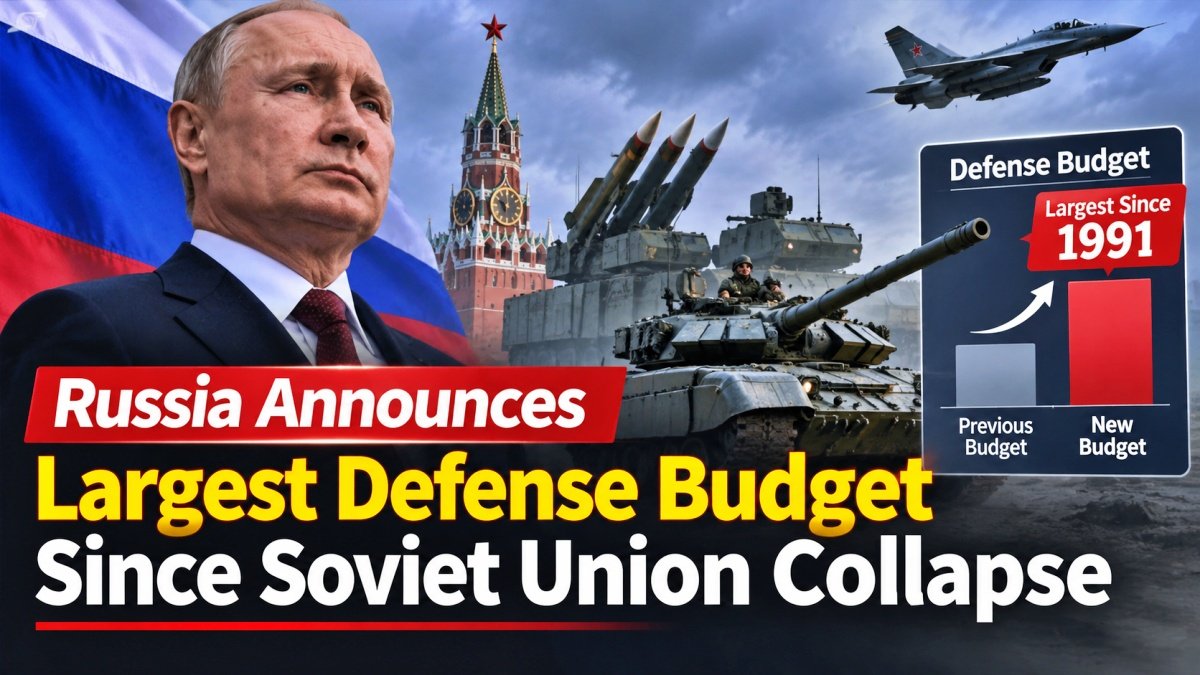
Russia has unveiled its largest defense budget since the fall of the Soviet Union, earmarking approximately ₹54 lakh crore for military spending over the next three years.
Key Points
- Budget Scale: Russia will spend an average of ₹18 lakh crore annually on its military over the next three years.
- India Comparison: The Russian annual military expenditure is 2.3 times higher than India's ₹7.85 lakh crore budget for 2026-27.
- Spending Share: Approximately 35.2% of the Russian government's total spending in 2027 will be dedicated to defense.
- Social Cuts: Funding for health, pensions, and housing will be reduced to accommodate the increased military spending.
- Budget Deficit: The 2027 budget deficit is estimated at ₹6.29 lakh crore, representing about 2.2% of Russia's GDP.
Unprecedented Military Investment
NEW DELHI: Russia has presented a massive defense budget that marks its highest level of military spending since the collapse of the Soviet Union. Under President Vladimir Putin, the government plans to spend roughly 50 lakh crore rubles, which converts to approximately ₹54 lakh crore, on military activities over the next three years. This translates to an average annual expenditure of ₹18 lakh crore.
When compared to neighboring regional powers, the scale of this spending is significant. Russia's annual military outlay is estimated to be 2.3 times greater than India's defense budget of ₹7.85 lakh crore for the 2026-27 fiscal year. This indicates that Russia is committing more than double the amount to its military forces every year compared to India.
Breakdown of Defense Spending
According to official government data, the defense sector will consume a substantial portion of the national budget. In 2027, about 35.2% of all government spending will be directed toward the military and defense. Specifically, the government plans to spend 17.15 lakh crore rubles, or about ₹19.84 lakh crore, on the military in 2027, which is a 33% increase from the 12.93 lakh crore rubles allocated for 2026.
While the budget is set to peak in 2027, slight decreases are projected for the following years. For 2028, the military spending is slated at 16.61 lakh crore rubles (approximately ₹19.21 lakh crore), and for 2029, it is expected to be 16.30 lakh crore rubles (approximately ₹18.85 lakh crore). Despite these minor adjustments, the expenditure remains significantly higher than historical levels.
Impact on Domestic Welfare and Economy
The surge in military funding comes at a cost to the Russian domestic population. Reports indicate that several essential departments will see budget cuts in 2027. The national economy budget is set to decrease by 3%, while housing and utilities, including electricity and water, will face an 8% reduction. Furthermore, health services are expected to see a 3% cut, and pensions along with government aid will be reduced by about 6%.
This shift highlights a prioritization of defense over social welfare. To fund the military, the government is diverting resources from programs that provide facilities and aid to common citizens. This move is also contributing to a growing fiscal imbalance, with the 2027 budget deficit estimated at 5.44 lakh crore rubles, or roughly ₹6.29 lakh crore, which accounts for about 2.2% of the total GDP.
War Costs and Future Outlook
The current spending trajectory is heavily influenced by the ongoing conflict in Ukraine, which began in February 2022. Research by Jenice Klug at Germany's Institute for International and Security Affairs (SWP) suggests that Russia has already spent approximately 58.3 lakh crore rubles, or ₹67.45 lakh crore, on the military since the start of the war. If the current three-year plan is fully executed, total military expenditure from the start of the war until 2029 could reach 108 lakh crore rubles, or about ₹124.45 lakh crore.
It is important to note that actual expenditures may be even higher, as some military-related costs are often hidden within the budgets of other government departments. To bridge the widening funding gap caused by these high costs, the Russian government will likely need to secure additional loans, further impacting the long-term national economy.