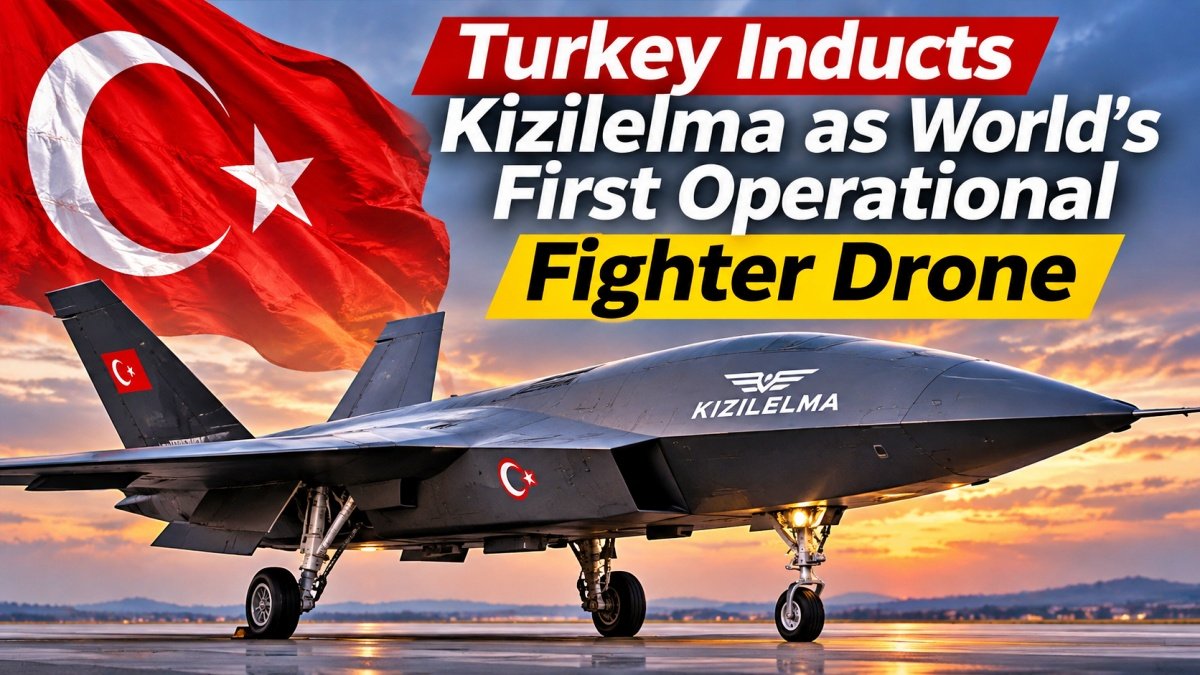
Turkey has officially inducted the first three Bayraktar Kizilelma uncrewed combat aircraft into its security forces, marking a significant milestone in unmanned fighter technology.
Key Points
- Official Induction: Turkey has accepted three Kizilelma aircraft into its military inventory.
- Combat Capability: The drone is specifically designed for air-to-air combat and fighter-type roles.
- Technical Specs: The aircraft features a top speed of Mach 0.9 and a 1,300kg payload capacity.
- Global Competition: The US, China, and India are developing similar loyal wingman and CCA programs.
Turkey Enters New Era of Unmanned Warfare
ANKARA: Turkish drone manufacturer Baykar has announced the induction of the first three Bayraktar Kizilelma uncrewed combat aircraft into the national security forces. This follows the successful completion of acceptance testing, with the firm claiming the move represents the world’s first operational induction of an uncrewed fighter jet. While the definition of ‘operational’ remains a point of discussion, the move signals a major shift in Turkey’s aerial defense strategy.
The Kizilelma program has seen rapid development since its unveiling in 2021. Baykar reported that the aircraft has logged approximately 600 test and training sorties during its development phase. Unlike standard armed drones that primarily focus on surveillance or ground strikes, the Kizilelma is engineered for fighter-type missions, including engaging other aircraft in the air.
Technical Capabilities and Performance
The Kizilelma is designed to complement Turkey’s crewed TF Kaan fighter. It boasts a reported top speed of Mach 0.9, a mission radius of roughly 900 km, and a service ceiling of 40,000 feet. With a payload capacity of about 1,300 kgs, the aircraft is positioned more as a light fighter than a traditional combat drone. A naval variant featuring short decks for ship deployment is also currently under development.
Recent testing has demonstrated the aircraft’s lethality. In November 2025, the Kizilelma utilized an indigenous Gökdoan missile to destroy a jet-powered target, guided by the Murad radar from Aselsan. Furthermore, the aircraft has successfully flown in autonomous formations, including a notable flight alongside Italian M-346 aircraft in May 2026 to test crewed-uncrewed teaming.
Global Defense Landscape and Indian Response
The induction of the Kizilelma places Turkey in a competitive global race for unmanned combat supremacy. The United States is advancing its Collaborative Combat Aircraft (CCA) program, having awarded production contracts in June 2026 to General Atomics and Anduril. Meanwhile, China declared its GJ-11 in service in November 2025, primarily for air-to-ground roles, and Australia is testing the Boeing MQ-28 Ghost Bat.
India is pursuing a similar trajectory through the Hindustan Aeronautics Limited (HAL) led Combat Air Teaming System (CATS). This initiative involves a twin-seat Tejas acting as a mothership for a swarm of unmanned vehicles, including the CATS Warrior. Developed with NewSpace Research and Technologies, the Warrior is a low-observable loyal wingman drone designed to serve as a sensor amplifier and carry next-generation close combat missiles.
Operational Outlook
While the aircraft has been inducted, it is currently unclear to what extent its air-to-air weapons have been fully cleared for independent use. The transition from successful test shots and autonomous flights to full-scale combat deployment will depend on the operational experience gained by the Turkish armed forces. It remains to be seen whether the Kizilelma will function primarily as an independent fighter or as a loyal wingman for the TF Kaan.
The move also highlights growing defense industrial alignments, as Turkey continues to expand its drone exports and technology sharing. As the Kizilelma enters active service, it will provide critical data to determine its role in future high-intensity aerial conflicts.