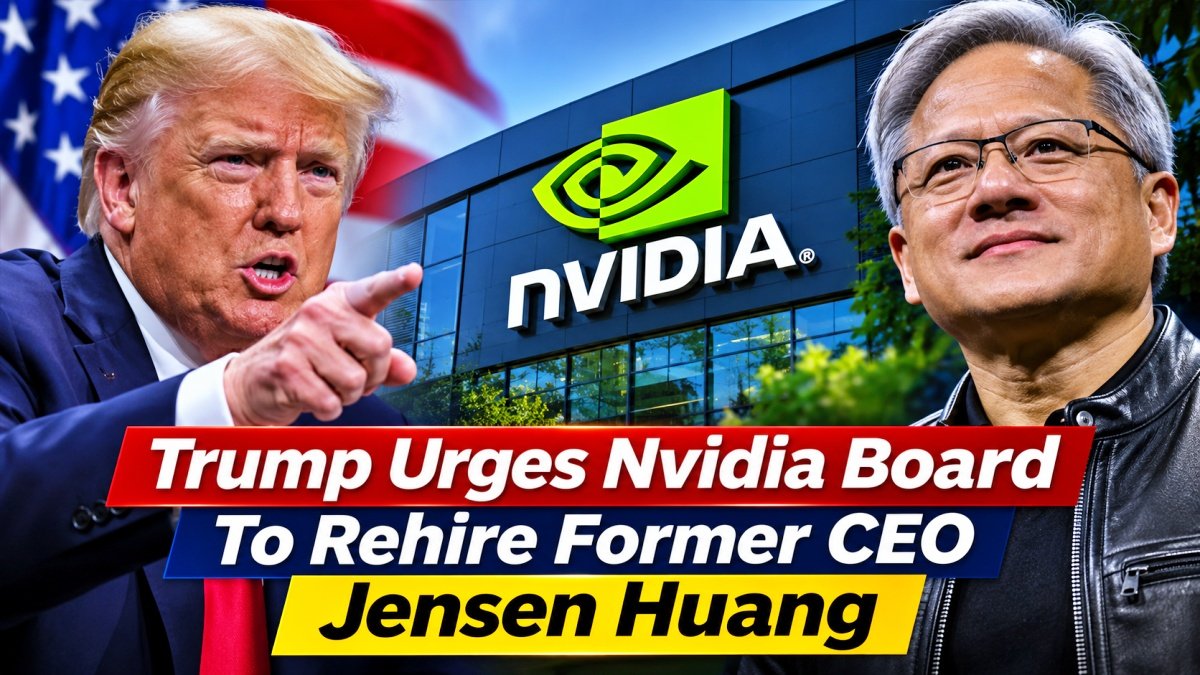
US President Donald Trump has publicly called on Nvidia to reappoint Jensen Huang as CEO following his resignation linked to a Chinese espionage scandal.
Key Points
- Trump Support: Trump urged the board to keep Huang for the benefit of the company and the US.: Trump stated on Truth Social that Huang’s leadership is best for America.
- Resignation Context: Huang resigned on November 12 following reports of an affair with a Chinese businesswoman.: The resignation followed an admitted affair with Alice Huang.
- Espionage Allegations: Reports suggest Alice Huang had contact with China’s Ministry of State Security.: Intelligence reports indicate potential attempts to obtain Nvidia’s AI chips.
- Board Rejection: Nvidia’s board has currently refused to reinstate Huang as CEO.: Chairman Harvey Jones confirmed the board has no plans to bring him back.
- Upcoming Inquiry: Huang is scheduled to appear before US Parliament committees on December 1.: He will face closed-door questioning regarding national security and chip exports.
Trump Calls For Leadership Return
WASHINGTON: US President Donald Trump has expressed his support for the reinstatement of Jensen Huang as the chief executive of Nvidia, the world’s leading semiconductor manufacturer. In a post on the social media platform Truth Social, Trump urged the company’s board of directors to reconsider Huang’s position, stating that his return would be beneficial for both the corporation and the United States.
The call comes as the tech industry grapples with the fallout of Huang’s sudden departure. Despite the political backing, the Nvidia board has remained firm in its decision. Chairman Harvey Jones recently clarified that the board has accepted Huang’s resignation and currently has no intentions to reinstate him, with CFO Colette Criss serving as the interim CEO.
Resignation and Espionage Scandal
Jensen Huang resigned from his post on November 12, a move triggered by reports of a personal affair with Alice Huang, a Chinese businesswoman. Huang publicly admitted to the relationship and issued an apology to his family. However, the situation escalated into a national security concern following reports from the New York Times.
According to the newspaper, which cited sources with knowledge of US intelligence, Alice Huang had been in contact with an officer from China’s Ministry of State Security for approximately one year. The report further alleged that her business partner, Kang Wei, was also linked to the same Chinese agency. While officials suspect China was attempting to acquire Nvidia’s advanced AI chips and proprietary information through these contacts, it has not been officially proven that Alice Huang acted as a spy.
Ongoing Investigations and Legal Scrutiny
The matter is currently under intense scrutiny by US authorities. National Intelligence Director J. Clayton confirmed that an investigation into Alice Huang and her company, Megaspeed, is currently underway. He noted that the American public would receive further clarity as the probe progresses.
Huang is scheduled to provide testimony in a closed-door session before three committees of the US Parliament on December 1. During these proceedings, he is expected to be questioned extensively on the movement of Nvidia’s advanced AI technology to China and broader implications for national security.
Internal Pressure and Market Reaction
Despite the board’s refusal, Huang has expressed a public desire to return to his role. On November 17, he stated on X that he was willing to resume as CEO if the board deemed it in the best interest of the company and the country. He noted that numerous employees, investors, and business partners had urged him to stay.
The situation has created significant ripples in the tech sector. While some reports indicate a softening of tone from the US Treasury Secretary, market analysts continue to monitor the leadership vacuum at Nvidia. Investors remain focused on how the company will navigate the ongoing espionage investigation while maintaining its dominance in the AI chip market.