






























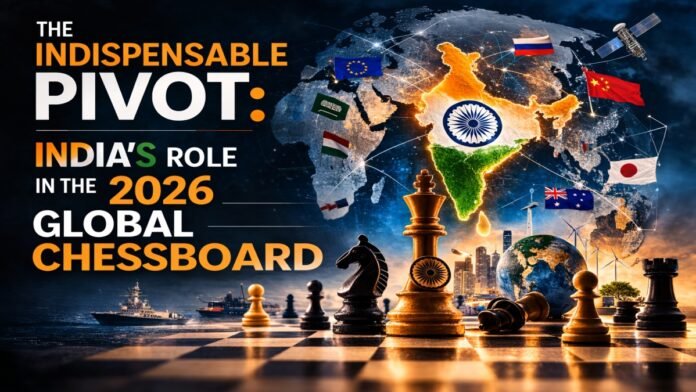
In the shifting sands of 2026, the term “middle power” feels increasingly inadequate to describe India. As the world grapples with what analysts call “fluid multipolarity,” a dizzying mix of trade wars, technological iron curtains, and traditional border tensions—India has emerged as the essential bridge. Whether it is hosting the ‘AI Impact Summit’ or presiding over BRICS, New Delhi is no longer just a participant in the global order; it is one of its primary architects.
The Past: The Legacy of Moral High Ground
To understand India’s current “principled pragmatism,” one must look back at the 1950s. Under Jawaharlal Nehru, India pioneered the Non-Aligned Movement (NAM). In a world bifurcated by the Cold War, India’s policy was one of survival and moral assertion. It sought to lead the newly decolonized nations by refusing to be a pawn for either the US or the USSR.
While critics often labeled this “idealistic,” it was deeply rooted in the desire for Strategic Autonomy. However, the 1962 conflict with China and the subsequent security pressures of the 1970s forced a shift toward “pragmatic non-alignment,” characterized by a closer strategic embrace of the Soviet Union. This era established the DNA of Indian diplomacy: a fierce protection of sovereign decision-making and a refusal to join formal military alliances. This trait remains the bedrock of Indian policy today.
The Transition: From Non-Alignment to Multi-Alignment
The collapse of the Soviet Union and the 1991 economic reforms marked a “tectonic shift.” India moved from being a reactive power to a proactive one. The “Look East” policy (later “Act East”) and a slow thaw in relations with Washington set the stage for the 21st century.
By the early 2020s, the doctrine evolved into Multi-alignment. Unlike the old non-alignment, which often meant keeping a distance, multi-alignment is about engaging everyone simultaneously. In 2026, this is visible in India’s ability to be a cornerstone of the Quad (with the US, Japan, and Australia) to ensure a “Free and Open Indo-Pacific,” while simultaneously playing a leading role in BRICS+ to challenge the dominance of Western financial systems.
The Present: Strategic Autonomy in a Transactional World
In 2026, the global order is increasingly transactional. Renewed protectionism in the West and the specter of a “G2” (a US-China duopoly) have made India’s role as a stabilizer more critical.
- Energy and Ethics: India’s refusal to abandon its energy ties with Russia, despite intense Western pressure, is the ultimate contemporary example of strategic autonomy. By prioritizing domestic inflation control and energy security, New Delhi signaled that its foreign policy is dictated by the needs of its 1.4 billion citizens, not by external moral mandates.
- The Indo-Pacific Sentinel: China’s “calibrated pressure” along the Line of Actual Control (LAC) and its naval expansion in the Indian Ocean have turned India into the primary regional balancer. India is no longer just “defending” its borders; it is building a security net through “minilaterals,” such as the I2U2 (India, Israel, UAE, US) and deepened defense ties with France and Canada.
- Economic Diplomacy: The recent conclusion of the Comprehensive Economic Partnership Agreement (CEPA) with Canada and the ongoing finalization of the India-EU FTA show a nation diversifying its trade to hedge against global volatility.
The Voice of the Global South
Perhaps India’s most significant role in 2026 is its self-appointed position as the “Voice of the Global South.” While the West focuses on systemic rivalry with China, much of the world is more concerned with debt distress, food security, and climate finance.
India has bridged this gap by exporting its Digital Public Infrastructure (DPI). By sharing the “India Stack” (UPI, Aadhaar, and digital health tools) with over 100 nations, India offers a democratic, transparent alternative to China’s debt-heavy infrastructure projects. This “Tech-Diplomacy” has created a reservoir of soft power that few other nations can match. Furthermore, India’s leadership in the International Solar Alliance and its advocacy for “Climate Justice” at global summits ensure that Great Power politics do not sideline the concerns of the developing world.
Challenges and the Road Ahead
The path is not without its thorns. In 2026, India faces the “middle-income trap” at home and a “hostile neighborhood” abroad. The instability in Bangladesh and the perennial friction with Pakistan require constant diplomatic firefighting. Moreover, as US tariffs tighten and China controls the chokepoints of critical minerals, India’s “balancing act” is under more strain than ever.
The biggest test for New Delhi will be maintaining its autonomy without slipping into isolation. As the lines between domestic politics, economy, and foreign policy blur, India’s ability to act as a “Stabilizing Bridge” will determine whether the 21st century is defined by a new Cold War or a more equitable multipolar order.
India in 2026 is a nation that is “non-Western but not anti-Western.” It is a country that can discuss semiconductors in Washington, energy in Moscow, and digital inclusion in Nairobi, all in the same week. By blending the strategic patience of its past with the assertive pragmatism of its present, India has made itself indispensable. In the current geopolitical situation, the world doesn’t just watch India; it relies on India to keep the conversation going when everyone else has stopped talking.