
























Key Highlights of the Supreme Court’s Query
- Status Report Mandated: The Centre must now clarify what steps have been taken since the August 2024 Constitutional Bench ruling.
- Petitioner Demands: Samata Andolan Samiti and OP Shukla have sought a definitive timeline for excluding the affluent “creamy layer” from quota benefits.
- Judicial Observation: The court noted that identifying the creamy layer is a “sensitive issue” that requires a clear stand from the Union.
- Focus on Sub-Classification: States like Telangana have already begun implementing sub-categorization, adding pressure on the Central Government to define its policy.
- Political Deadlock: The move reopens a fierce debate that the Modi government had largely deferred in late 2024 due to widespread protests.
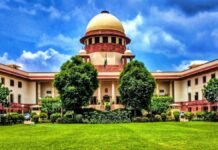
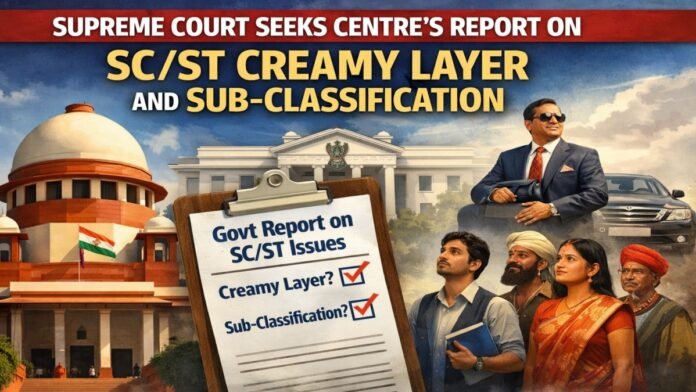
On Tuesday, February 10, 2026, a three-judge bench of the Supreme Court, led by Chief Justice Surya Kant and including Justices Joymalya Bagchi and NV Anjaria, asked the Narendra Modi government to explain its inaction regarding the 2024 Constitutional Bench verdict. The court has requested an “Action Taken Report” (ATR) to understand how the government intends to handle the complex issues of sub-classification and the “creamy layer” within Scheduled Caste (SC) and Scheduled Tribe (ST) communities.
The hearing was prompted by petitions from the Samata Andolan Samiti and OP Shukla, who argue that the benefits of reservation are currently being monopolized by a “prosperous elite” within these groups. They have asked the court to direct the Centre to collect empirical data on the representation of various sub,groups and to establish objective criteria for the exclusion of the creamy layer.
Background: The 2024 Landmark Ruling
This legal development is rooted in the August 1, 2024, decision where a seven-judge bench, headed by then CJI DY Chandrachud, ruled 6:1 that states have the constitutional power to sub-classify SCs and STs. Justice BR Gavai, in his concurring opinion, had explicitly stated that the “creamy layer” principle, which currently applies only to Other Backward Classes (OBCs), should be extended to SCs and STs to ensure that the most marginalized individuals receive the intended benefits.
The Political and Social Tug-of-War
The government finds itself in a difficult political position. In 2024, following the Supreme Court’s verdict, massive protests erupted across India. Dalit and tribal organizations, supported by parties like the BSP and LJP, argued that the creamy layer concept would weaken the community’s collective bargaining power. In response, the Union Cabinet, led by Prime Minister Modi, had clarified that the “creamy layer” was not part of B.R. Ambedkar’s vision for SC/ST quotas and that the government had no immediate plans to implement it.
However, the legal landscape has shifted significantly in 2025 and early 2026:
- State Initiatives: Telangana became the first state to implement SC sub-categorization in April 2025, creating a “reservation within reservation” model.
- UGC Controversy: In January 2026, the University Grants Commission (UGC) notified new Equity Regulations to tackle campus discrimination. However, the Supreme Court stayed these rules on January 29, 2026, after general category students and some reserved subgroups argued that the rules lacked protections against false complaints and failed to address discrimination within reserved categories.
The Road Ahead: Faith vs. Policy
The Supreme Court’s latest demand for a report forces the government to move beyond verbal assurances and present a formal policy framework. While the government remains wary of alienating its Dalit and tribal vote banks ahead of upcoming state elections, the court’s focus on “empirical evidence” and “equitable distribution” makes it increasingly difficult to maintain the status quo.
Experts suggest that the government might propose a liberal income threshold or exclude certain categories like Class 3 and Class 4 employees from the creamy layer, but any move toward formalizing the classification is likely to trigger renewed political friction.