

































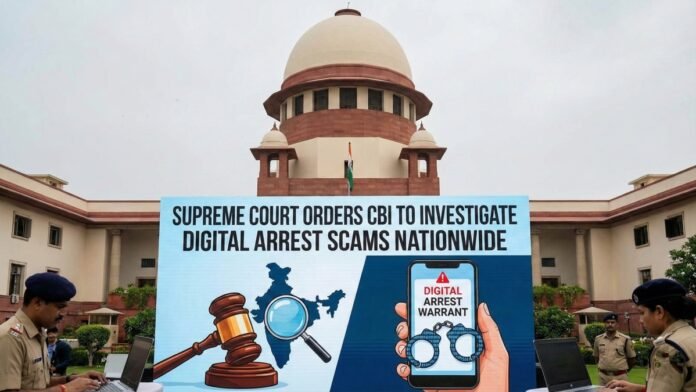
CRITICAL KEY POINTS AT A GLANCE
- Supreme Court of India directed CBI to prioritize investigation of digital arrest scams above all other cybercrime categories
- Approximately ₹3,000 crore siphoned through digital arrest and related cyber frauds across the country
- Supreme Court took suo motu (self,initiated) cognizance based on complaint from elderly couple who lost ₹1.5 crore
- Fraudsters impersonate police, CBI officers, ED officials, and judges through video and phone calls
- CBI granted full independence to investigate banking officials under Prevention of Corruption Act where fraudulent accounts were used
- Supreme Court directed all states to immediately grant CBI permission to investigate digital arrest cases regardless of ruling political party
- Meta, Google and other social media platforms ordered to provide all data, information, and technical support to CBI immediately
- CBI authorized to seek Interpol assistance for cases involving international dimensions or money transfers abroad
- Reserve Bank of India asked to explore AI and machine learning systems to detect and automatically freeze suspicious accounts
- Victims primarily include senior citizens threatened with forged Supreme Court and High Court orders
- Two FIRs registered in Haryana revealing organized pattern of offences
- Scammers use WhatsApp, video calls, and messaging platforms to contact and intimidate victims
- Fraudsters demand immediate transfers under threat of property seizure and arrest
The Supreme Court of India on December 1, 2025, issued historic and wide,ranging directives addressing an alarming epidemic of digital arrest scams devastating citizens across the nation. The bench comprising Chief Justice of India Surya Kant and Justice Joymalya Bagchi determined that digital arrest fraud “requires immediate attention of the premier investigating agency of the country” and accordingly directed the CBI to prioritize these cases above all other cybercrime categories.
The Supreme Court’s decisive action represents the first comprehensive judicial response to an organized network of cybercriminals who have systematically defrauded Indians of nearly ₹3,000 crore through elaborately coordinated scams. The suo motu (self,initiated) case was triggered when an elderly couple from Haryana wrote to the Supreme Court, revealing that they had been defrauded of ₹1.5 crore between September 1 and 16, 2025, by scammers impersonating CBI officers, Intelligence Bureau officials, and judicial authorities.
Understanding Digital Arrest, The Terrifying Nature of Modern Cybercrime
Digital arrest represents an emerging and particularly insidious form of cybercrime wherein fraudsters impersonate legitimate law enforcement authorities, judicial officials, and government agency representatives to intimidate and coerce victims into transferring money. The scam operates through carefully orchestrated audio and video calls that create an atmosphere of immense psychological pressure and fear among victims.
During the digital arrest scam, fraudsters falsely accuse victims of involvement in illegal activities such as money laundering, tax evasion, or national security violations. They keep victims in a state of virtual hostage, maintaining continuous contact through multiple communication channels while presenting forged legal documents, Supreme Court orders, and official governmental correspondence to establish false credibility.
The scammers create fictional scenarios of severe legal consequences including arrest, property seizure, and imprisonment unless immediate monetary payments are made into specified bank accounts. By maintaining constant contact through video calls, the fraudsters prevent victims from independently verifying the legitimacy of claims or seeking help from genuine authorities.
The Trigger Case, Senior Citizens Lose ₹1.5 Crore in Organized Scam
The Supreme Court’s decisive action was catalyzed by a particularly distressing case involving an elderly couple who fell victim to a highly coordinated digital arrest scam during September 2025. The victims were contacted multiple times through WhatsApp and video calls by individuals claiming to be officers from the CBI, Enforcement Directorate, and the judiciary.
The fraudsters displayed forged orders allegedly originating from the Supreme Court and Bombay High Court, creating an impression of legitimate judicial proceedings against the victims. Under threat of arrest and property seizure, the couple was coerced into transferring a total of ₹1.5 crore through multiple banking transactions to accounts controlled by the scammers.
Two separate First Information Reports (FIRs) were subsequently registered with cybercrime branches in Ambala and Haryana, revealing an extensively organized pattern of such offences targeting vulnerable senior citizens. The investigation revealed that the scammers employed sophisticated psychological tactics, technical capabilities, and coordinated networks to perpetrate these frauds at scale across multiple states.
Supreme Court Orders CBI to Lead Nationwide Investigation with Complete Independence
Recognizing the severe magnitude and organized nature of digital arrest scams, the Supreme Court directed the Central Bureau of Investigation to immediately commence a comprehensive, unified, pan,India investigation into all such cases across the country. The Court clarified that the CBI shall prioritize digital arrest scam investigations above all other categories of cybercrime, which will be addressed only in subsequent phases.
Chief Justice Surya Kant emphasized the necessity of centralized investigation through a single premier agency, recognizing that the fraud network spans multiple states and operates with sophisticated coordination mechanisms. The Supreme Court granted the CBI complete and unprecedented independence to investigate these cases, clarifying that the agency can initiate investigations and freeze accounts used for cybercrime even in the absence of formal First Information Reports.
Additionally, the Supreme Court directed all state governments, irrespective of the political party in power, to immediately grant the CBI permission to investigate digital arrest cases within their respective jurisdictions. This directive ensures that factional political considerations cannot hinder national security investigations into organized cybercrime.
Banking Sector Scrutiny, CBI Authorized to Investigate Corrupt Officials
Recognizing that digital arrest scams could not operate at scale without complicity or negligence from elements within the banking sector, the Supreme Court granted the CBI complete independence to investigate the role of bankers and banking officials. The Court authorized the CBI to investigate bankers under the Prevention of Corruption Act 1988 in cases where bank accounts were improperly opened and subsequently misused to facilitate digital arrest scams.
This directive addresses a critical vulnerability in the financial system whereby fraudsters systematically abuse banking services to receive and launder victim funds. The CBI’s investigative authority extends to examining whether banking officials demonstrated gross negligence, accepted bribes to overlook suspicious account activities, or actively participated in facilitating fraudulent transactions.
The Supreme Court recognized that fraudsters typically operate sophisticated networks of bank accounts, often using legitimate,appearing business entities as fronts to mask illicit money transfers. Investigation into banking sector complicity becomes essential to dismantle these entire networks rather than merely apprehending street,level scammers.
Reserve Bank of India Tasked with AI,Powered Fraud Detection Mechanisms
Beyond directing CBI investigations, the Supreme Court requested the Reserve Bank of India (RBI) to explore deployment of artificial intelligence and machine learning systems to automatically detect and freeze suspicious accounts linked to cybercrime. This proactive technological approach would enable the banking system to identify patterns of fraudulent activity in real,time rather than relying exclusively on reactive investigation after victims report losses.
The Court asked the RBI to assist by exploring whether AI systems could be trained to identify characteristics typical of digital arrest scam accounts, such as rapid fund transfers, multiple withdrawals through ATMs, and suspicious cross,bank transactions. Implementation of such systems would provide an additional protective layer beyond traditional banking compliance mechanisms, potentially preventing crores of rupees in losses before fraudsters can access victim funds.
Social Media and Technology Platforms Ordered to Extend Full Cooperation
Recognizing that digital arrest scams operate primarily through social media platforms, messaging applications, and video call services, the Supreme Court issued explicit directives to technology companies including Meta (Facebook, WhatsApp, Instagram), Google (Gmail, YouTube), and other digital intermediaries. These companies were ordered to immediately provide the CBI with all necessary data, information, metadata, and technical support to facilitate fraud investigation.
The directives include requirements that social media platforms share user identification information, communication records, device information, location data, payment transaction details, and communication content to enable law enforcement to identify and apprehend scammers. Technology platforms were specifically instructed that cooperation with CBI investigations is non,negotiable and represents a fundamental legal obligation.
The Supreme Court acknowledged that scammers deliberately exploit the anonymity provided by digital platforms to impersonate legitimate authorities and spread fear among victims. This understanding led the Court to conclude that cooperation from digital intermediaries is absolutely essential to dismantle organized cybercriminal networks operating through these channels.
Interpol Assistance for Cross,Border and International Dimensions
The Supreme Court further directed that if CBI investigations reveal that digital arrest scam networks operate from locations outside Indian territory or that proceeds are being transferred to foreign countries, the CBI is authorized to seek assistance from Interpol (International Criminal Police Organization). This recognition of potential international dimensions reflects the reality that sophisticated cybercriminal networks often operate across multiple countries with funds flowing through offshore accounts.
Coordination between Indian law enforcement agencies and Interpol member countries would enable multinational action to dismantle international networks, freeze foreign accounts containing proceeds from Indian citizens, and extradite criminals involved in these frauds. Several investigations have already revealed that digital arrest scams involve sophisticated coordination with call centers operating in multiple countries, including reports of operations from South and Southeast Asian locations.
Psychological Predation on Senior Citizens, The Vulnerable Victims
Digital arrest scams disproportionately target senior citizens and financially vulnerable populations who are less familiar with digital fraud techniques and more likely to panic when confronted with threats of legal consequences. Elderly victims often lack confidence in distinguishing genuine government communications from fraudulent impersonations, making them particularly susceptible to scammers presenting forged judicial documents.
The psychological predation tactics employed by scammers exploit legitimate societal respect for law enforcement, judiciary, and government institutions, weaponizing this trust to coerce financial transfers. Scammers maintain victims in continuous psychological distress through repeated calls, video conference threats, and fabricated legal proceedings, often preventing victims from seeking assistance or verifying claims through independent channels.
Mechanics of the Scam, How Fraudsters Operate the Network
Digital arrest scammers typically operate in highly organized, coordinated networks with specialized roles including call center operators, individuals presenting as officials, document forgers, money laundering specialists, and account handlers. Victims are usually contacted initially through messaging applications like WhatsApp, with scammers claiming to represent legitimate government agencies.
Upon initial contact, scammers guide victims to join video calls where individuals dressed as police or judicial officers present forged documents and fabricate legal proceedings against the victim. The psychological pressure escalates through repeated calls, threats of arrest, and demands for immediate monetary transfers to preserve assets and secure bail.
Victims are instructed to transfer funds to specified bank accounts, often through multiple smaller transactions to evade banking compliance systems. Fraudsters maintain contact throughout the process, preventing victims from disconnecting and seeking independent verification of claims.
Nationwide Impact and Criminal Reach
Since the Supreme Court took suo motu cognizance in October 2025, media reports have documented similar digital arrest scams across multiple states including Delhi, Haryana, Punjab, Karnataka, and Maharashtra. The coordinated nature of these incidents suggests a centralized criminal network operating across state boundaries with sophisticated operational protocols.
The total estimated loss of ₹3,000 crore represents one of the most significant organized cybercrime losses in recent Indian history, underscoring the scale and sophistication of these criminal networks.
Path Forward, Comprehensive National Response
The Supreme Court’s comprehensive directives represent the beginning of what promises to be an intensive national investigation into digital arrest scam networks. CBI investigation teams are expected to coordinate across all states, access banking data, cooperate with social media platforms, and potentially seek Interpol assistance for international dimensions.
The involvement of multiple agencies, technology platforms, financial institutions, and international law enforcement represents an unprecedented comprehensive response to organized cybercrime in India. Citizens who have fallen victim to digital arrest scams are encouraged to immediately file complaints with local cybercrime police units while preserving all communication records, fraudulent documents, and transaction evidence for CBI investigation.