

































Key Points:
- Williams retired December 27, 2025, concluding a 27-year NASA career
- Set NASA record with 608 total days in space, ranking second among all agency astronauts
- Completed nine spacewalks lasting 62 hours, 6 minutes, the longest duration by any female astronaut
- Commanded the International Space Station during her 2012 mission
- Final mission launched June 2024 aboard Boeing Starliner, returning safely March 2025
- Honored with wax statue installation at West Bengal museum
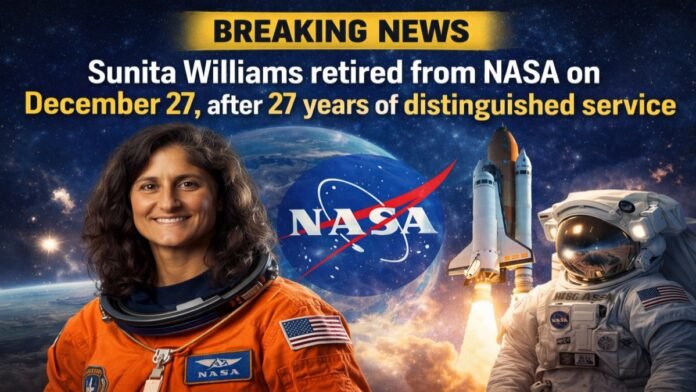
Sunita Williams, one of NASA’s most accomplished astronauts and a pioneer in human spaceflight, officially retired from the agency on December 27, 2025, closing an extraordinary 27-year career that established her as a record-holder and inspiration for future space explorers.
The retirement announcement marks the end of an era for NASA’s astronaut corps. Williams, 59, accumulated 608 days in orbit across three missions, making her the second most experienced NASA astronaut in terms of time spent in space. Agency officials described her contributions as foundational for upcoming lunar and Mars missions.
Historic Spaceflight Achievements
Williams’ journey began in December 2006 when she first launched aboard Space Shuttle Discovery for a 195-day expedition to the International Space Station. Her second mission in 2012 proved landmark, she launched from Kazakhstan’s Baikonur Cosmodrome and became commander of the space station, only the second woman to hold that prestigious position during a 127-day mission.
Her final spaceflight, launched in June 2024 aboard Boeing’s Starliner spacecraft, tested next-generation commercial crew vehicles. Technical challenges extended the mission until March 2025, adding 286 days to her cumulative record. NASA praised her leadership during the unplanned extension, noting her expertise proved invaluable for spacecraft testing protocols.
Spacewalk Record
Williams distinguished herself through extraordinary extravehicular activity, conducting nine spacewalks that totaled 62 hours and 6 minutes. This achievement represents the longest spacewalk time by any female astronaut globally and ranks fourth among all astronauts regardless of gender. Her EVA expertise contributed to critical station maintenance, scientific instrument installation, and spacesuit technology development.
Leadership and Global Impact
The Johnson Space Center director stated that Williams’ career will inspire generations of astronauts and engineers. Williams herself described space as her favorite place and NASA as a source of immense respect throughout her life.
Her influence extended beyond American spaceflight. In a unique international tribute, West Bengal’s prestigious wax museum installed a life-size statue of Williams, taking artists approximately two months to complete the detailed sculpture. The installation recognizes her Indian heritage and her status as an inspiration to millions in India and the Indian diaspora.
Personal Reflections and Future Legacy
Upon returning to Earth in March 2025, Williams shared her first social media post, calling her return the best homecoming ever. She particularly highlighted seeing India from space as a profoundly special experience that connected her to her ancestral homeland.
NASA administrator Bill Nelson described Williams’ service as a remarkable example of courage and leadership. He emphasized that her work directly paves the way for the Artemis lunar program and eventual human missions to Mars. Her expertise in long-duration spaceflight and spacewalk operations provides critical data for planning these ambitious deep space expeditions.
The retirement of Sunita Williams marks the end of a historic era in human spaceflight, but her influence will persist through the astronauts she mentored, the records she established, and the pathways she created for future explorers venturing beyond low Earth orbit.