





























Key Points
- LUMS becomes first Pakistani university to offer regular Sanskrit course since independence
- Three-month intensive workshop on Sanskrit grammar and ancient literature preceded the launch
- University plans to expand into full diploma program by 2027
- Special research programs on Ramayana, Gita, and Mahabharata to begin soon
- Ancient Sanskrit manuscripts from 1930 will be studied and preserved
- Initiative aims to strengthen understanding of shared South Asian cultural heritage
For the first time since independence, a higher education institution in Lahore has taken such a significant step regarding Sanskrit studies, signalling a potential cultural renaissance in the region.
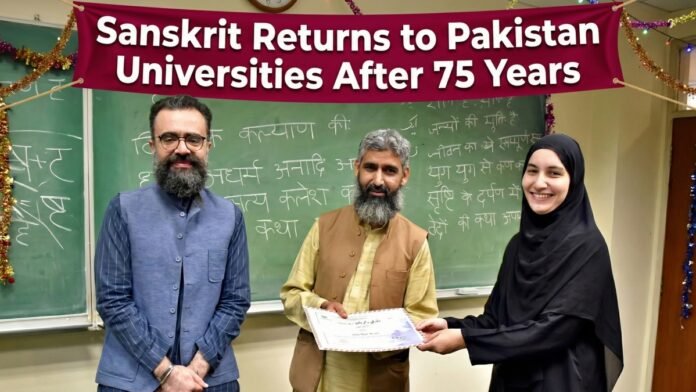
Lahore University of Management Sciences, after conducting an intensive workshop on Sanskrit, has now included it as a regular course in its academic curriculum. This initiative is considered a historic shift in the field of linguistic and cultural studies in Pakistan, opening new avenues for scholarly exploration of ancient texts.
Historic Sanskrit Studies in Lahore After 75 Years
A special workshop on Sanskrit was held at LUMS for the past three months, attracting participants from diverse backgrounds. The program included not only rigorous training in Sanskrit grammar but also extensive discussions on the Puranas and ancient Indian literature, providing participants with comprehensive exposure to classical Indian thought.
A large number of students and various professionals participated in this pioneering program. This workshop marked the first time since Pakistan’s independence from British rule that Sanskrit studies were organised on such a large scale, representing a watershed moment in the country’s academic history.
Launch of Regular University Course
Following the overwhelming success of the Sanskrit workshop, LUMS has launched a four-credit regular university course. This is a full-fledged academic course with limited seats currently available, ensuring quality instruction and personalised attention for early participants.
The university administration plans to increase the number of seats and expand it into a comprehensive Sanskrit diploma program by 2027. This step will not only promote linguistic diversity but also allow students to understand ancient texts and philosophical traditions in their original language, fostering deeper cultural appreciation.
Research Initiatives on Ramayana and Gita
Dr. Ali Usman Qasmi, Director of the Gurmani Centre at LUMS, announced that the university will soon launch special courses and research programs on the Ramayana, Gita, and Mahabharata. He believes that in the next 10 to 15 years, Pakistan will produce scholars who will conduct in-depth research on Sanskrit and Indian scriptures.
This step is considered crucial in understanding the shared cultural heritage of South Asia and gaining direct access to original texts rather than relying on translations. The initiative could potentially create a new generation of Pakistani scholars specialising in classical Indian studies, contributing to regional academic discourse.
Significance of Sanskrit and Vedic Studies
According to Dr. Qasmi, many historians believe that the Vedas were composed in this region of the Indian subcontinent. Therefore, the study of Sanskrit and the Vedas is extremely important for the history and linguistic studies of Pakistan, providing essential context for understanding the region’s ancient past.
He explains that LUMS already teaches Punjabi, Pashto, Sindhi, Balochi, Arabic, and Persian. However, many Sanskrit words are present in all these languages, creating linguistic connections that span centuries. Therefore, learning Sanskrit will strengthen the entire linguistic ecosystem and provide deeper insights into the evolution of South Asian languages.
Ancient Manuscripts Collection
According to available information, LUMS also possesses several ancient Sanskrit manuscripts. These were collected on palm leaves by the scholar JCR Woolner in 1930, representing a valuable historical archive that has remained largely untouched for decades.
However, no research has been conducted on them since 1947, leaving this treasure trove of ancient knowledge unexplored. Now, the university may begin working on the study and preservation of these manuscripts, potentially uncovering new insights into ancient South Asian scholarship and cultural practices.
Implications for Regional Cultural Dialogue
This development regarding Sanskrit and ancient Indian texts in Pakistan could open new avenues at the cultural and academic levels. It also has the potential to increase dialogue between the two countries on their shared heritage, creating opportunities for people-to-people understanding beyond political differences.
Despite the political challenges that have historically constrained academic exchanges, experts believe that a positive change is visible in the intellectual environment. Dr. Qasmi emphasises that if we want to increase mutual understanding in society, it is essential to understand and connect with our ancient classical heritage, which predates modern political boundaries.
Future Prospects and Expansion Plans
The success of the initial course will determine the pace of expansion, but LUMS administration remains committed to developing a comprehensive Sanskrit studies program. Plans include hiring specialised faculty, establishing a dedicated research centre, and creating exchange programs with Indian and international institutions specialising in Sanskrit and classical studies.
University officials are also exploring collaborations with global Sanskrit institutions to ensure academic rigour and access to the latest research methodologies. This international approach could position LUMS as a regional hub for classical studies, attracting scholars from across South Asia and beyond.
Student Response and Academic Interest
Initial student response has been overwhelmingly positive, with the limited seats filling quickly after the announcement. Participants from the workshop have reported transformative experiences, noting how Sanskrit studies have provided new perspectives on their own linguistic and cultural backgrounds.
Many students have expressed interest in continuing to advanced levels, citing personal and academic motivations for studying the ancient language. This grassroots academic interest suggests a growing appetite among Pakistani youth for exploring pre-partition cultural heritage and understanding the deeper connections that bind South Asian societies.