

































Key Points
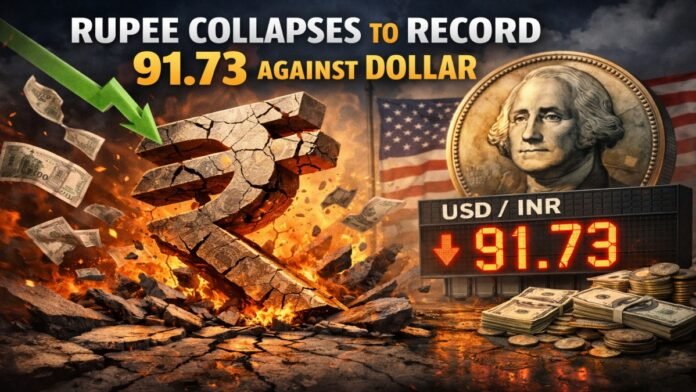
- Rupee hits all-time low of 91.73, down 76 paise in single trading session
- Foreign investors sold ₹29,315 crore of Indian equities in first 20 days of January 2026
- Trump’s tariff policies and Greenland dispute trigger global flight to dollar safety
- US economic strength and high interest rates attract capital away from emerging markets
- RBI actively intervening to prevent sharp depreciation, support seen at 90.30-90.50
- Currency crossed 90 mark for first time in December 2025, now nears 92 in just 21 days
The Indian rupee’s freefall accelerated on Wednesday as persistent capital outflows and global uncertainty pushed the currency past another psychological barrier. Closing at 91.73 per dollar, the rupee’s 76-paise decline represents the largest single-day drop since it first breached the 90-mark in December 2025. Currency dealers reported heavy dollar demand throughout the session as foreign investors continued their unprecedented selling spree.
Foreign portfolio investors have emerged as the primary catalyst for the rupee’s deterioration. Data shows FPIs have withdrawn a staggering ₹29,315 crore from Indian equity markets in just the first 20 days of 2026, creating enormous demand for dollars as they repatriate funds. When foreign investors exit Indian assets, they exchange rupees for dollars, directly pressuring the local currency. Market veterans note that the pace of outflows has intensified since mid-January, coinciding with Trump’s administration signaling aggressive trade policies.
US President Donald Trump’s renewed tariff threats against European nations and his controversial stance on Greenland have injected fresh volatility into global markets. His administration’s protectionist rhetoric has triggered a classic risk-off sentiment, prompting investors to abandon emerging market assets in favor of safe-haven investments like the US dollar and gold. The uncertainty has been particularly damaging for currencies like the rupee, which thrive on stable global trade conditions.
Compounding the pressure, the US economy continues to demonstrate remarkable resilience. America’s declining unemployment rate and robust economic indicators have convinced global investors that the Federal Reserve will maintain elevated interest rates for longer than previously anticipated. This prospect of higher returns on US assets has triggered a global capital rotation, with funds flowing into American banks and treasury bonds, further strengthening the dollar’s position against virtually all emerging market currencies.
Amit Pabari, Managing Director of CR Forex Advisors, identified critical technical levels for the rupee’s trajectory. “If the rupee decisively crosses the 91.07 level, it could soon reach 92.00,” Pabari warned, noting that psychological barriers tend to accelerate once broken. He pointed out that the currency has already weakened by over 1.5% in just three weeks, a pace that typically prompts central bank intervention.
The Reserve Bank of India has indeed been actively managing the rupee’s decline, periodically selling dollars from its foreign exchange reserves to smooth volatility. Currency traders observed RBI intervention during Wednesday’s session, though the scale proved insufficient to prevent the record close. The central bank appears to be defending the 90.30 to 90.50 range as critical support, but the intensity of outflows has overwhelmed these efforts.
Market participants now await the RBI’s next move, with speculation mounting about whether the central bank will deploy more aggressive measures, including potential interest rate adjustments or enhanced forward market interventions, to stem the currency’s slide before it reaches the 92-mark.