



























Key Highlights of the Rajasthan Budget 2026-27
- Record Expenditure: Total budget outlay fixed at ₹21,52,100 crore, a 41.39% jump from the previous year.
- Farmer Incentive: A special bonus of ₹150 per quintal over the MSP for wheat.
- Infrastructure Push: ₹11,800 crore allocated for road network expansion and ₹400 crore for industrial parks.
- Rural Connectivity: ₹920 crore dedicated to 26 Railway Overbridges (ROBs) and Underbridges (RUBs).
- Social Security: Over ₹28,400 crore distributed in pension funds to 9.1 million beneficiaries.
- Youth Employment: Renewed commitment to time-bound recruitment cycles and exam transparency.
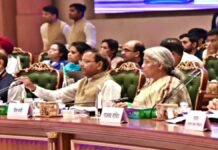
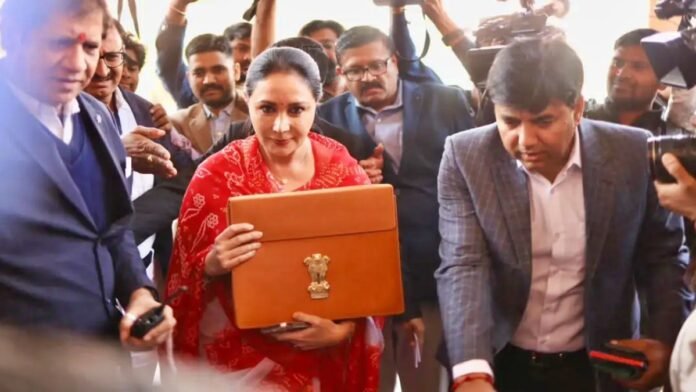
On Wednesday, Deputy Chief Minister and Finance Minister Diya Kumari presented a transformative fiscal roadmap in the State Assembly. This third budget under Chief Minister Bhajan Lal Sharma’s administration is the largest in the state’s history, designed to align with the national vision of a developed India by 2047.
By setting the total expenditure at ₹21,52,100 crore, the government has signaled an aggressive growth strategy. The Finance Minister, arriving in traditional Rajasthani attire with a symbolic saffron budget bag, emphasized that the document is a “confluence of faith and economy,” aiming to modernize the state while preserving its cultural identity.
The Agrarian Revolution and Rural Relief
The budget places the farmer at the center of its economic strategy. A specialized relief package of ₹10,900 crore has been carved out to bolster social security in rural areas. Most notably, the government announced an additional incentive of ₹150 over the Minimum Support Price (MSP) for wheat, a move expected to significantly increase the disposable income of millions of farming families.
Beyond direct financial aid, the government is focusing on the modernization of the agricultural sector. New schemes aim to introduce high-tech farming techniques and establish localized agricultural export hubs to strengthen the rural economy.
Building the Infrastructure of Tomorrow
To transition Rajasthan into an industrial leader, the 2026,27 budget allocates substantial capital for connectivity:
- Roads and Logistics: Building on the 42,000 kilometers of roads already developed, an additional ₹11,800 crore has been sanctioned for further expansion.
- Industrial Hubs: ₹400 crore is earmarked for the development of modern industrial and logistics parks, intended to attract global manufacturing units.
- Urban-Rural Linkages: To eliminate traffic bottlenecks, ₹920 crore will be spent on constructing ROBs and RUBs at 26 critical railway crossings across the state.
- Smart Villages: A dedicated ₹500 crore provision will bring modern, city-like amenities to rural clusters to curb migration and improve living standards.
Social Empowerment and Digital Governance
The Finance Minister highlighted the government’s efficiency, claiming that approximately 900 schemes from the previous two budgets have already been successfully executed. Social security remains a cornerstone, with ₹28,400 crore reaching 9.1 million people through direct benefit transfers.
For the youth, the budget addresses the long-standing demand for regularized employment. The government reiterated its commitment to conducting all state recruitment examinations on a strict schedule, supported by enhanced technology to prevent paper leaks and ensure merit-based selection.
A Vision for Economic Sovereignty
Chief Minister Bhajan Lal Sharma hailed the budget as a fulfillment of Prime Minister Narendra Modi’s “Sabka Saath, Sabka Vikas” mantra. By focusing on “Nari Shakti” (Women’s Power) and youth-led growth, the administration believes Rajasthan is now on a high-growth trajectory that will see it become one of India’s top-performing economies by the end of the decade.