
































Key Points:
- Fare hike of 1-2 paise per km for journeys exceeding 215 km
- No increase for trips under 215 km and suburban/season ticket holders
- Expected additional revenue of ₹600 crore per year for railways
- Sleeper and general class passengers form the largest affected group
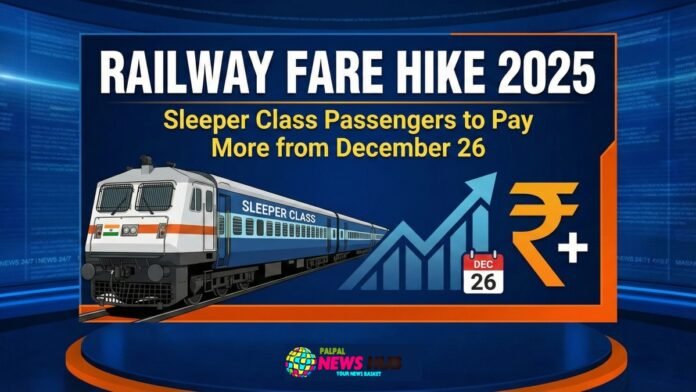
- Increase takes effect from December 26, 2025
Indian Railways, often called the lifeline of the country, announced a hike in passenger fares on Sunday, December 21, 2025, triggering concerns among millions of daily travelers. The decision, which will generate an additional ₹600 crore annually, has sparked debate about its disproportionate impact on different passenger categories, particularly those traveling in sleeper and general classes who form the railway’s core customer base.
The New Fare Structure and Implementation Timeline
The revised fares will take effect from December 26, 2025, giving passengers a five-day window to book tickets at current rates. For journeys exceeding 215 kilometers, passengers will pay an additional 1 to 2 paise per kilometer, depending on their travel class. This incremental increase may seem small, but it accumulates significantly over long distances, affecting the common man’s budget.
Railway officials confirmed that the fare revision applies uniformly across mail and express trains, while keeping suburban services untouched. The ministry’s data reveals that sleeper class accounts for nearly 60% of total reserved passengers, making this hike particularly relevant for middle and lower-income families who rely on railways for affordable long-distance travel.
Relief Measures for Short-Distance and Daily Commuters
The railway ministry has strategically shielded millions of short-distance travelers from the fare increase. Journeys under 215 kilometers will see no price change, preserving affordability for regional travel. Additionally, suburban train services and monthly season ticket (MST) prices remain frozen, protecting daily commuters in metropolitan areas like Mumbai, Delhi, Kolkata, and Chennai.
This targeted approach aims to balance revenue generation with social responsibility. The 215 km threshold covers most daily and weekly commutes while capturing long-distance travelers who can supposedly absorb the marginal increase. However, passenger rights groups argue that this logic ignores the financial strain on migrant workers and students who travel long distances regularly.
Impact Analysis by Passenger Category
The fare hike’s impact varies dramatically across travel classes. For a 500 km journey, non-AC passengers will pay approximately ₹10 more, while AC travelers face a similar increase. The real burden falls on sleeper class passengers who travel frequently, as even a ₹20-30 increase per trip adds up to significant monthly expenses.
General class passengers, who travel without reservations, will also feel the pinch despite the 1 paisa per km rate being lower than mail/express trains. These travelers, often the poorest segments of society, choose general class specifically to minimize costs, making any increase particularly sensitive.
Financial Rationale Behind the Decision
According to senior ministry sources, the fare revision addresses rising operational costs and funds ambitious infrastructure projects. Indian Railways, the country’s second-largest employer, maintains a vast network spanning 68,000 km, requiring constant maintenance and modernization. The additional ₹600 crore revenue will support station redevelopment, track upgrades, and the introduction of new trains.
The ministry faces a financial paradox, passenger fares cover only about 57% of operational costs, leaving a substantial subsidy burden. While politically difficult, periodic fare adjustments help reduce this gap without placing the entire burden on the national budget. The current hike follows a similar pattern of small, incremental increases rather than large, infrequent jumps.
Political and Public Reaction
The announcement has drawn mixed reactions from political parties and passenger associations. Opposition leaders criticized the timing, calling it insensitive to common citizens facing inflation. Passenger associations have threatened protests, arguing that service quality hasn’t improved commensurately with fare increases.
Social media platforms saw trending hashtags like #RailwayFareHike and #CommonManBurden, with users sharing calculations of increased travel costs. Many pointed out that while suburban passengers were spared, the real middle class, those traveling in sleeper class for 300-1000 km journeys, bear the brunt.
Practical Implications for Travelers
Passengers planning travel after December 26 should budget for higher ticket prices. A Mumbai-Delhi journey of approximately 1,400 km will cost ₹14-28 more per person in sleeper class. Family trips during summer vacations and festival seasons will see proportionally higher increases.
Smart travelers are rushing to book tickets before the deadline, causing a surge in bookings on railway ticketing platforms. The IRCTC website reported a 40% increase in bookings for January travel immediately after the announcement.