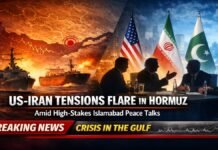


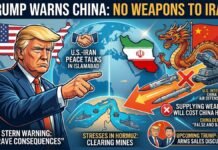
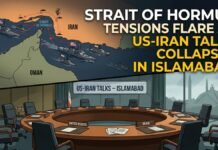
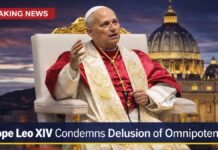
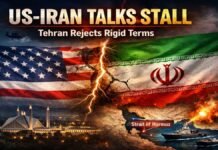
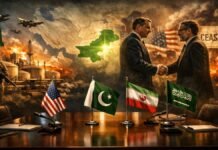














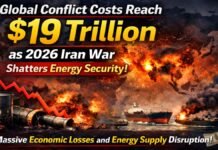


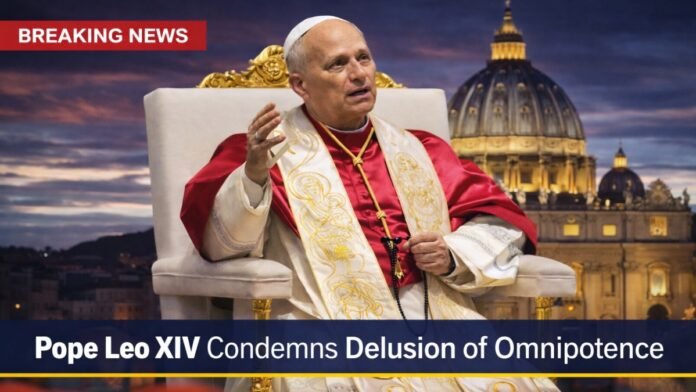

Historic peace negotiations between the United States and Iran have collapsed in Pakistan, leaving a crippling global energy crisis unresolved. Concurrently, Pope Leo XIV delivered an unprecedented rebuke of the conflict, condemning the “delusion of omnipotence” and calling for an immediate end to the display of power.
Key Developments
US Vice President JD Vance announced the collapse of direct peace talks in Islamabad after a 21-hour marathon session.
Pope Leo XIV, the first American-born pontiff, warned against the “worship of self and money” at St. Peter’s Basilica.
Negotiations failed to reopen the Strait of Hormuz, which handles 20% of global energy supplies.
The US delegation included Special Envoys Steve Witkoff and Jared Kushner, facing high-stakes diplomatic pressure.
Pope Leo XIV, a Chicago native elected in 2025 as the first American-born Pope, issued a forceful statement during an evening prayer service at St. Peter’s Basilica. His remarks coincided with high-stakes peace talks in Pakistan, where he explicitly stated that the worship of self and money must end globally. Denouncing the “delusion of omnipotence” fueling the war between the US, Israel, and Iran, the pontiff declared that God does not bless any conflict.
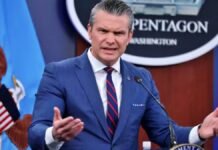
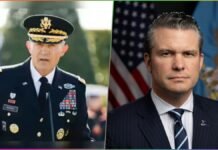
He strongly pushed back against the rhetoric of US officials who have justified the violent military campaign on religious grounds, a pointed reference to Defense Secretary Pete Hegseth, and he called President Donald Trump’s threats to destroy Iranian civilization truly unacceptable. In an extraordinarily rare political move for a pontiff, Pope Leo urged citizens to actively contact their elected representatives to demand an end to the war.
The Islamabad Summit
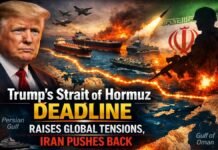
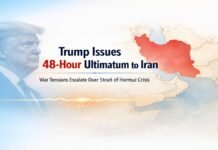
As the Pope called for peace, a critical diplomatic effort was unfolding in Islamabad, Pakistan. The escalation of the conflict in early 2026 led Iran to block the Strait of Hormuz. Because this maritime chokepoint handles a vital portion of the world’s energy shipments, its closure triggered a severe global energy crisis and sent oil prices soaring worldwide.
Pakistan stepped in as a mediator, leveraging its diplomatic connections with China to bring Tehran and Washington to the table for the first direct, high-level meetings between the two nations in more than a decade. The primary objective was to convert a fragile two-week ceasefire into a permanent peace deal and secure the reopening of the strait.
Diplomatic Deadlock
The United States delegation was led by Vice President JD Vance, whose skepticism of foreign entanglements was seen as a potential advantage for his credibility in the negotiations. Vance was joined by Steve Witkoff, the US Special Envoy for Peace Missions, and Jared Kushner, who officially returned to the administration in February 2026 as a Special Envoy.
Meanwhile, Kushner faced media scrutiny for allegedly blurring the lines between his diplomatic role and his private equity firm, Affinity Partners, as he continued to raise billions from Middle Eastern investors.
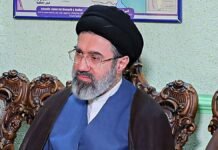
On the other side of the table, the Iranian delegation was led by Mohammad Bagher Ghalibaf, the Speaker of Iran’s Parliament and a central wartime leader following the outbreak of the 2026 war. Despite reported internal friction from the Islamic Revolutionary Guard Corps regarding his negotiating authority, Ghalibaf was accompanied by key state figures, including Foreign Minister Abbas Araghchi and Central Bank of Iran Governor Abdolnaser Hemmati. Hemmati’s presence was particularly critical as he sought to stabilize the plunging rial amid a severe economic crisis and currency devaluation that has gripped the nation.
Despite the historic nature of the meeting and the desperate global need to resolve the energy crisis, the negotiations ultimately failed. On April 12, 2026, Vice President Vance departed Pakistan and announced that the marathon 21-hour talks had ended without an agreement. Vance cited Iran’s refusal to accept US red lines, specifically regarding commitments to completely abandon the development of nuclear weapons, leaving the Middle East and the global energy market in a state of continued uncertainty.