






























Key Points:
- Four KN-25 rockets fired during the latest test exercise
- Maximum strike range reported at around 358.5 km, with overall capability up to 400 km
- Kim Jong Un personally oversaw the launch
- System designed to counter electronic jamming and enemy interference
- US analysts say KN-25 blurs the line between rockets and ballistic missiles
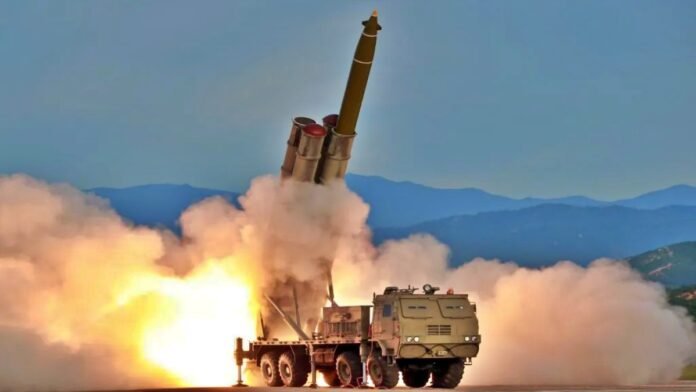
North Korea has successfully tested its KN-25 rocket-based artillery system, widely described as the world’s longest-range multiple rocket launcher. According to state media, four rockets were launched during the latest exercise, demonstrating the system’s ability to strike targets at a distance of up to 358.5 kilometers, even under conditions such as electronic jamming.
Leader Kim Jong Un was present at the test site and was quoted by state media as calling the KN-25 a “strategic deterrent” for the Korean People’s Army. He stated that the launcher was developed for special precision attacks and is equipped with an autonomous guidance system designed to ensure accuracy despite enemy countermeasures and electronic interference.
What Makes the KN-25 Unique
The KN-25 occupies a grey zone between traditional rocket artillery and short-range ballistic missiles. While it is officially classified as a rocket system, its advanced avionics, inertial navigation, satellite guidance, and aerodynamic design give it missile-like characteristics.
North Korean sources and foreign military analysts estimate the KN-25’s maximum range at up to 400 kilometers. By comparison, China’s PCL-191 system can reportedly strike targets up to 500 kilometers away, but it relies on ballistic missiles for that range. As a pure rocket-based platform, the KN-25 is considered unmatched globally.
Launcher Variants and Deployment Strategy
The system is deployed in both 6-cell and 4-cell launcher variants. A tracked launcher version has also been developed, specifically for operations in mountainous and forested terrain, making detection and targeting more difficult. Given North Korea’s geography, this mobility significantly enhances survivability and operational flexibility.
Military experts note that North Korea maintains one of the world’s largest artillery forces. With systems like the KN-25, Pyongyang has the capability to cover most, if not all, of the Korean Peninsula, including key population centers such as Seoul.
US Concerns and Strategic Signaling
US defense assessments have repeatedly warned that the KN-25’s long range and precision blur the traditional distinction between rockets and missiles. Its ability to deliver accurate strikes over long distances raises concerns about escalation risks during any future conflict.
Analysts also suggest that the latest test may serve a dual purpose: operational validation and strategic messaging. Some experts believe Pyongyang could be showcasing the KN-25 to foreign partners, including Russia, amid reports that Moscow is importing large quantities of military equipment from North Korea, including artillery and rocket systems, as part of expanding defense cooperation.
The test adds to growing regional unease, reinforcing concerns about North Korea’s continued advancement in long-range precision strike capabilities despite international sanctions and diplomatic pressure.