























Key Highlights
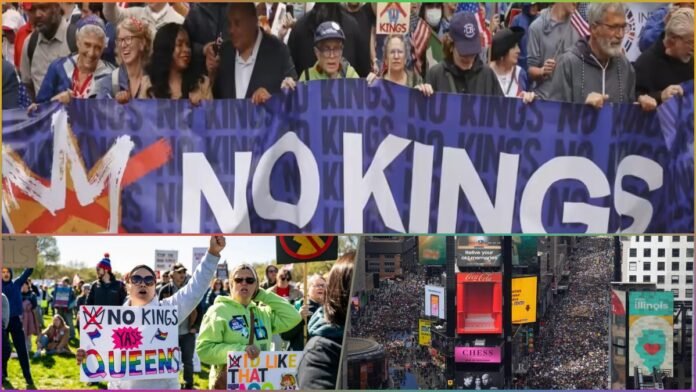
- Third Wave of Protests: The “No Kings” movement saw its largest turnout yet, marking the third major mobilization since last year.
- Star-Powered Resistance: Rock icon Bruce Springsteen joined Minnesota Governor Tim Walz in St. Paul to condemn federal immigration tactics.
- Economic Frustration: Protesters cited skyrocketing fuel prices and inflation, linked to the deepening regional war in the Middle East, as primary catalysts.
- Global Tensions: The rallies coincided with Iranian strikes on Israeli and Gulf targets in retaliation for U.S.-backed operations.
The geopolitical landscape reached a critical juncture this week as the ongoing conflict in the Middle East continues to destabilize global markets. Following intensified military actions by the United States and Israel, Iran has expanded its retaliatory strikes to include strategic locations across the Gulf nations. This escalation has sparked a domestic firestorm within the United States, where critics of President Donald Trump have labeled his “war-first” stance as a catalyst for global instability.
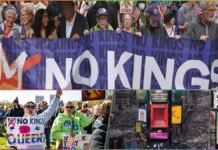
In response, the “No Kings” movement organized a series of coordinated demonstrations on Saturday. The protests, which spanned from coastal metropolises to rural hubs, represent a growing coalition of Americans concerned about executive overreach and the potential for a full-scale ground war with Iran.
Coast-to-Coast Mobilization
In New York City, a dense corridor of protesters marched from Midtown Manhattan toward the federal plaza. Banners displayed a wide range of grievances, ranging from the administration’s aggressive immigration stances to the direct threat of a nuclear-armed conflict.
Across the country in San Francisco, a diverse crowd assembled at Embarcadero Plaza. The march toward the Civic Center highlighted the intersectionality of the movement, with participants carrying American flags alongside banners supporting Ukrainian sovereignty and transgender rights. Despite the heavy police presence, the atmosphere remained largely peaceful as organizers focused on a message of democratic resilience.
The Battle for the Heartland: St. Paul Rally
Perhaps the most significant event took place in St. Paul, Minnesota, where thousands gathered to hear from Governor Tim Walz and legendary musician Bruce Springsteen. The rally took on a somber tone as Springsteen paid tribute to Alex Pretty and Renee Good, two individuals killed during a controversial federal immigration raid in January 2026.
“Attacks on our cities and our neighbors will not be tolerated,” Springsteen told the cheering crowd, “The commitment I see here proves that this is still America, a place where the people, not a single individual, hold the power.”
Governor Walz, a vocal critic of the administration, delivered a stinging rebuke of federal tactics. He stated that when the individual sitting in the White House, who is attempting to become a dictator, dispatched his untrained, aggressive officers to Minnesota, the citizens raised their voices in defense of decency and kindness.
Economic Strain and Social Friction
The unrest is not solely driven by foreign policy. The American economy is currently grappling with a “sluggish” period characterized by high inflation and a sharp spike in fuel prices, both exacerbated by the instability of Middle Eastern oil corridors.
While the majority of Saturday’s events were non-violent, flashes of friction appeared in West Palm Beach, Florida. A verbal altercation erupted between approximately 50 Trump supporters and “No Kings” protesters near the President’s Mar-a-Lago estate. Law enforcement intervened to prevent the shouting match from escalating into physical violence, but the incident underscored the deep-seated polarization currently gripping the country.
As the “No Kings” movement prepares for further action, the White House has yet to issue a formal response to the latest wave of demonstrations.