
































Key Points:
- Khaleda Zia died at age 80 after battling multiple health complications
- Served as Bangladesh Prime Minister twice (1991-1996, 2001-2006)
- Imprisoned in 2018, released in August 2024 after Sheikh Hasina’s government collapsed
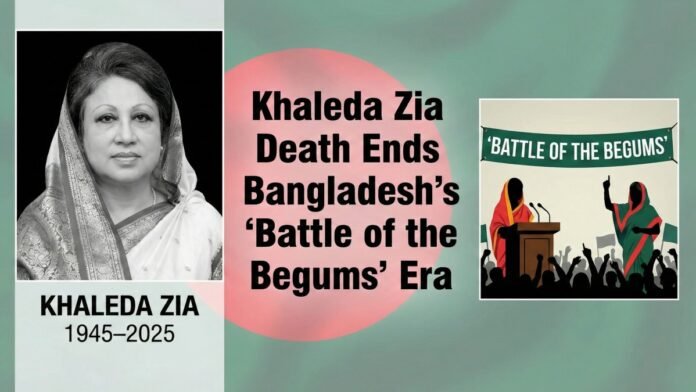
- Her death ends the legendary “Battle of the Begums” rivalry with Hasina
- Both leaders’ families suffered assassinations in the 1970s and 1980s
- Khaleda’s son Tarique Rahman is BNP’s acting chairman, recently returned from London exile
- Supreme Court acquitted her of final corruption charges in January 2025
Former Bangladeshi Prime Minister and BNP chairperson Khaleda Zia passed away in a Dhaka hospital on December 30, 2025, at age 80, drawing the curtain on one of Asia’s most compelling political sagas. Her death occurred just weeks before scheduled general elections, where she had been cleared to potentially contest after the Supreme Court’s January 2025 acquittal in her final corruption case. The three-time premier, who spent her last months receiving medical treatment in London before returning to Bangladesh in May 2025, died surrounded by family members, including her elder son Tarique Rahman, who had returned from 17 years of self-imposed exile in London to be with his mother during her final days.
The Origins of the ‘Battle of the Begums’
The legendary rivalry, known as the “Battle of the Begums,” began in the crucible of Bangladesh’s turbulent birth and early instability. Khaleda Zia entered politics not by ambition but by tragedy; her husband, military ruler Ziaur Rahman, was assassinated in a 1981 coup, forcing her to take command of the Bangladesh Nationalist Party he had founded. Simultaneously, Sheikh Hasina was emerging as the political heir to her father, Sheikh Mujibur Rahman, the father of the nation, who was brutally assassinated in 1975 along with most of his family.
In the 1980s, the two women formed an unlikely alliance against military dictator Hussain Muhammad Ershad, jointly leading pro-democracy movements that culminated in his 1990 removal. This partnership, forged in shared struggle, would soon dissolve into one of the world’s most bitter political rivalries. When Khaleda Zia became Bangladesh’s first female Prime Minister in 1991, she inherited her husband’s legacy, while Hasina carried her father’s liberation war heroism. Their personal and political differences would define Bangladesh’s trajectory for the next three decades.
Decades of Political Warfare
Every election from 1991 onward became a battlefield between these two formidable leaders. Bangladeshi politics revolved so completely around them that no third force could emerge. Nobel laureate Muhammad Yunus’s recent rise came through mass movement, not traditional political power. Khaleda’s first term (1991-1996) established her as a powerful administrator, but her defeat in 1996 brought Hasina to power for a five-year term marked by administrative actions against Khaleda and her son Tarique Rahman.
The 2001 election returned Khaleda to power, this time with controversial Islamist allies including Jamaat-e-Islami. Her second term (2001-2006) proved tumultuous, marked by accusations of anti-India rhetoric and alleged support for insurgencies in India’s northeastern states. The political climate turned venomous in 2004 when a grenade attack on Hasina’s convoy killed 24 people and narrowly missed the opposition leader herself. Hasina blamed Khaleda’s government and Tarique Rahman for the attack, allegations that deepened their enmity.
Imprisonment, Exile and Downfall
Khaleda’s political fortunes collapsed after the 2006-2008 military-backed caretaker government period. When Hasina returned to power in 2009, she remained Prime Minister until August 2024, systematically weakening Khaleda and the BNP. In 2018, a special court sentenced Khaleda to 17 years in prison in two corruption cases involving orphanage funds and charitable trusts. Her son Tarique Rahman, facing numerous charges including corruption and the 2004 grenade attack, fled to London in 2008 and remained in exile.
During her imprisonment, Khaleda’s health deteriorated significantly. She appealed 18 times to Hasina’s government for permission to travel abroad for medical treatment, but each request was denied. The BNP called the charges politically motivated, while Hasina’s administration maintained judicial independence. Khaleda spent her final years in a rented house under house arrest after a brief 2020 release, her political career seemingly over.
The Dramatic Reversal and Final Days
The August 2024 student-led uprising that forced Hasina to flee to India dramatically altered Bangladesh’s political landscape. The interim government led by Nobel laureate Muhammad Yunus ordered Khaleda’s release on August 6, 2024, just a day after Hasina’s departure. Yunus’s administration proved to be Khaleda’s unexpected savior, granting her permission to travel to London for advanced medical treatment in January 2025, something Hasina had denied for years.
During her four-month London stay, Khaleda received treatment for her multiple ailments while her son Tarique Rahman managed party affairs from exile. She returned to Bangladesh on May 6, 2025, to a hero’s welcome from BNP supporters, though her frail condition was evident. The Supreme Court’s January 2025 acquittal in her final corruption case cleared the path for her political comeback, and she was considered a potential candidate in the February 2026 general elections.
The Rivalry’s Legacy and Bangladesh’s Future
Khaleda Zia’s death marks the definitive end of an era that defined Bangladeshi politics. The “Battle of the Begums” left deep scars on the nation’s democratic institutions, with both leaders accused of authoritarian tendencies, corruption, and political vindictiveness. Their rivalry prevented the emergence of alternative leadership and institutionalized a zero-sum political culture that prioritized personal loyalty over national interest.
With Hasina in exile in India and Khaleda now deceased, Bangladesh stands at a political crossroads. Tarique Rahman, as BNP’s acting chairman, faces the challenge of leading the party without his mother’s formidable presence, while carrying the baggage of corruption allegations and his long exile. The interim government must navigate the complex legacy of both leaders while preparing for elections that will shape Bangladesh’s democratic future.
The passing of Khaleda Zia closes a dramatic chapter in South Asian political history, a story of two women who rose from personal tragedy to dominate their nation’s politics, only to end with one in exile and the other in the grave, their bitter rivalry finally concluded by mortality itself.