






























Key Points
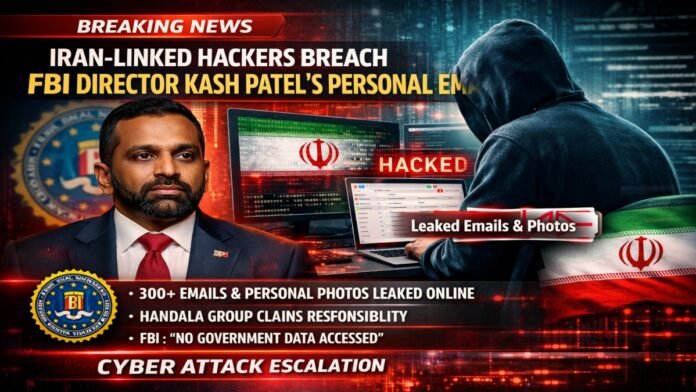
- The “Handala Hack Team,” an Iranian-linked group, claimed responsibility for the breach on March 27, 2026.
- Leaked materials include over 300 emails, Patel’s resume, and personal photos from between 2010 and 2019.
- The FBI confirmed the incident but clarified that the compromised data is “historical” and contains no government information.
- The attack occurs amid intense regional conflict, following coordinated U.S. and Israeli strikes against Iran in late February.
In a major security lapse, the personal digital communications of FBI Director Kash Patel have been targeted and compromised by a hacking collective tied to Iranian intelligence. The breach, which came to light on Friday, March 27, 2026, involves the leak of hundreds of personal files and emails belonging to the head of America’s premier investigative agency.
‘Handala’ Group Claims Retaliation
The “Handala Hack Team,” a persona widely identified by cybersecurity researchers as an operational arm of Iran’s Ministry of Intelligence and Security, took credit for the operation. On their leak site, the group mockingly announced that Patel’s name had been added to their list of “successfully hacked victims.” As proof of the intrusion, the hackers published several private photographs of the FBI Director, including images of him smoking cigars and posing with a vintage convertible.
The group stated that the attack was a direct response to recent U.S. actions, including the seizure of Iranian web domains and a $10 million reward offered by the Department of State for information on the collective’s members.
Scope of the Leaked Data
An analysis of the leaked documents reveals a significant trove of correspondence. While the hackers claim to have access to sensitive files, the sample released so far contains more than 300 emails spanning 2010 to 2019. These records appear to include a mix of professional resumes, personal travel details, and work-related exchanges from Patel’s earlier career.
A senior official from the U.S. Department of Justice confirmed the authenticity of the materials, noting that the data “appears authentic,” though the full extent of the breach remains under investigation by federal cyber experts.
FBI and Government Response
The FBI has officially acknowledged the targeting of Director Patel’s personal Gmail account. Bureau spokesperson Ben Williamson stated that the agency has taken all necessary steps to mitigate potential risks associated with the activity. Crucially, the FBI emphasized that the information in question is “historical in nature,” asserting that no current government data or classified information was stored on the personal account.
The incident has sparked renewed debate over the cybersecurity habits of high-ranking officials. Analysts point out that by targeting personal systems rather than heavily defended government networks, state-sponsored actors can still glean sensitive biographical details that could be used for psychological operations or further intelligence gathering.
Geopolitical Context
This cyberattack unfolds against a backdrop of severe tensions between Washington and Tehran. Following a series of “pre-emptive” strikes launched by the U.S. and Israel against Iranian targets in February 2026, the digital battlefield has seen a marked escalation. The “Handala” group has recently claimed other high-profile hits, including a disruptive attack on the medical device manufacturer Stryker and the theft of data from employees of defense contractor Lockheed Martin.
The breach of Director Patel’s account is seen by security experts as an attempt by Iran to signal that no U.S. official, no matter their rank, is beyond the reach of their cyber-intelligence units.