

































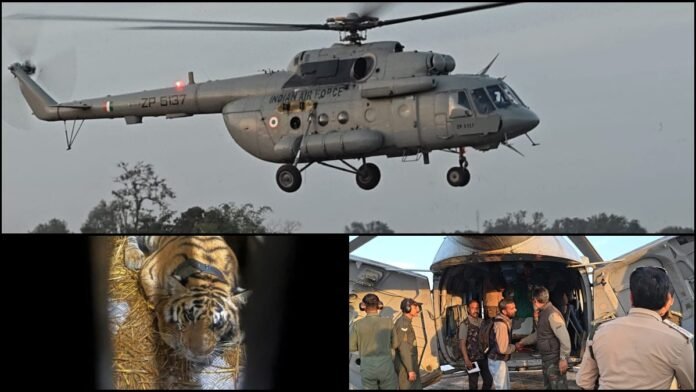
Key Points:
- Tigress PN-224, 3 years old, transported from Pench (MP) to Ramgarh Vishdhari (Rajasthan)
- First interstate aerial tiger translocation in Indian wildlife history using IAF MI-17 helicopter
- 24-day operation began November 28, completed December 21, 2025
- Primary goal: Introduce new gene pool to Rajasthan’s in-bred tiger population
- Tigress removed initial radio collar, required re-tranquilization on December 18
- Expert team includes IFS officer Gurleen Kaur and veterinary specialist Dr. Akhilesh Mishra
- Flight duration: 2 hours 15 minutes with mid-air refueling stop in Gwalior
The Indian Air Force MI-17 helicopter lifted off from Pench Tiger Reserve’s Karmajhiri airstrip at 6:47 AM on Sunday, carrying a precious cargo that could reshape tiger conservation in India. Inside a specially designed 800-kilogram transport crate, tigress PN-224, a three-year-old sub-adult weighing 145 kilograms, began her unprecedented 800-kilometer journey to Rajasthan. The aircraft, piloted by Wing Commander Anil Thakur and co-pilot Squadron Leader Priya Reddy, maintained a steady altitude of 3,000 feet to ensure stable atmospheric pressure for the sedated animal. After a brief refueling stop at Gwalior’s Maharajpur Air Force Station at 7:52 AM, the helicopter resumed its journey westward, landing at Jaipur’s Sanganer Airport at 9:02 AM, where Rajasthan Forest Department vehicles waited to complete the final 150-kilometer road transfer to Ramgarh Vishdhari.
Scientific Imperative: Combating Genetic Crisis
The translocation addresses a critical conservation challenge, genetic inbreeding depression threatening Rajasthan’s tiger population. Wildlife Institute of India research reveals that over 85% of tigers in Rajasthan’s reserves, including Ranthambore, Sariska, and Ramgarh Vishdhari, share a common ancestry tracing back to just eight founder tigers reintroduced in 2008. This limited genetic pool has resulted in increased cub mortality rates, reduced disease resistance, and congenital abnormalities in recent years. Dr. Rajesh Gopal, former head of the National Tiger Conservation Authority, explains that introducing PN-224’s distinct genetic lineage from Pench’s well-established population could increase genetic diversity by an estimated 12-15% over two generations. The Madhya Pradesh gene pool, derived from 23 different breeding tigers, offers vital allelic variation that Rajasthan’s population desperately needs.
The 24-Day Operation: Challenges and Triumphs
The mission commenced on November 28 when a joint team of 45 forest officials from both states deployed 50 high-resolution camera traps across Pench’s 758 square kilometers. The tigress, identified through her unique stripe pattern and first photographed on December 1, proved exceptionally elusive. On December 5, Dr. Akhilesh Mishra successfully darted her with 3.5 milligrams of medetomidine and fitted a GPS-GSM radio collar, but the resourceful cat removed it within 18 hours using her dewclaw, a behavior rarely documented in tigers. The team had to restart tracking, eventually locating her in the dense Khamarpani beat on December 18. This time, veterinary experts used a stronger collar design with reinforced Kevlar straps and administered a longer-acting sedative combination. The final capture on December 20 required a 12-hour stakeout in sub-zero temperatures before the successful tranquilization at 5:30 AM.
Expert Supervision and Multi-Agency Coordination
IFS officer Gurleen Kaur, a 2012-batch officer with specialization in large carnivore translocation, led the mission with meticulous planning. The expert team included Dr. Akhilesh Mishra, Pench’s senior veterinary officer with 17 years of experience; wildlife biologist Dr. Sunil Limaye from the Wildlife Conservation Society; and Rajasthan’s Deputy Conservator of Forests, Mahendra Singh Shekhawat. The Indian Air Force’s 43 Helicopter Unit provided the MI-17, specially modified with a climate-controlled cabin maintaining 22°C temperature and 60% humidity. A wildlife veterinarian monitored PN-224’s vital signs continuously during flight, tracking her heart rate, which stabilized at 48 beats per minute under sedation. The entire operation cost approximately ₹42 lakhs, funded jointly by the central government’s Project Tiger scheme and Rajasthan’s wildlife budget.
Political Significance and Conservation Milestone
Lok Sabha Speaker Om Birla, representing Kota-Bundi constituency, hailed the mission as “a revolutionary step in India’s wildlife management” in his social media post. Madhya Pradesh’s Forest Minister Vijay Shah and Rajasthan’s Chief Minister Bhajan Lal Sharma jointly announced that this translocation establishes a template for future genetic management across India’s 53 tiger reserves. The National Tiger Conservation Authority has already identified three more potential translocations for 2026, including a male tiger from Kanha to Satkosia (Odisha) and a tigress from Corbett to Palamau (Jharkhand). Conservationists view this as a paradigm shift from reactive rescue operations to proactive genetic management, essential for maintaining India’s 3,682 tigers, as per the 2025 census.
Future Monitoring and Release Protocol
Upon arrival at Ramgarh Vishdhari, PN-224 was transferred to a 10-hectare soft-release enclosure where she will spend 30 days acclimatizing to her new environment. The enclosure contains natural prey species, including spotted deer and wild boar, to encourage hunting behavior. Dr. Limaye’s team will monitor her movements via the radio collar, which transmits location data every two hours. If she demonstrates normal feeding and territorial marking for three consecutive weeks, she will be released into the 1,501 square kilometer core zone by mid-January 2026. Ramgarh Vishdhari currently hosts 8 tigers, including 3 females, and officials hope PN-224 will establish a new territory in the Kachida Valley, potentially producing her first litter by late 2026, thereby injecting fresh genetic material into Rajasthan’s tiger population.