






























Key Points:
- New CPI series with base year 2024 to be released February 12, 2026
- National accounts data with base year 2022-23 scheduled for February 27, 2026
- Index of Industrial Production with base year 2022-23 to launch May 28, 2026
- Consultation workshop on December 23, 2025, to discuss methodological changes
- NITI Aayog Vice Chairman Suman K. Bery to lead the workshop
- Changes aim to capture structural shifts in India’s post-pandemic economy
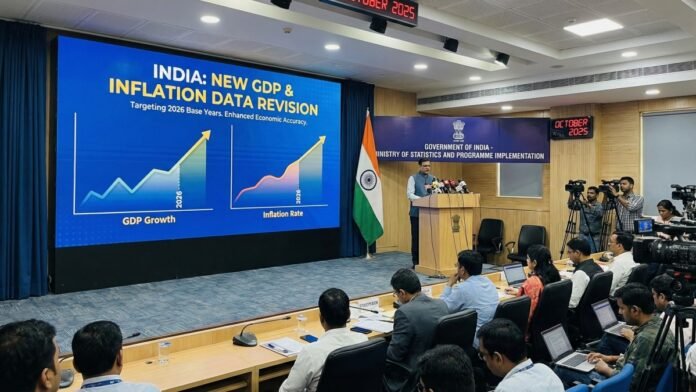
The Ministry of Statistics and Programme Implementation is preparing to unveil India’s most comprehensive economic data revision in nearly a decade, a move that will reshape how policymakers, investors, and analysts understand the country’s economic trajectory. The announcement, made on Monday, December 22, 2025, outlines a phased release schedule beginning in February 2026. This revision addresses the long-standing need to update economic benchmarks that currently rely on outdated consumption patterns, industrial structures, and price behaviors from over a decade ago. The current CPI uses 2012 as its base year, while GDP and IIP calculations still reference the 2011-12 economic structure, missing significant changes in digital services, gig economy work, and post-pandemic consumption habits.
Detailed Timeline and Release Schedule
The ministry has established a precise timeline for rolling out the new statistical series. The Consumer Price Index revision will be the first to launch on February 12, 2026, adopting 2024 as its base year, a notably recent reference period that will incorporate the latest consumption expenditure survey data collected across 150,000 households in 2024. The national accounts data, which determines GDP calculations, will follow on February 27, 2026, using the financial year 2022-23 as its base, aligning with the period when India’s economy returned to pre-pandemic output levels. The Index of Industrial Production will be released last, on May 28, 2026, also with 2022-23 as its base year, allowing time to integrate data from the Annual Survey of Industries covering nearly 2 lakh manufacturing units. This staggered approach ensures each dataset undergoes rigorous validation before publication.
The Consultation Process and Stakeholder Engagement
A critical consultation workshop scheduled for Tuesday, December 23, 2025, will bring together India’s top economic minds to review and refine the proposed methodological changes. NITI Aayog Vice Chairman Suman K. Bery will preside as chief guest, joined by Chief Economic Advisor V. Anantha Nageswaran, who will provide insights on how the new data series will influence economic policy formulation. Ministry Secretary Saurabh Garg and Director General of Central Statistics N. K. Santoshi will present detailed technical proposals. The workshop will host approximately 120 participants, including chief economists from major banks like SBI and HDFC, representatives from the RBI and SEBI, state government statistical commissioners, and subject matter experts from institutions such as the Indian Statistical Institute and the National Council of Applied Economic Research. This collaborative approach aims to build consensus and ensure the revised series meets diverse user needs.
Methodological Innovations and Structural Changes
The base year revision involves far more than simple recalibration, it introduces fundamental methodological improvements to capture India’s evolving economic landscape. For the CPI, the new series will expand its basket of goods and services from the current 299 items to approximately 350 items, adding categories like plant-based meat alternatives, streaming service subscriptions, and electric vehicle charging costs. The weight of food items will decrease from 45.86% to around 40%, reflecting changing consumption patterns, while services like healthcare and education will see increased representation. The GDP series will incorporate the System of National Accounts 2020 standards, recognizing intangible assets like research and development expenditure as capital formation. The IIP will reclassify industries under the National Industrial Classification 2022, creating separate categories for emerging sectors like lithium battery manufacturing and semiconductor assembly.
Economic Rationale and Policy Implications
Updating base years is essential because economic structures change significantly over time. The 2011-12 base year predates major policy initiatives like GST implementation, the digital payments revolution, and the production-linked incentive schemes that have transformed manufacturing. The new series will provide more accurate inflation readings, helping the RBI make better monetary policy decisions. For GDP, the revised methodology may lead to recalibrated growth figures for recent years, potentially showing stronger performance in services and manufacturing than previously estimated. Investors will benefit from more reliable industrial production data that better reflects capacity utilization in modern industries. The government will use these statistics to design more targeted welfare schemes and infrastructure investments, particularly for sectors that the new data reveals as underperforming.
International Standards and Global Comparability
The revision aligns India’s statistical practices with international standards set by the International Monetary Fund‘s Special Data Dissemination Standard and the United Nations System of National Accounts. This alignment will enhance global investors’ confidence in Indian economic data and facilitate better comparisons with other emerging economies. The World Bank and Asian Development Bank have offered technical assistance for the revision process, with experts from these institutions participating in validation exercises. The new series will also incorporate global best practices in data collection, including greater use of digital transaction data from NPCI and GSTN, reducing the time lag in economic indicators from the current 45-60 days to approximately 30 days, bringing India closer to real-time economic monitoring capabilities.
Challenges and Implementation Hurdles
Despite the clear benefits, implementing such a massive statistical overhaul presents significant challenges. State governments must upgrade their data collection infrastructure, particularly for agricultural statistics and informal sector surveys. The ministry needs to train over 5,000 field investigators across India in new survey methodologies. There are concerns about data continuity; economists worry that the new series may not be directly comparable with historical data, complicating long-term trend analysis. To address this, the ministry will release back-series data for the past five years, recalculating GDP, CPI, and IIP using the new methodology to provide a consistent time series. Additionally, the ministry must ensure that the new digital data sources maintain privacy standards compliant with the Digital Personal Data Protection Act, 2023.