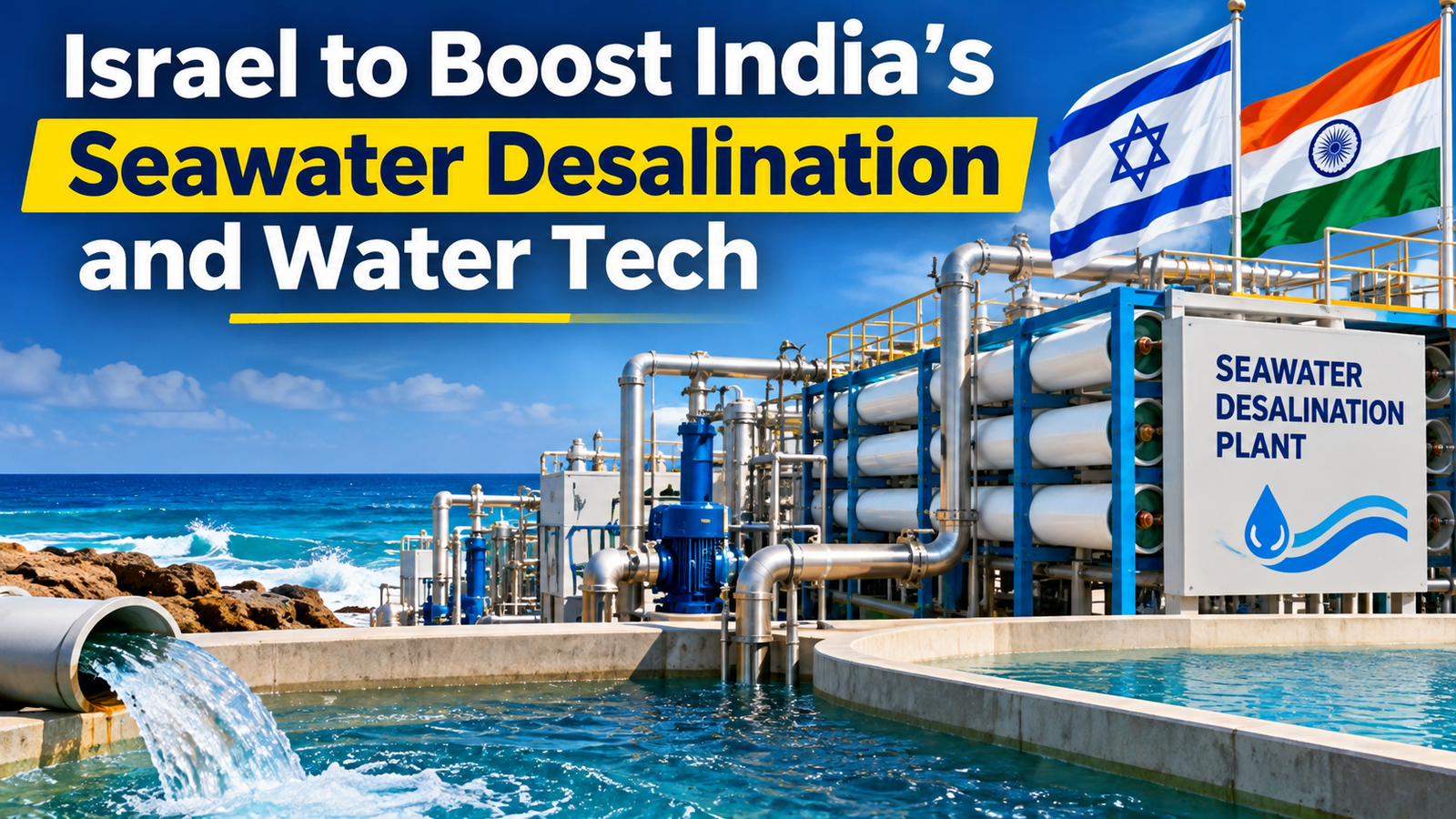
Israel is looking to deepen its water technology partnership with India, focusing on seawater desalination, wastewater reuse, and large-scale infrastructure projects.
Key Points
- Desalination Goal: Israel aims to nearly double its desalination capacity to 1,500-1,600 MCM in seven years.
- Tech Hubs: India-Israel Centres of Water Technology are being established at IIT Madras and IIT Roorkee.
- Investment Focus: Israeli companies see opportunities in smart irrigation, leakage detection, and wastewater treatment.
- Strategic Shift: The partnership is moving from knowledge exchange to large-scale, tangible infrastructure projects.
Strengthening Bilateral Water Ties
NEW DELHI: India and Israel are poised to enhance their longstanding cooperation in the water sector, with a focus on scalable technology and infrastructure. Noa Amsalem, the water attaché at the Israeli embassy in India, highlighted that the partnership has evolved significantly, now involving the Ministry of Jal Shakti, the Ministry of Housing and Urban Affairs, various state governments, and premier academic institutions.
The collaboration is currently manifesting through the establishment of India-Israel Centres of Water Technology. These centers, located at IIT Madras and IIT Roorkee, are designed to focus on urban water management and the Namami Gange programme, respectively. The objective is to transition from simple knowledge sharing to the implementation of practical projects that offer lasting impacts on India’s water security.
Potential for Seawater Desalination
Amsalem noted that India possesses an extensive coastline, providing a significant opportunity to harness seawater desalination as a reliable freshwater source. While desalination was once considered costly, advancements in membrane technology and energy efficiency have made it increasingly cost-competitive compared to transporting freshwater from distant locations.
Israel, which currently meets about one-fourth of its water supply through desalination, is aiming to increase its capacity to 1,500-1,600 million cubic metres (MCM) over the next seven years. Drawing from this experience, Israel intends to support India in developing large-scale seawater and inland brackish water desalination facilities.
Investment and Technological Synergy
The Indian water sector is viewed as a prime destination for Israeli investment, particularly driven by flagship government programmes like the Jal Jeevan Mission, AMRUT, and Namami Gange. These initiatives have created a high demand for advanced solutions in areas such as smart water management, leakage detection, and irrigation technologies.
Rather than focusing solely on direct investment, the Israeli approach emphasizes a collaborative model. By pairing Israeli technological expertise with India’s manufacturing capabilities and engineering strengths, the two nations aim to create a mutually beneficial ecosystem. This strategy seeks to foster long-term partnerships with state governments and water utilities to build sustainable infrastructure.
Recent Developments and Future Roadmap
Recent activities underscore the momentum of this cooperation. In 2026, the Economic and Trade Missions of Israel’s Ministry of Economy and Industry led a professional delegation across South, Central, and North India to promote water technologies. Simultaneously, an Indian delegation of water-sector stakeholders visited Israel to explore joint initiatives.
Looking toward the next decade, the roadmap involves a shift from individual, small-scale projects to large-scale collaborations. The goal remains bridging Israeli innovation with India’s evolving needs to ensure efficient and sustainable water management across the country.