



























Key Points
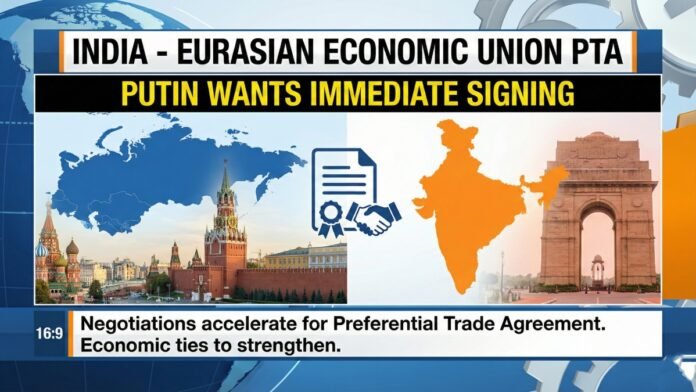
- Putin wants to expedite Preferential Trade Agreement with EAEU during India visit
- India completed first round of negotiations a week ago, signing pending
- EAEU comprises Russia, Armenia, Belarus, Kazakhstan, and Kyrgyzstan
- Current India-Russia trade at $70 billion, target to exceed $100 billion before 2030
- Agreement will facilitate free flow of goods, services, and capital
- US closely monitoring development as potential counterweight to its tariff policies
- Cooperation extends beyond energy to AI, industrial development, and payment systems
- Many Russian companies preparing to increase purchases from India
- Agreement finalized on August 20, only signing remains
- Reliable payment and insurance systems essential for trade agreement
Russian President Vladimir Putin is prioritizing the expedited completion of the long-pending Preferential Trade Agreement between India and the Eurasian Economic Union during his visit, viewing it as a critical strategic move in global politics and economics. The Russian leader wants the agreement signed as soon as possible to open new avenues for economic cooperation, a strategy that has already alarmed Washington, as it could directly challenge US economic policies and tariff measures. India completed the first round of negotiations with the EAEU just a week ago, and Putin’s intervention aims to remove remaining bureaucratic hurdles and finalize the deal promptly.
The EAEU, comprising Russia, Armenia, Belarus, Kazakhstan, and Kyrgyzstan, represents a significant economic bloc that would provide India greater access to Asian and Eurasian markets. The agreement will simplify trade procedures, reduce barriers, and facilitate the free flow of goods, services, and capital between India and these countries. On August 20, India finalized the terms and conditions of the free trade agreement with this bloc, leaving only the formal signing ceremony pending.
$100 Billion Trade Target and Economic Impact
Currently, trade between India and Russia stands at $70 billion, and both governments are actively working to surpass the $100 billion mark before 2030. According to Putin, the EAEU agreement will be the strongest step in this direction, removing barriers to trade and investment flows. Many Russian companies are already preparing to increase product purchases from India, signaling strong business interest in the partnership. The agreement will significantly boost India’s trade and help mitigate the impact of US-imposed tariffs, creating an alternative economic network that reduces India’s dependence on American markets.
The strategic timing of this agreement is crucial, as India has suffered losses due to the Trump administration’s tariff policies, making the EAEU partnership an attractive counterweight to Washington’s economic measures. This development explains why US officials are closely monitoring the situation, concerned about the potential creation of a parallel economic bloc that could diminish American influence in the region .
Beyond Energy, A Comprehensive Partnership
Putin has clarified that his visit to India extends far beyond traditional energy agreements, aiming to strengthen the bilateral trade system through major oil and gas supply contracts alongside comprehensive economic cooperation. The Russian President emphasized that reliable payment and insurance systems are essential components for a successful free trade agreement, addressing previous challenges in India-Russia trade transactions. The partnership will encompass industrial development and artificial intelligence cooperation, areas where Russia has made significant progress and India stands to benefit substantially.
The collaboration in AI and industrial sectors represents a new dimension in India-Russia relations, moving beyond the historical focus on defense and energy. This broader partnership framework includes technology transfer, joint research initiatives, and cooperation in emerging technologies that could position both nations as leaders in the global digital economy. The comprehensive nature of this agreement signals a strategic shift in India-Russia relations toward a more diversified and resilient economic partnership.
US Concerns and Geopolitical Implications
Washington’s concern stems from the potential of this agreement to create a robust alternative to US-led economic frameworks, particularly as it could undermine the effectiveness of American tariff policies against India. The US has been watching India’s increasing engagement with Russia and the EAEU with apprehension, fearing it could lead to the formation of an economic bloc that operates outside Western influence. This agreement represents a significant challenge to Washington’s economic policies, as it provides India with viable alternatives to American markets and reduces US leverage in trade negotiations.
The strategic partnership between PM Modi and Putin through the EAEU framework demonstrates India’s multi-alignment foreign policy, balancing relations with both Western powers and traditional allies like Russia. As the agreement moves toward finalization, US officials are likely to increase diplomatic pressure on India, though New Delhi appears committed to pursuing its economic interests independently. The success of this agreement could encourage other nations facing US tariffs to explore similar partnerships, potentially reshaping global trade dynamics .