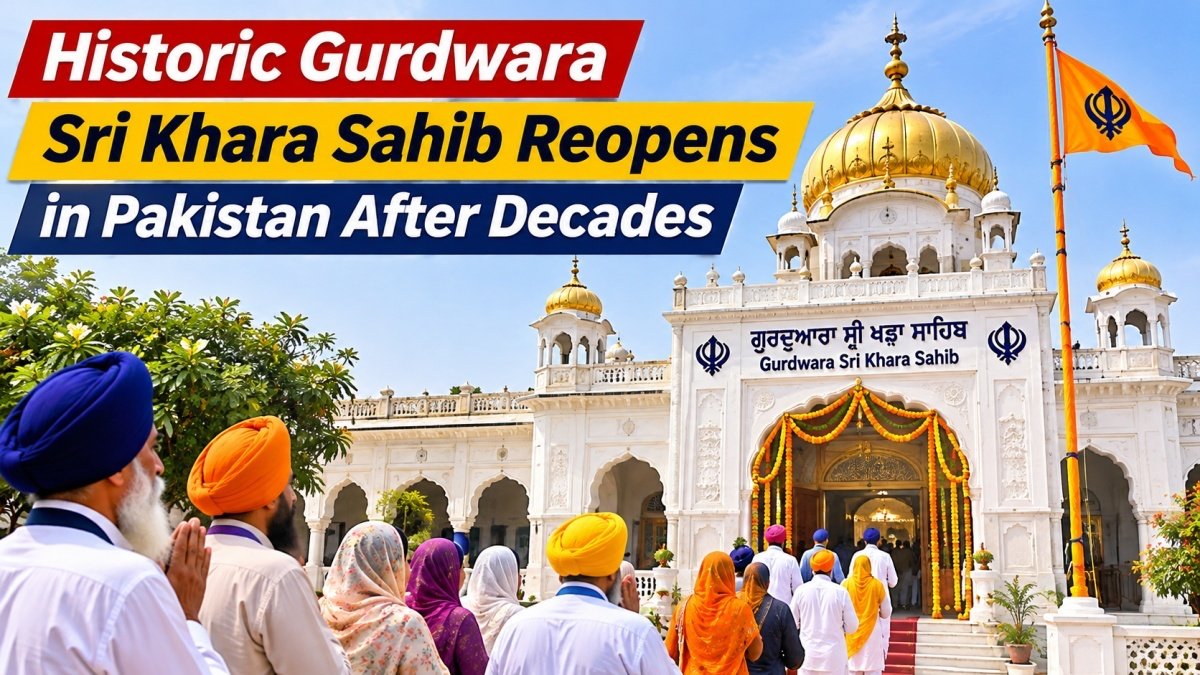
The historic Gurdwara Sri Khara Sahib in Pakistan's Punjab province has reopened to Sikh pilgrims after remaining closed for several decades following the 1947 partition.
Key Points
- Site Reopened: The Gurdwara was reopened following extensive renovation work.
- Historical Significance: The site is associated with the sixth Sikh Guru, Shri Guru Hargobind Sahib Ji.
- Government Role: The Punjab government and Evacuee Trust Property Board collaborated on the restoration.
- Official Inauguration: Punjab Minister Sardar Ramesh Singh Arora performed the formal opening ceremony.
- Pilgrim Attendance: Devotees from India and other global locations attended the ceremony.
Restoration and Reopening
GUJRANWALA: The historic Gurdwara Shri Khara Sahib, situated in the Mattu Bhayke village near Naushera Virkan in the Gujranwala district, has officially reopened its doors to Sikh devotees. The site, located approximately 100 kilometers from Lahore, had remained inaccessible for decades following the 1947 partition of India and Pakistan. The completion of the renovation coincided with the 557th birth anniversary of Baba Guru Nanak Dev Ji.
The restoration project was a joint effort between the Punjab government and the Evacuee Trust Property Board (ETPB). The initiative aimed to preserve the religious heritage of the region and provide minority communities with the opportunity to practice their faith independently. The reopening marks a significant milestone for the Sikh community, many of whom have been unable to visit the holy site for over 80 years.
Historical and Religious Context
According to Sikh historical traditions, the site holds deep spiritual importance as it is associated with Shri Guru Hargobind Sahib Ji, the sixth Guru of the Sikhs. Records indicate that Guru Hargobind Ji visited this region in 1620 while returning from Kashmir. During his stay, he reportedly preached against the consumption of tobacco and encouraged the local population to follow the teachings of Guru Nanak Dev Ji.
The Gurdwara, also known as Gurdwara Chevi Patshahi, features a building constructed between 1933 and 1934 by the local Sikh community. The architecture is noted for its decorative floral paintings, domes, and intricately carved ceilings. Following the partition, the Sikh population migrated to India, leaving the religious site deserted for several generations.
Official Ceremony and Reactions
The formal inauguration was performed on Saturday by Sardar Ramesh Singh Arora, the Punjab Minister for Minority Affairs and Chairman of the Pakistan Sikh Gurdwara Manager Committee, alongside Jathedar Giani Kuldeep Singh Gargaj of Akal Takht Sahib. The ceremony saw a significant turnout of Sikh devotees who traveled from various parts of the world, including India, to participate in the prayers.
During the event, Minister Arora stated that the renovation was designed to preserve the original architecture and religious identity of the Gurdwara. He highlighted the commitment of Chief Minister Maryam Nawaz toward protecting historical religious sites and promoting the welfare of minority communities. He described the reopening as a symbol of harmony, tolerance, and peaceful co-existence between different religions in Pakistan.
Jathedar Giani Kuldeep Singh Gargaj expressed his appreciation for the Punjab government's efforts, calling the initiative a commendable step toward preserving Sikh heritage. He noted that the restoration fulfills the spiritual aspirations of devotees who have been separated from this holy site for decades.