
































Key Points
- Cyclone Ditvaah is approaching North Tamil Nadu, Puducherry, and South Andhra Pradesh coasts with extremely heavy rainfall expected
- Red and orange weather alerts issued for Tamil Nadu, Puducherry, and coastal Andhra Pradesh
- Dense fog conditions prevailing across North India, Punjab, Haryana, and Delhi with visibility severely affected
- Temperature drop of 2-4°C expected across northwest India from December 1st onwards
- Over 6,000 relief camps set up and 28 NDRF teams deployed in Tamil Nadu
- More than 50 flights cancelled across Tamil Nadu districts due to adverse weather
- Cyclone killed over 153 people in Sri Lanka with 191 missing
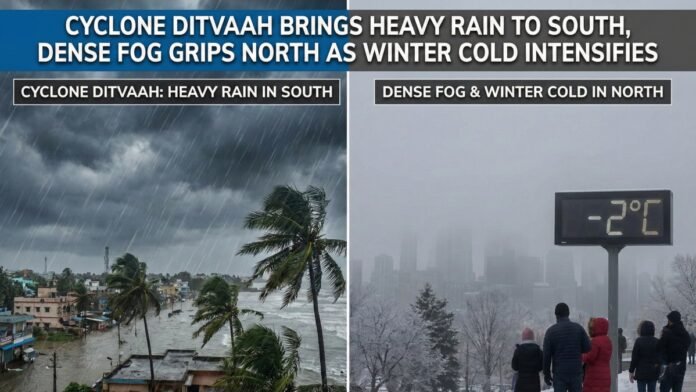
Severe cold has gripped many regions of North India, with dense fog creating hazardous visibility conditions across Punjab, Haryana, Chandigarh, Delhi, and Western Uttar Pradesh on Wednesday morning. Minimum temperatures in these states have plummeted to between 6-10°C, affecting daily life and transportation. Dense fog conditions are expected to persist during early morning hours in isolated pockets of Himachal Pradesh, Haryana, Chandigarh, and Delhi through November 30th.
In Delhi specifically, partly cloudy skies are expected today (November 30), with moderate fog anticipated in the morning hours. The maximum temperature is projected between 23-25°C, while minimum temperatures will remain between 8-10°C, though air quality concerns persist in the capital region. The IMD has issued formal warnings for dense fog conditions very likely to prevail during early morning hours in isolated pockets across multiple northern states.
Sharp Temperature Drop Coming from December 1st, Severe Winter Ahead
The India Meteorological Department has predicted a significant intensification of cold weather from December 1st onwards, marking the beginning of a severe winter phase. Night temperatures across northwest India are projected to drop by 2-4°C over the next three days, with minimum temperatures likely to fall below 7°C. Maximum daytime temperatures are also expected to drop considerably below 20°C, with fog potentially intensifying during morning hours across the region.
Cold wave conditions are very likely to prevail in isolated pockets of Punjab during November 30 to December 2, while Odisha will experience cold wave conditions on November 30. Extended forecasts indicate that for the week of December 4-10, 2025, minimum temperatures will be below normal by 2-4°C over most parts of the country, with cold wave conditions likely in isolated pockets of north Rajasthan, Punjab, and Haryana.
Cyclone Ditvaah Unleashes Heavy Rain in South India, Red Alert for Tamil Nadu
Cyclone Ditvaah, which has formed over the southwest Bay of Bengal near Sri Lanka’s coastal region, is now approaching the Indian coast with unprecedented rainfall intensity. The storm is expected to reach close to the North Tamil Nadu, Puducherry, and South Andhra Pradesh coast by early November 30, 2025, bringing extremely heavy rainfall and strong winds. The IMD has issued a red alert for extreme rainfall in North Tamil Nadu, Puducherry, and Karaikal, with orange alerts in Chennai and surrounding districts.
Heavy to extremely heavy rainfall (over 204 mm in 24 hours) is expected in North Tamil Nadu and Puducherry until December 1, with isolated extremely heavy falls also possible in coastal Tamil Nadu on November 30. Additionally, heavy to very heavy rainfall is forecast for coastal Andhra Pradesh, Yanam, and Rayalaseema until December 2nd, with isolated extremely heavy falls in south coastal Andhra Pradesh and coastal Rayalaseema on November 30. These rainfall patterns pose significant risks of urban flooding, waterlogging, and infrastructure damage across affected regions.
Government Response and Disaster Management Operations Underway
In response to Cyclone Ditvaah, the Indian government has mobilised massive relief and rescue operations across southern states. Tamil Nadu has set up 6,000 relief camps and deployed 28 teams from the National Disaster Response Force (NDRF) and State Disaster Response Force (SDRF) to manage the crisis. Over 50 flights have been cancelled across multiple districts in Tamil Nadu as airlines shut down operations due to adverse weather conditions.
Prime Minister Narendra Modi expressed his condolences for the devastation in Sri Lanka, where Cyclone Ditvaah claimed over 153 lives with 191 people missing. India has dispatched food items and essential relief supplies to Sri Lanka under Operation Sagar Bandhu, reaffirming its commitment to neighbourhood assistance. The IMD continues to issue hourly updates to aviation, maritime, and civil authorities to ensure public safety and coordinated emergency response.
Eastern and Other Regions Face Moderate Temperature Changes
Temperatures in eastern and northeastern India will remain relatively normal for the immediate period, though minimum temperatures may experience a drop of 2-3°C thereafter. Odisha will experience a cold wave on November 30, with dense fog expected in many areas during the morning hours. In contrast, Maharashtra and Gujarat will see relatively stable temperatures for the next 24 hours, with slight fluctuations expected in subsequent days.
Weather conditions across South Interior Karnataka will see isolated heavy rainfall on November 29 and 30, while Telangana may experience isolated heavy rainfall on November 30. Kerala and Mahe will receive isolated heavy rainfall on November 28 and 29. The diverse weather patterns across India highlight the country’s varied climate zones and the need for region-specific preparedness measures.