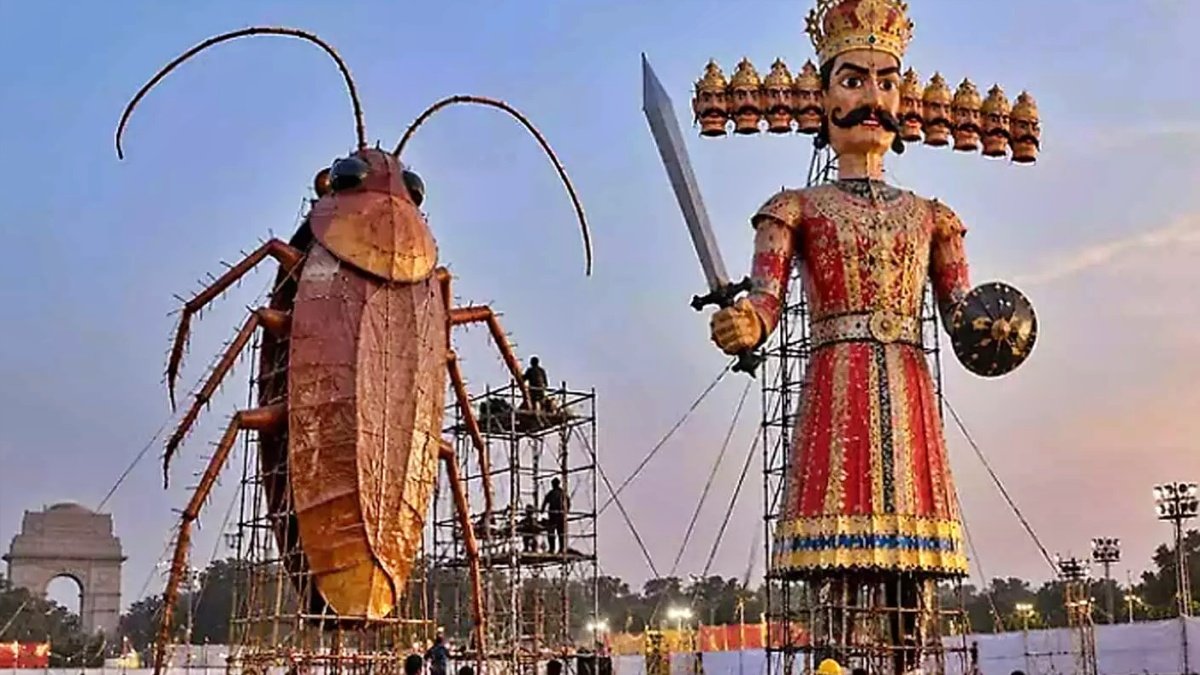
CJP founder Abhijeet Dipke thanked Delhi Ramlila organisers for ‘free publicity’ after they planned to burn a cockroach effigy. AAP leader Saurabh Bharadwaj has filed an FIR complaint against the organisers.
Key Points
- CJP Reaction: Abhijeet Dipke called the cockroach effigy a form of ‘free publicity’.
- Effigy Purpose: The effigy symbolises filth and promotes cleanliness under Swachh Bharat campaigns.
- AAP Complaint: Saurabh Bharadwaj filed an FIR against the organisers for hurting religious sentiments.
- Political Context: CJP has been protesting against government officials in Delhi.
NEW DELHI: The founder of the Cockroach Janata Party (CJP), Abhijeet Dipke, has expressed gratitude to the organisers of a Ramlila event in Delhi for what he described as ‘free publicity’ following their announcement to burn a 30-foot cockroach effigy alongside those of Ravana, Meghnad, and Kumbhkarna. The effigy, intended to symbolise filth and promote cleanliness under the Swachh Bharat campaign, has sparked controversy. Dipke’s remarks suggest he views the effigy as a form of media exposure for his party, which has been involved in protests against various government officials in the national capital.
The Shree Keshav Ram Leela Committee, which organises the annual event in Pitampura, stated that the cockroach effigy serves as a metaphor for filth and is part of their efforts to promote cleanliness under the national Swachh Bharat initiative. Committee president and BJP MLA Ashok Goel denied any political motivation behind the decision, asserting that it aimed to highlight the victory of good over evil while reinforcing the message of cleanliness.
Controversy Over Religious Symbolism
The proposed effigy has raised questions on social media, with users expressing concerns about its appropriateness at a religious event. Critics argue that the effigy mixes contemporary political narratives with traditional Hindu festival symbolism, potentially diluting its cultural significance. AAP leader Saurabh Bharadwaj has taken a firm stance against the effigy, filing a complaint with the Lieutenant Governor and Delhi Police commissioner. In a post on X, Bharadwaj accused the organisers of deliberately hurting religious sentiments and altering sacred traditions. He also claimed that the effigy could incite communal tensions.
The complaint, which names committee president Ashok Kumar Sevraha and Delhi minister Kapil Mishra among others, seeks the removal of the effigy from media platforms. Bharadwaj has warned that he will approach the courts if no action is taken against the organisers. The incident adds to the ongoing tensions between political groups and cultural institutions in Delhi, where religious festivals often become arenas for political expression.
Political Context and Protests
The controversy comes amid ongoing protests by the CJP in Delhi. The party initially protested against former Union Education Minister Dharmendra Pradhan and later joined demonstrations demanding the resignation of Chief Election Commissioner Gyanesh Kumar. This latest incident involving the cockroach effigy may further fuel political discourse around the intersection of religion and politics in India.
The burning of effigies during Ramlila is a traditional practice, but the inclusion of a cockroach symbol has drawn sharp criticism. While the organisers claim it is a symbolic gesture for cleanliness, opponents argue that such representations risk trivialising religious traditions. The situation highlights the delicate balance between promoting social messages and respecting cultural practices during festivals.