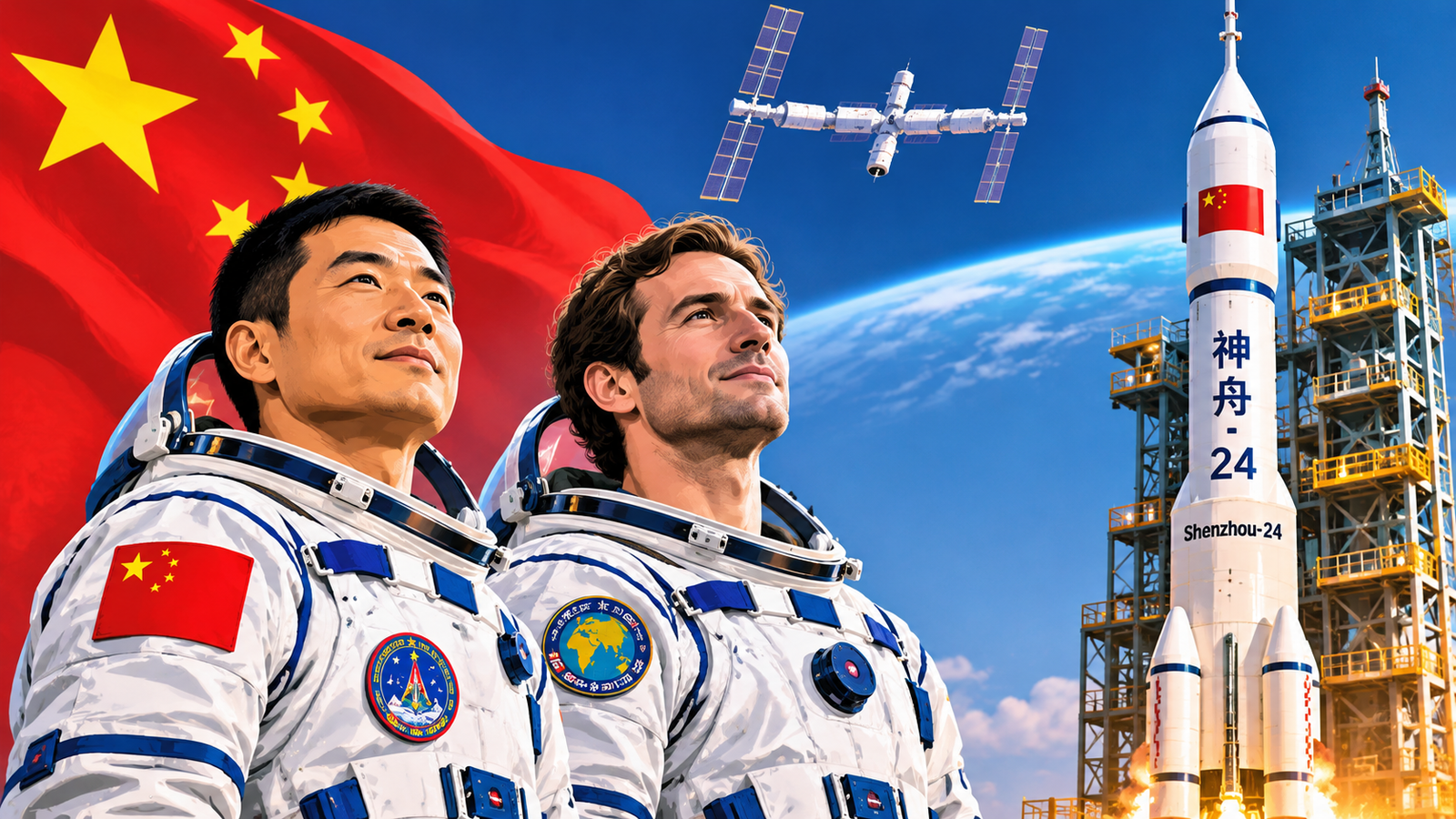
China has announced the inclusion of Pakistani astronaut Muhammad Jishan Ali in the Shenzhou-24 mission, marking the first time a foreign astronaut will reach the Tiangong space station.
Key Points
- First Foreign Entry: Muhammad Jishan Ali will be the first non-Chinese astronaut to visit the Tiangong space station.
- Mission Crew: The three-member crew includes Jishan Ali along with Chinese astronauts Tang Hongbo and Wu Yi.
- Scientific Goals: The Pakistani astronaut will conduct four experiments in biotechnology and materials science.
- Launch Details: The mission is scheduled to launch from the Jiuquan Satellite Launch Center on Wednesday morning.
- Lunar Ambitions: China aims to send a manned mission to the Moon by 2030 as part of an intensifying space race.
Historic China-Pakistan Space Cooperation
JIUQUAN: China has officially unveiled the crew for its upcoming Shenzhou-24 space mission, featuring a landmark partnership with Pakistan. Muhammad Jishan Ali, a Pakistani astronaut, has been selected to join the mission, making him the first foreign national to reach China’s Tiangong space station. This collaboration follows a formal agreement reached between the two nations in February 2025 to enhance scientific cooperation in the space sector.
According to China’s state news agency Xinhua, the mission will involve a three-member team. Jishan Ali will travel alongside his Chinese colleagues, Tang Hongbo and Wu Yi. The launch is slated for Wednesday morning from the Jiuquan Satellite Launch Center located in northwest China. This milestone is being hailed as a significant achievement in the strengthening ties between China and Pakistan, providing new strength to the scientific cooperation between the two countries.
The inclusion of a foreign astronaut in a Chinese human space mission marks a significant shift in China’s space diplomacy. By opening its space station to international partners, China is positioning itself as a key player in global space exploration while fostering bilateral ties with regional neighbors.
Scientific Objectives and Payload Role
During the mission, Jishan Ali will serve as a payload specialist, a role primarily dedicated to executing scientific research in the orbital environment. According to China’s state TV channel CCTV, he will spend a portion of his time at the space station conducting joint experiments between the two countries. He will also be responsible for assisting in the daily operations of the station.
Ali is tasked with overseeing four specific scientific projects focused on biotechnology and materials science. These projects include experiments on photosynthetic microorganisms in space, which scientists hope will provide critical data on how organisms behave and function in extraterrestrial environments. These studies are essential for understanding the long-term viability of biological life in microgravity.
Upon completion of the mission, Ali is expected to return to Earth from the Shenzhou-23 spacecraft. The success of these experiments will likely pave the way for more complex joint research initiatives between the space agencies of China and Pakistan in the coming years.
Astronaut Records and Future Goals
The mission also holds a personal milestone for Chinese astronaut Tang Hongbo. While his two companions are traveling to space for the first time, Tang is a veteran who has previously visited space twice. With this mission, he will become the first astronaut to reach China’s Tiangong space station on three separate occasions, highlighting the experience and expertise China is leveraging for its orbital presence.
Beyond the current mission, China is actively preparing for more ambitious goals, including a planned manned mission to the Moon by 2030. This move comes as the global space race intensifies, with the United States’ NASA agency aiming to land astronauts on the lunar surface by 2028. The Shenzhou-24 mission represents a key step in China’s expanding presence in orbital exploration.
The Tiangong space station serves as a critical laboratory for China’s long-term goals. By establishing a permanent presence in low Earth orbit and successfully hosting international partners, China is building the infrastructure and diplomatic framework necessary for its future lunar and deep-space exploration objectives.