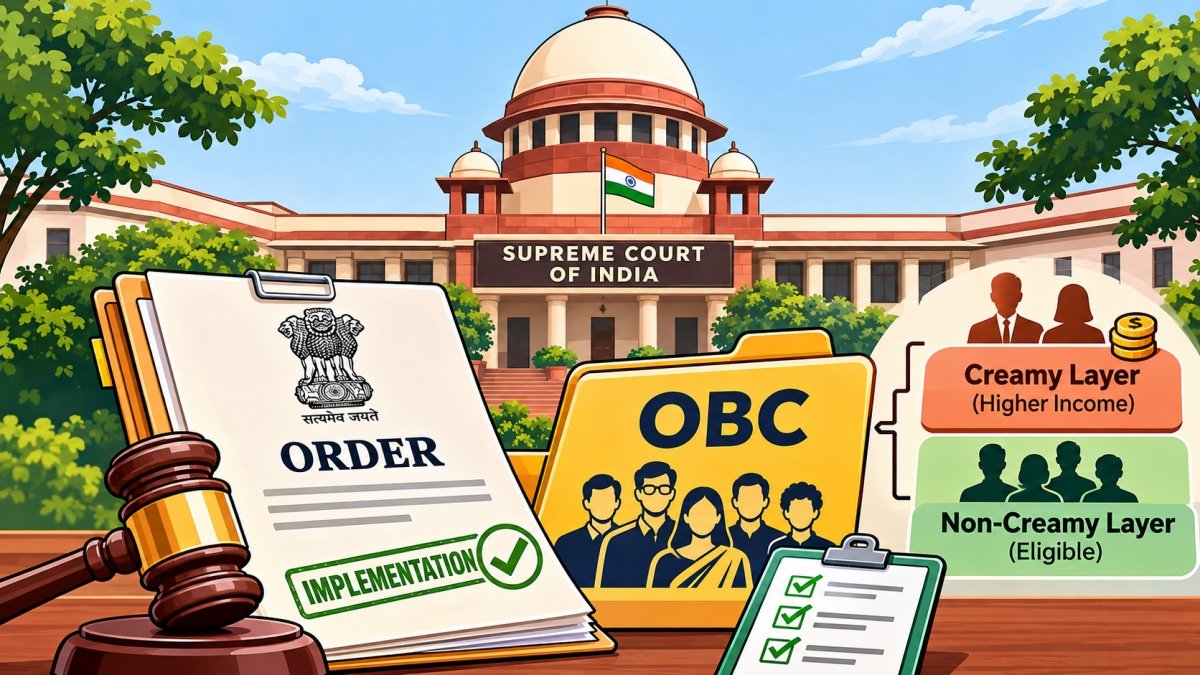
The Union Government has initiated the process of complying with a Supreme Court order to redefine ‘creamy layer’ status for OBC candidates in Civil Services.
Key Points
- SC Compliance: The Centre is now following the March 11, 2026, Supreme Court judgment regarding OBC reservations.
- Candidate Relief: Nearly 140 selected candidates across various batches will benefit from the new criteria.
- New Criteria: Parental job status and post categories will now be considered instead of just annual income.
- Deadline Set: The Department of Personnel and Training must complete the compliance by January 6, 2027.
Implementation of Supreme Court Judgement
NEW DELHI: The Union Government has commenced the process of complying with the Supreme Court judgement dated March 11, 2026, concerning the ‘creamy layer’ status of Other Backward Classes (OBC) candidates. This move provides significant relief to candidates selected in the 2025 Civil Services Examination (CSE) who were previously excluded from reservation benefits based on their parents’ income.
According to sources from the Department of Personnel and Training (DoPT), the government is now allocating services to candidates whose parents work in Public Sector Undertakings (PSUs) or in government jobs, such as school teachers. Previously, these candidates were often classified as ‘creamy layer’ solely based on parental income, but the new directive shifts the focus to the status and category of the parents’ posts.
Impact on Selected Candidates
The decision is expected to benefit approximately 20 candidates from the 2025 batch who were specifically identified under the March 11 judgement. Furthermore, nearly 140 other selected candidates from various batches, some dating back to 2016, will see a change in their status. Once the DoPT completes the compliance, these individuals may be eligible for entry into various Civil Services or elevation to higher services, including the Indian Administrative Service (IAS) and the Indian Police Service (IPS).
For the 2025 batch, this development opens the door for the Foundation Course at the Lal Bahadur Shastri National Academy of Administration (LBSNAA). While the academy has yet to announce the specific start date for the 14-week course, the removal of the ‘creamy layer’ hurdle is a critical step for these aspirants.
Legal Context and Judicial Timeline
Since 2016, the Union Government had consistently rejected OBC certificates for candidates whose parents earned more than ₹8 lakh per annum, citing ‘creamy layer’ status. However, on November 6, the Supreme Court reaffirmed its earlier ruling, stating that salary or income alone cannot be the sole determining factor when parents are employed in PSUs, private establishments, or schools.
The bench, consisting of Justice P S Narasimha and Justice R Mahadevan, originally gave the government six months to implement the March 11 judgement. Although the Centre sought a two-year extension in August 2026 to establish post equivalence, the court denied the request, citing a lack of reasonable justification. The court granted a final two-month window, setting a compliance deadline of January 6, 2027.
Policy Framework and Next Steps
In its November 6 order, the court clarified that while the government is free to formulate reservation and ‘creamy layer’ policies in accordance with the Constitution, it is not required to prescribe specific timelines for consulting stakeholders or establishing post equivalence. These matters remain within the domain of the executive and the legislature.
Records indicate that 56 of the 140 affected candidates were direct parties to the litigation. While 38 of these individuals are currently serving in lower ranks due to their previous ‘creamy layer’ classification, the current compliance process may lead to their elevation to higher ranks or the allotment of superior posts.