



























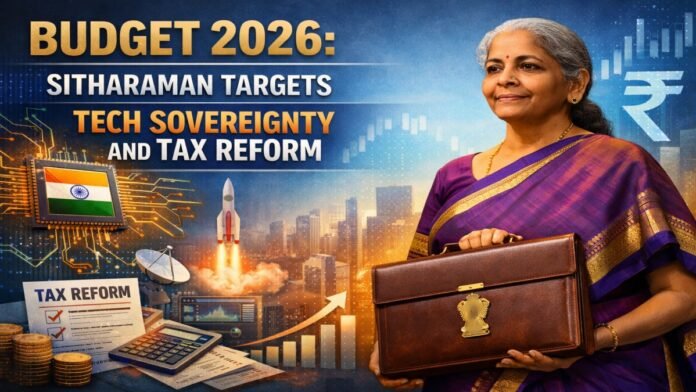
Key Highlights
- Critical Minerals Mission: Special tax concessions and a massive fund to process 17 rare earth elements, challenging global monopolies.
- Pharma Expansion: Three new NIPER institutes announced and ₹10,000 crore allocated to the bio-pharma sector.
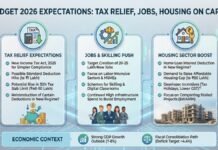
- Tax Reform: A new, simplified Income Tax law to take effect from April 1, 2026, with reduced TCS on foreign travel.
- Technology & Infrastructure: Formal launch of ISM 2.0 for semiconductor production and 7 new high-speed rail corridors.
- Healthcare: Significant price reductions for essential diabetes and cancer medications.
In a departure from tradition, Union Finance Minister Nirmala Sitharaman presented the Union Budget 2026 in Parliament today, Sunday, February 1. This session marks her record-breaking ninth budget and the 15th for the Modi administration. Opening her speech on the auspicious occasion of Magh Purnima and Guru Ravidas Jayanti, Sitharaman emphasized that this is the first budget prepared in Kartavya Bhavan.
The Minister outlined “Three Duties” that define this year’s economic blueprint:
- Growth & Productivity: Enhancing competitiveness to withstand global volatility.
- Empowerment: Fulfilling the aspirations of citizens to make them partners in prosperity.
- Inclusivity: Ensuring “Sabka Saath Sabka Vikas” through equitable access to resources across all regions.
Strengthening the “Pharmacy of the World”
A major pillar of the 2026 budget is the reinforcement of India’s pharmaceutical infrastructure. Sitharaman announced the establishment of three new National Institutes of Pharmaceutical Education and Research (NIPER), alongside the upgrading of the seven existing institutes in Mohali, Ahmedabad, Hyderabad, Kolkata, Guwahati, Raebareli, and Hajipur.
With a ₹10,000 crore allocation for the bio-pharma sector, the government aims to move beyond manufacturing into high-end research and innovation. This initiative is paired with immediate relief for citizens, as the budget slashes prices for critical diabetes and cancer medications.
The Critical Minerals Mission: Challenging Global Monopolies
In a move seen as a direct challenge to China’s 90% monopoly on rare earth elements, the Finance Minister launched the Critical Minerals Mission. Rare earth minerals, a group of 17 elements essential for everything from smartphones to missile guidance systems, are now a top strategic priority.
India currently holds the world’s fifth-largest reserves but has lacked the processing technology to utilize them. To bridge this gap, the budget establishes:
- Rare Earth Corridors: Dedicated zones in Odisha, Kerala, Andhra Pradesh, and Tamil Nadu.
- Incentives: Massive funding and tax concessions for mining and processing.
- Chemical Parks: Three new dedicated parks to support mineral processing.
Tech Sovereignty and ISM 2.0
To further India’s goal of becoming a global tech hub, the government formally launched the India Semiconductor Mission 2.0 (ISM 2.0). This phase focuses on creating specialized semiconductor and mineral corridors to stabilize the domestic supply chain for electronics manufacturing.
Infrastructure remains a high priority, with the announcement of seven high-speed rail corridors and the development of 20 new waterways. Additionally, ₹5,000 crore has been earmarked annually for the development of Urban Economic Zones to manage India’s rapid urbanization.
Major Income Tax Reforms
The Finance Minister introduced sweeping changes to the direct tax regime, aimed at improving the ease of living and reducing litigation:
- The New Tax Law: Effective April 1, 2026, a simplified tax code will replace the current complex structure.
- Penalty Relief: In a move toward trust-based governance, minor technical errors will now only attract financial penalties rather than criminal prosecution.
- Foreign Travel: The Tax Collected at Source (TCS) on foreign travel has been lowered to 5%.
- Filing Deadlines: The return filing deadline is solidified as July 31.
Stock exchanges, including the NSE and BSE remained open during the Sunday session, reflecting the high stakes and investor interest in these transformative policies. Sitharaman concluded by reiterating the government’s commitment to “Viksit Bharat,” aiming for full development by the centenary of India’s independence in 2047.