
































- Key Points:
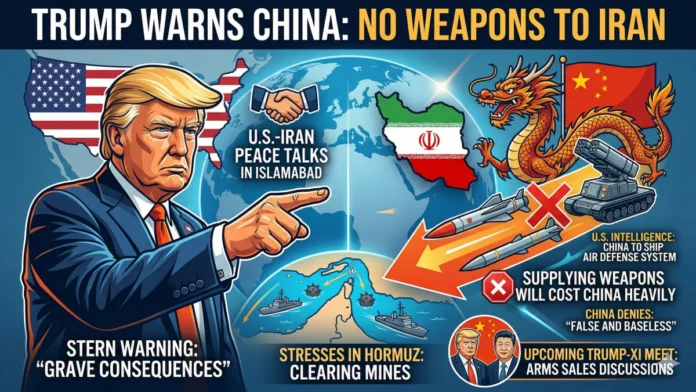
- President Trump explicitly states that supplying weapons to Iran would come at a “heavy cost” for China, citing a threat of “extremely grave consequences.”
- While historic ceasefire talks are underway in Islamabad, their effectiveness is under scrutiny due to the contingent participation of the Iranian delegation, which has linked its presence to a broader ceasefire including Lebanon.
- The fragile ceasefire in the Strait of Hormuz is tested as the U.S. deploys minesweepers to counter Iranian mines, while Iran denies all U.S. naval transits and warns of a “strong response.”
- U.S. intelligence suggests China may ship a new advanced air defense system to Iran via third-party nations in the coming weeks, which would cast a pall over the upcoming Trump-Xi Jinping summit.
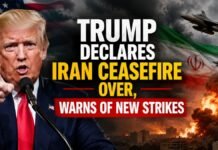
The ongoing, historic ceasefire talks in Islamabad, Pakistan, are facing a critical test. Hosted by Pakistan, the negotiations aim to consolidate a recent temporary ceasefire into a lasting peace agreement in the Middle East. While a high-level U.S. delegation, led by Vice President JD Vance, is present, the effective participation of the Iranian delegation has become the subject of intense diplomatic maneuvering.
Tehran has publicly linked its full participation in the Islamabad talks to a broader regional ceasefire that must also include Lebanon, where Israel continues its strikes against Hezbollah targets. This contingent participation adds layers of complexity, as the U.S. and Israel work to find common ground for a regional de-escalation that satisfies all parties. The success or failure of these talks is a central concern for the international community.
Trump’s Direct Warning to Beijing
In a conversation with journalists, President Donald Trump reinforced his position with unwavering clarity. “It is going to create big problems for them,” he stated, adding, “They know that, and they have been told that. If they go ahead with this, the extremely grave consequences will outweigh any perceived benefit.”
President Trump’s warning is not a surprise, as his administration has consistently emphasized that external nation interference is a major obstacle to regional stability. By threatening ” extremely grave consequences,” the U.S. is signaling that any form of weapon supply, especially advanced systems, will be met with powerful, multifaceted retaliation, impacting diplomatic and economic relations.
Fragile Truce in the Strait of Hormuz
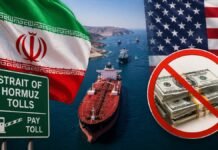
The maritime security situation in the Strait of Hormuz remains equally fraught. President Trump revealed that Iran has laid naval mines and dangerous booby traps in the critical waterway, creating a direct threat to global energy transit and international naval vessels. In a forceful response, U.S. minesweepers have been fully deployed and are actively clearing the mines to maintain a semi-open status.
However, a definitive resolution is elusive. Iran, through its state-affiliated media and official statements, has categorically denied that any U.S. military vessel has successfully passed through this region since the ceasefire began. Furthermore, Iran’s Revolutionary Guard Corps has issued a counter-warning, stating that any attempt by foreign military vessels to transit the waterway will be met with a “strong response.” The contradictory claims underscore the profound lack of trust and the high risk of a miscalculation that could derail the entire peace process.
U.S. Intelligence vs. China’s Denial
Adding to the tension are conflicting narratives between U.S. intelligence and Chinese official statements. According to a CNN report, U.S. intelligence agencies possess credible estimates that Iran may soon receive advanced military systems from China. These estimates suggest that China could ship a new, sophisticated air defense system to Iran within the next few weeks, potentially utilizing a complex network of third-party nations to obscure the origin of the transfer.
The Chinese Embassy in Washington has been quick to issue a flat denial. Officials have called all such intelligence assessments “completely false and baseless,” asserting that China has “never supplied weapons to any party” involved in the conflict. China urged the United States to refrain from making unfounded accusations in the absence of concrete evidence and to avoid “poisoning the atmosphere” for international diplomacy. The lack of verifiable evidence, which China highlights, makes this a pivotal geopolitical dispute.
Impact on Upcoming Political Moves
The timing of this escalating dispute could not be more critical. Donald Trump is scheduled to visit China next month for a highly anticipated tour, a summit where he is set to hold direct talks with Chinese President Xi Jinping. This diplomatic event, initially seen as an opportunity to reduce trade and political friction, is now overshadowed by the Iran weapons issue.
If intelligence reports are validated, any weapons shipment would be viewed as a direct challenge to U.S. national security and a betrayal of the ongoing peace negotiations in Islamabad. Experts believe this conflict has the potential to transform the upcoming Trump-Xi meeting from a productive dialogue into a sharp, decisive confrontation, with far-reaching implications for global security and economic stability.