
































Key Election Highlights
- Poll Schedule: The Election Commission has condensed the 2026 West Bengal polls into a rare two-phase process, with voting scheduled for April 23 and April 29.
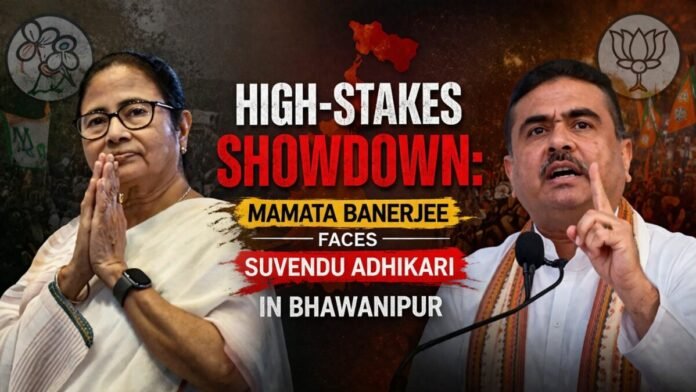
- The Epicenter: In a high-profile battle, Suvendu Adhikari is challenging Mamata Banerjee in her home bastion of Bhawanipur, echoing their 2021 Nandigram face-off.
- Welfare vs. Governance: TMC is campaigning on the success of the Lakshmi Bhandar and Kanyashree schemes, while the BJP is targeting the government on corruption and industrial stagnation.
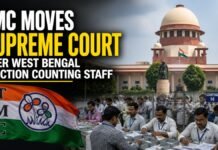
- Latest Update: On April 3, 2026, the TMC formally requested the removal of the Bhawanipur Returning Officer, alleging bias toward the opposition.
- Counting Day: The fate of the 294-member assembly will be decided on May 4, 2026.
Since dismantling the Left Front’s 34-year reign in 2011, Mamata Banerjee has remained the central axis of West Bengal politics. Her political identity, built on the grassroots movements of Singur and Nandigram, continues to rely on a carefully curated image of austerity. Dressed in her trademark white cotton sari and rubber slippers, “Didi” has successfully positioned herself as a relatable guardian of the poor. This persona was central to her 2021 victory, where the “Bangla Nijer Meyekei Chay” (Bengal wants its own daughter) slogan effectively branded her opponents as “outsiders,” a narrative that remains a cornerstone of her 2026 strategy.
Welfare Schemes as a Political Shield
The Trinamool Congress (TMC) has fortified its vote bank through a robust network of social security initiatives. The Kanyashree Prakalpa, which received international acclaim from the United Nations, has been instrumental in securing the loyalty of younger voters by promoting female education. More recently, the Lakshmi Bhandar scheme, providing direct cash transfers to women, has created a formidable “silent” vote bank. Analysts suggest that these schemes act as a buffer against anti-incumbency, providing tangible relief to millions of households amidst broader economic concerns.
The Suvendu Challenge and the Bhawanipur Battle
The 2026 elections have taken a dramatic turn with the BJP’s decision to field Suvendu Adhikari, the current Leader of the Opposition, against the Chief Minister in her own constituency of Bhawanipur. This move is a calculated attempt to pin the Chief Minister down to her seat, limiting her ability to campaign extensively across the state. Adhikari, who famously defeated Banerjee in Nandigram in 2021, is leveraging his knowledge of the TMC’s internal machinery to challenge her administrative record.
The battle for Bhawanipur is already heating up. Just yesterday, on April 3, the TMC moved the Election Commission to seek the immediate removal of the local Returning Officer, claiming the official is working in proximity to Adhikari’s camp. This escalating friction underscores the “prestige fight” nature of this specific seat.
Shifting Dynamics and the Road to May 4
While the TMC relies on its organizational strength at 70,000 booths, the 2026 landscape presents new hurdles. The BJP has shifted its rhetoric, moving away from purely ideological attacks to focus on “Good Governance” and the lack of industrial investment in the state. Furthermore, the decision to hold the elections in just two phases is a significant departure from previous multi-phase schedules. This condensed timeline is expected to allow for a more concentrated deployment of central security forces, a move the opposition hopes will mitigate local volatility.
As the campaign enters its final stretch toward the April 23 commencement, the youth vote has emerged as a wildcard. While rural support for TMC’s welfare model remains high, urban segments and younger demographics are increasingly vocal about unemployment and the need for industrial growth. Whether the “Khela Hobe” spirit can overcome 15 years of natural anti-incumbency will be revealed when the results are announced on May 4.