


































On March 8, 2026, India created cricketing history by defeating New Zealand by 96 runs in the ICC Men’s T20 World Cup final at the Narendra Modi Stadium in Ahmedabad. The victory marked a historic moment for Indian cricket, as the team became the first in men’s cricket to win three T20 World Cup titles and the first to successfully defend the trophy in consecutive editions. It was also the first time India lifted the T20 World Cup on home soil, transforming a stadium once associated with painful defeats into a venue of triumph and redemption.
This victory carried additional emotional significance because Ahmedabad had previously witnessed two major disappointments for India: the 2023 ODI World Cup final loss to Australia and a Super Eight defeat to South Africa earlier in the same 2026 tournament. By defeating New Zealand in the final, India symbolically erased those painful memories and established itself as the dominant force in modern T20 cricket.
Strategic Transformation Under Gambhir and Suryakumar
India’s triumph in the 2026 T20 World Cup was the result of a significant tactical transformation initiated after the team’s 2024 T20 World Cup victory. Following the retirement of stalwarts Rohit Sharma and Virat Kohli from T20 Internationals, the team entered a transitional phase. Under the leadership of captain Suryakumar Yadav and head coach Gautam Gambhir, India adopted an aggressive approach focused on fearless batting, rapid scoring, and flexible team composition.
Gambhir promoted a “high-risk, high-reward” philosophy, encouraging players to attack from the very beginning rather than conserving wickets. The strategy relied heavily on powerful hitters and versatile all-rounders who could contribute with both bat and ball. This approach proved highly successful, with India recording numerous scores above 200 and maintaining the highest average strike rate among full-member cricket nations in the lead-up to the tournament.
Dominance in the Group Stage
The 2026 ICC Men’s T20 World Cup, jointly hosted by India and Sri Lanka, featured 20 teams divided into four groups. India was placed in Group A alongside Pakistan, the Netherlands, Namibia, and the United States.
One of the most anticipated matches of the tournament took place in Colombo on February 15, 2026, when India faced Pakistan amid political tensions between the two countries. Despite the charged atmosphere, India dominated the match. Ishan Kishan scored a brilliant 77 off 40 balls, helping India reach 175/7. Pakistan struggled during the chase as India’s bowlers applied relentless pressure. Hardik Pandya, Jasprit Bumrah, and Axar Patel removed key Pakistani batters, restricting Pakistan to 114 runs and giving India a comfortable 61-run victory.
India maintained an unbeaten record in the group stage, advancing confidently to the Super Eight phase.
Challenges in the Super Eight Stage
India faced a setback in the Super Eight stage when South Africa defeated them by 76 runs in Ahmedabad, ending their 12-match winning streak in T20 World Cups. The defeat placed India under immense pressure.
However, the team quickly bounced back with strong performances against Zimbabwe and the West Indies. In the crucial match against the West Indies, Sanju Samson played a match-winning innings of 97 not out off 50 balls, guiding India to successfully chase a challenging target of 196. The victory ensured India’s qualification for the semi-finals.
Record-Breaking Semi-Final Against England
India’s semi-final clash against England at Wankhede Stadium in Mumbai became one of the most thrilling matches in T20 World Cup history. Batting first, India scored 253/7, with Sanju Samson contributing 89 runs off 42 balls. Valuable support came from Shivam Dube and Hardik Pandya, who accelerated the scoring in the final overs.
England mounted a fierce challenge, led by Jacob Bethell’s spectacular 105 off 48 balls. However, India managed to hold their nerve, thanks largely to Jasprit Bumrah’s disciplined bowling, and secured a narrow 7-run victory. The match produced a combined total of 499 runs and 34 sixes, the highest in a T20 World Cup knockout match.
The Final: India’s Complete Dominance
In the final against New Zealand, India delivered a spectacular performance. The opening partnership between Abhishek Sharma and Sanju Samson provided a blistering start, with India scoring 92 runs in the powerplay, equalling a T20 World Cup record.
Abhishek Sharma scored 52 runs off just 21 balls, while Sanju Samson played a magnificent innings of 89 runs, which became the highest individual score in a T20 World Cup final. Supported by Ishan Kishan’s quick 54, India posted 255/5, the highest total ever in a T20 World Cup final.
New Zealand struggled during the chase of 256. India’s bowlers quickly dismantled their top order. Jasprit Bumrah delivered a match-winning performance with figures of 4/15, while Axar Patel and Varun Chakravarthy also contributed crucial wickets. New Zealand was eventually bowled out for 159, giving India a convincing 96-run victory.
Historical Legacy
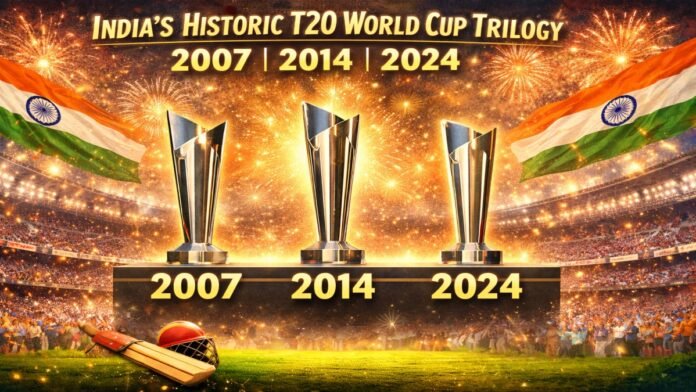
India’s victory established a historic T20 World Cup trilogy, with titles in 2007, 2024, and 2026. The achievement cemented India’s reputation as the most successful team in T20 World Cup history. Meanwhile, New Zealand’s defeat extended their unfortunate record of losing multiple ICC white-ball finals in recent years.
The triumph also elevated Gautam Gambhir’s reputation as a coach, as his aggressive tactical approach reshaped India’s T20 strategy and produced one of the most dominant teams in the format.
India’s victory in the 2026 T20 World Cup represented more than just a successful title defense. It symbolized the culmination of a strategic transformation built on fearless batting, versatile all-rounders, and disciplined bowling. The triumph at Ahmedabad erased past disappointments and confirmed India’s status as the leading powerhouse of modern T20 cricket, setting a benchmark for future generations and leaving other teams striving to match their dominance.